Text to imageArt stylesStyle guide
Unrolling the Cloth Sea
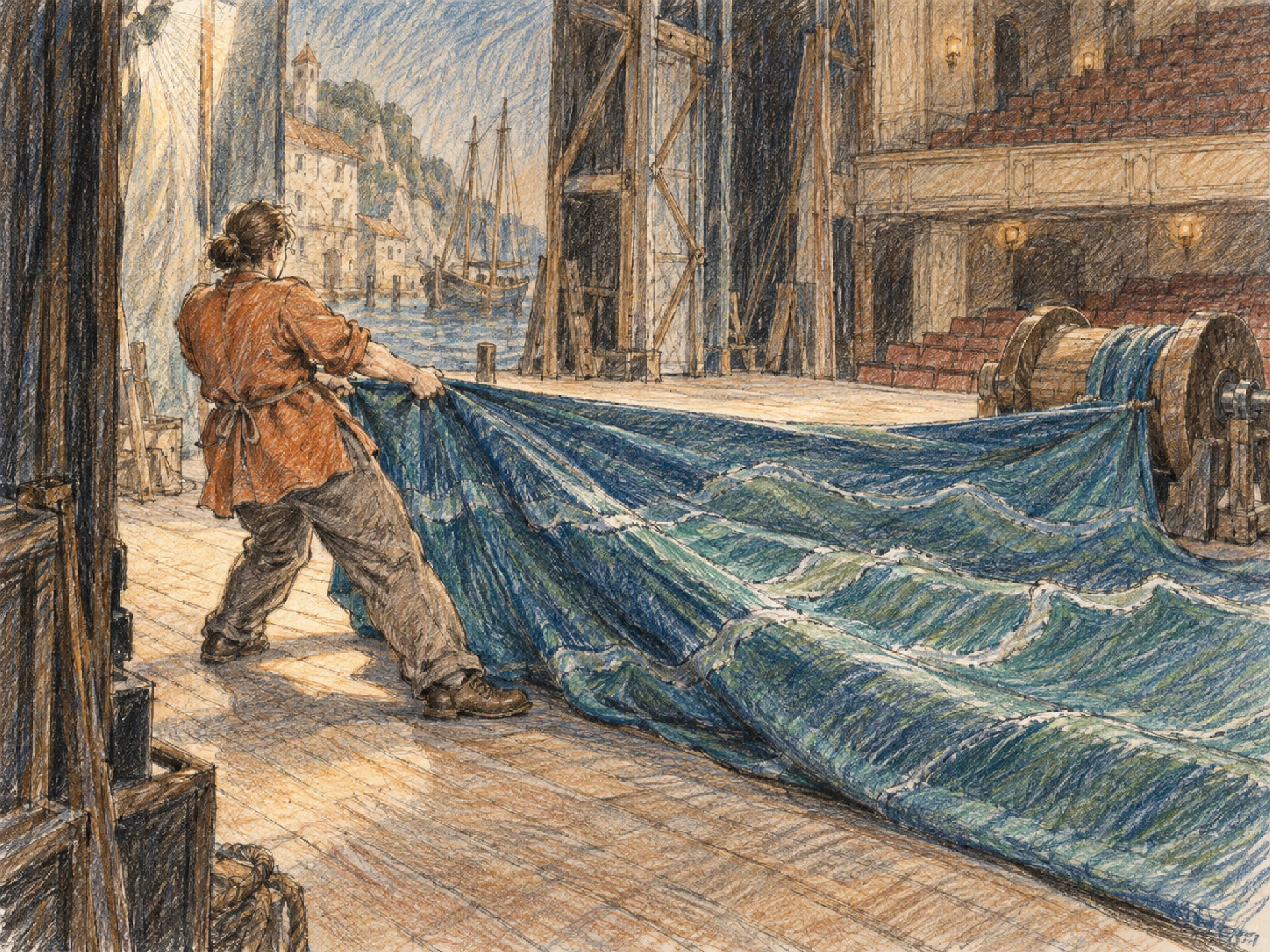
A stagehand unfurls an enormous cloth sea among layered theater scenery. Rough exploratory pencil lines and open colored-pencil layers convey the energy of a handmade theater.
Remix this referenceUnrolling the Cloth Sea
- Form language
- Group complexity into broad, slightly lopsided masses; smaller descriptive shapes remain suggestive and may vary naturally.
- Contour
- Use searching graphite contours with occasional doubled lines, pressure changes and unfinished ends instead of uniform tracing.
- Mark-making
- Lay colored-pencil strokes in loose directional bundles over rough graphite; allow stray strokes and intermittent paper gaps.
- Surface rendering
- Build tone through uneven overlapping pencil layers with visible paper grain; soften transitions through lighter pressure rather than digital blur.
Priority
Keep rough pencil and colored-pencil sketchbook drawing visibly present in the finished image.
What to avoid & what to check
Exact prompt for this example
MODULE OWNERSHIP
subject: Subject count, type, stable proportions and landmarks, resting face geometry, hair shape, physical materials, garment construction and permanent marks. No emotion, movement, color assignment or rendering recipe.
expression: Facial soft-tissue displacement and pupil direction, muscle coordination, regional intensity, asymmetry and onset/peak/release. No head/body pose, stable appearance, skin color or rendering.
gesture: Head/neck/body/limb orientation, joint movement, support, contact and pose-caused occlusion using existing anatomy. No eye/pupil movement, emotion, identity, props inventory or camera.
props: Prop count, type, construction, physical material and scale relative to the subject. Holding/contact belongs to gesture, position to composition, color to palette.
scene: Environment elements, terrain, backdrop/floor presence and structural detail. No canvas positions, camera, lighting, assigned colors or render texture.
camera: Projection, focal-length impression, camera elevation/yaw/roll, viewing distance and crop. No actor pose, world placement, lighting or canvas aspect ratio.
composition: Normalized 0-100% canvas positions, scale in frame, depth/overlap, focal hierarchy and margins. No joint pose, camera projection, rendering, subject/prop inventory or emotion.
palette: Color anchors, hue/saturation/value ranges, colors assigned to parts and approximate color coverage. No illumination direction, shading algorithm, physical material or layout.
lighting: Light-source direction/softness/intensity, ambient illumination, physical shadow direction/length and highlight position. Absence of directional illumination is allowed. No shading technique, palette or material changes.
style: Reusable form abstraction, contour weight/taper/edge quality, medium and mark scale/density/direction, surface rendering and tonal transition technique. No fixed subject proportions, anatomy, identity, expression, pose, palette, light-source direction, camera or layout.
output: Image count, aspect ratio, size, file/alpha requirements and global lettering/logo/watermark restrictions. No background scenery, crop, style, identity or pose.

SUBJECT
inventory: One adult stagehand; no other people.
geometry: An ordinary adult build with broad hands and a compact knot of hair at the nape.
resting-face: Resting facial geometry is unprescribed.
appearance: A woven work smock over loose trousers and soft leather shoes, with simple, practical construction.

PRIORITY


AVOID


CHECK


GESTURE
head: The stagehand turns the head away from the viewer, concealing facial landmarks; the neck follows the arms' pulling direction.
torso: The hips shift backward while the torso twists slightly to counterbalance the fabric's pull.
limbs: Both arms draw outward from bent elbows; staggered feet and flexed knees support the pulling action.
contact: Both hands grip the reinforced cloth edge; both feet bear weight on the stage floor.

PRIORITY


AVOID


CHECK


PROPS
inventory: One stage-sized cloth sea and one waist-high winding drum.
construction: The cloth has a reinforced hem and broad sewn wave ridges; the drum has a wooden cylinder and a plain metal axle.

PRIORITY


AVOID


CHECK


SCENE
inventory: A small rehearsal theater with a stage floor, side wings, harbor scenery and empty seating tiers.
structure: Exposed timber braces support the harbor set; narrow passages connect the wings to the auditorium.

PRIORITY


AVOID


CHECK


CAMERA
projection: Moderate wide-angle perspective gives readable depth with restrained edge distortion.
viewpoint: View obliquely across the stage from a slightly elevated side-wing position, with a level horizon.
crop: Include the stagehand's full body and ample surrounding theater in a broad environmental view.

PRIORITY


AVOID


CHECK


COMPOSITION
placement: The stagehand occupies the left third; the cloth spans the lower half toward the right edge, with the drum farther right.
depth: A cropped wing frames the foreground; the stagehand and cloth occupy the middle layer, with scenery and seating behind.
spacing: The gripping hands lead the focal hierarchy, followed by the spreading cloth; leave breathing room above the action.

PRIORITY


AVOID


CHECK


PALETTE
colors: Indigo, sea green, rusty orange and warm ivory, supported by muted brown; reserve strong saturation for accents.
assignment: Indigo and sea green belong to the cloth, rusty orange to the smock, and ivory and muted brown to the theater.
balance: Quiet ivory and brown dominate; the cloth provides the largest saturated area and the smock a smaller accent.

PRIORITY


AVOID


CHECK


LIGHTING
sources: Broad, soft light enters from high stage left, supported by gentle ambient illumination.
shadows: Soft floor shadows extend toward stage right; overlapping cloth folds retain soft local shadows.
highlights: Broad highlights touch the upper cloth ridges, the backs of the hands and the drum's upper rim.

PRIORITY


AVOID


CHECK


STYLE GUIDE
form-language: Group complexity into broad, slightly lopsided masses; smaller descriptive shapes remain suggestive and may vary naturally.
contour: Use searching graphite contours with occasional doubled lines, pressure changes and unfinished ends instead of uniform tracing.
mark-making: Lay colored-pencil strokes in loose directional bundles over rough graphite; allow stray strokes and intermittent paper gaps.
surface-rendering: Build tone through uneven overlapping pencil layers with visible paper grain; soften transitions through lighter pressure rather than digital blur.

PRIORITY
Keep rough pencil and colored-pencil sketchbook drawing visibly present in the finished image.

AVOID


CHECK


OUTPUT
format: One image, landscape 4:3, 2048 × 1536 pixels, opaque PNG.
restrictions: No lettering, logos or watermarks.

PRIORITY


AVOID


CHECK


FINAL INTEGRATION
gesture + composition: Let the action and arrangement cooperate so the grip remains legible within the surrounding layers.
style + lighting: Translate the illumination through the drawing medium while preserving its lively, visibly handmade character.
Model information comes from image provenance. The same prompt may produce a different result.