Text to imageArt stylesStyle guide
One Hot-Air Balloon · Colored-Sand Painting
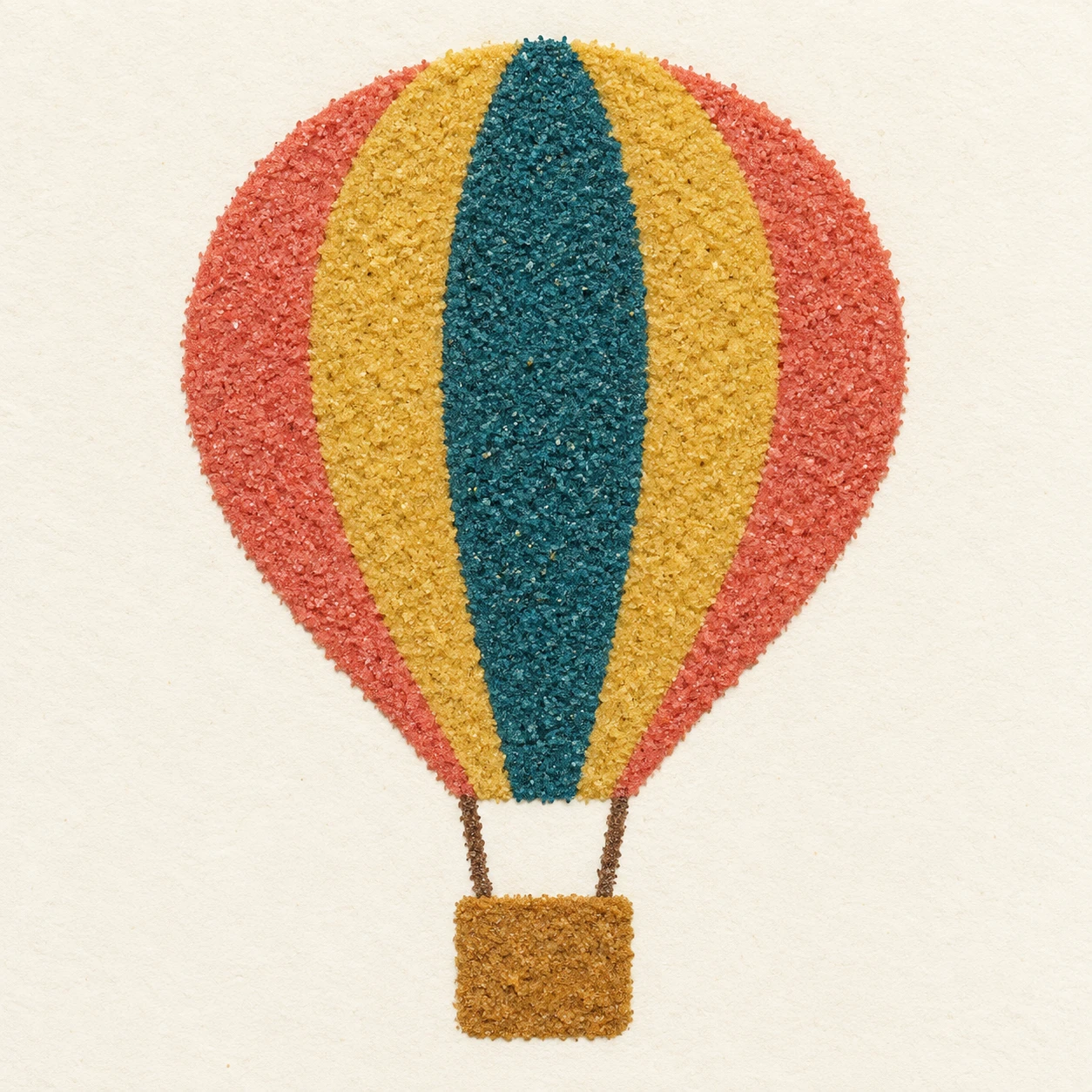
A flat balloon illustration built from densely packed colored sand and clearly separated color fields.
One Hot-Air Balloon · Colored-Sand Painting
- Shape & line
- Build the envelope from a broad rounded crown that tapers toward a short lower neck. Divide it into five curved vertical panels, and define their shared edges through adjoining sand colors rather than drawn outlines; use narrow dark-sand strips for the two suspension lines.
- Color & light
- Alternate muted coral and mustard panels, with a deep teal center panel and an ochre basket. Keep each panel mostly uniform in value; use soft, even illumination so color separation describes the balloon without glossy highlights or modeled gradients.
- Texture & material
- Fill every colored shape with dense, matte sand grains that remain visible as irregular specks at close view. Let a few grains roughen the silhouette and panel boundaries, while keeping the underlying shapes intact; preserve smooth exposed ivory paper around the balloon.
- Composition
- Place the envelope in the upper middle of the square and the basket directly beneath it, leaving a clear ivory gap crossed only by the two suspension lines. Make the envelope several times wider than the basket, and keep all parts comfortably inside the frame so the grain texture supports an immediately readable silhouette.
Priority
Prioritize visible sand grains and clear adjoining color fields within a recognizable balloon silhouette.
What to avoid & what to check
Avoid smooth digital fills, painted brush marks, glossy beads, and heavy outlines.
Check that the five panels remain distinct and both suspension lines visibly connect the envelope to the basket.
Exact prompt for this example
SUBJECT
One hot-air balloon with a rounded, vertically paneled envelope above one small rectangular basket; two short suspension lines visibly connect the basket to the envelope.

COMPOSITION
A straight-on view of the complete balloon, centered on a plain ivory field with generous margins; keep the envelope, suspension lines, and basket clearly readable.

STYLE GUIDE
1. Shape & line
Build the envelope from a broad rounded crown that tapers toward a short lower neck. Divide it into five curved vertical panels, and define their shared edges through adjoining sand colors rather than drawn outlines; use narrow dark-sand strips for the two suspension lines.

2. Color & light
Alternate muted coral and mustard panels, with a deep teal center panel and an ochre basket. Keep each panel mostly uniform in value; use soft, even illumination so color separation describes the balloon without glossy highlights or modeled gradients.

3. Texture & material
Fill every colored shape with dense, matte sand grains that remain visible as irregular specks at close view. Let a few grains roughen the silhouette and panel boundaries, while keeping the underlying shapes intact; preserve smooth exposed ivory paper around the balloon.

4. Composition
Place the envelope in the upper middle of the square and the basket directly beneath it, leaving a clear ivory gap crossed only by the two suspension lines. Make the envelope several times wider than the basket, and keep all parts comfortably inside the frame so the grain texture supports an immediately readable silhouette.

PRIORITY
Preserve the requested identity, count, action, composition and output settings. Apply the style rules within those constraints; a style reference must not replace the subject or layout. Within the style: Prioritize visible sand grains and clear adjoining color fields within a recognizable balloon silhouette.

AVOID
Avoid smooth digital fills, painted brush marks, glossy beads, and heavy outlines.

OUTPUT
One square image showing a finished colored-sand artwork viewed straight on, with no lettering, captions, signatures, or watermarks.

SELF-CHECK
Check that the five panels remain distinct and both suspension lines visibly connect the envelope to the basket.
Model information comes from image provenance. The same prompt may produce a different result.