Text to imageIllustrationStyle guide
A Goose Through the Ladder
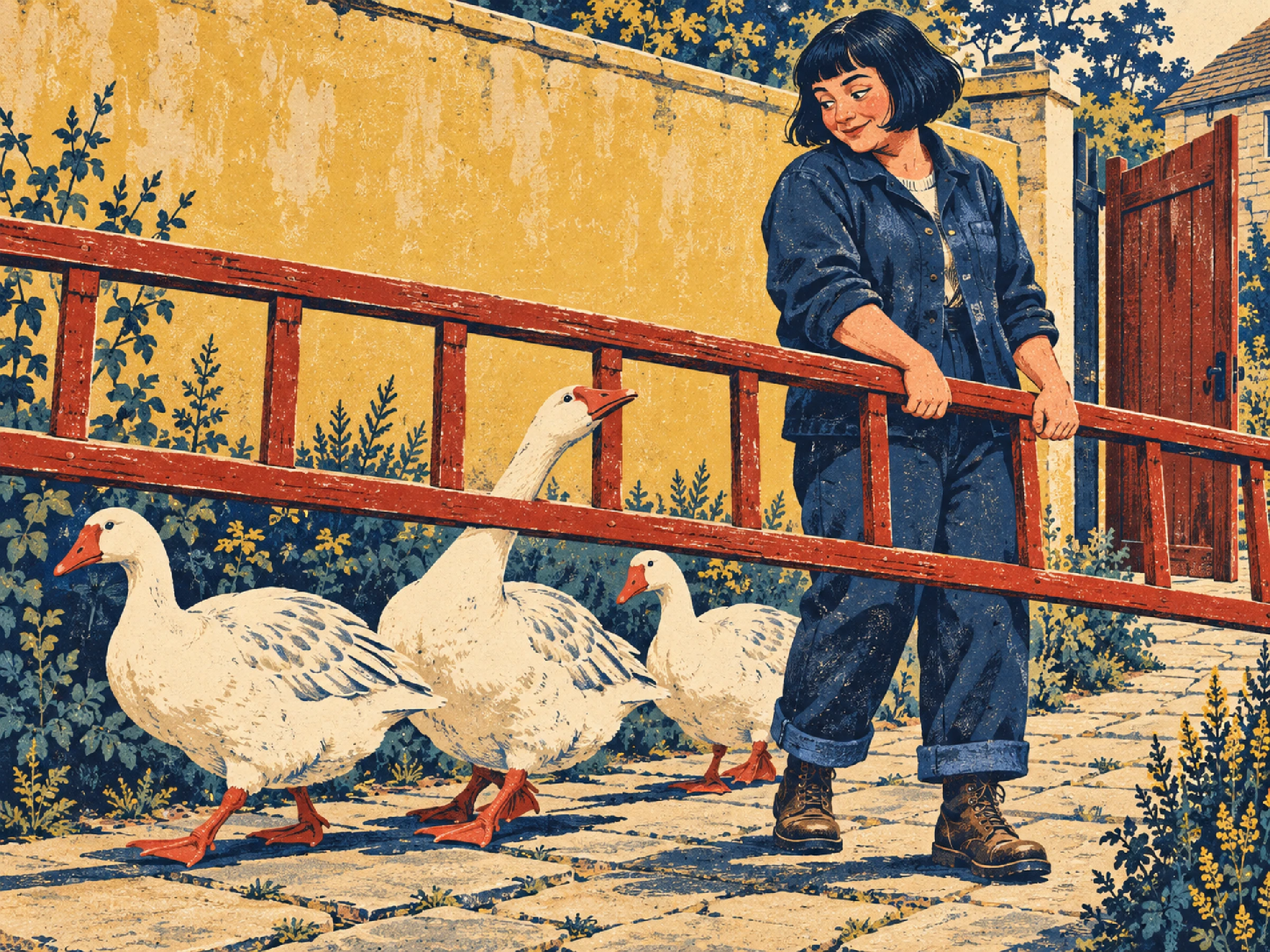
A ladder carrier pauses when a goose threads its neck between the rungs. Two companions crowd the garden passage, forming a lively screen print of overlapping shapes and imperfect ink pulls.
Remix this referenceA Goose Through the Ladder
- Form language
- Build a graphic screen print from broad ovals, blunt wedges and repeated bars; simplify small details into decisive shape rhythms.
- Contour
- Favor unoutlined silhouettes with occasional heavy, blunt key strokes; retain small irregularities in hand-cut edges.
- Mark-making
- Let broken squeegee drags and sparse stippled interruptions vary naturally in scale; leave quieter passages between active marks.
- Surface rendering
- Use opaque ink layers with occasional dense overprints and slight registration slips; make tonal changes through stepped ink shapes.
Priority
Preserve the decisive shape rhythm and visible character of pulled screen-print ink.
What to avoid & what to check
Exact prompt for this example
MODULE OWNERSHIP
subject: Subject count, type, stable proportions and landmarks, resting face geometry, hair shape, physical materials, garment construction and permanent marks. No emotion, movement, color assignment or rendering recipe.
expression: Facial soft-tissue displacement and pupil direction, muscle coordination, regional intensity, asymmetry and onset/peak/release. No head/body pose, stable appearance, skin color or rendering.
gesture: Head/neck/body/limb orientation, joint movement, support, contact and pose-caused occlusion using existing anatomy. No eye/pupil movement, emotion, identity, props inventory or camera.
props: Prop count, type, construction, physical material and scale relative to the subject. Holding/contact belongs to gesture, position to composition, color to palette.
scene: Environment elements, terrain, backdrop/floor presence and structural detail. No canvas positions, camera, lighting, assigned colors or render texture.
camera: Projection, focal-length impression, camera elevation/yaw/roll, viewing distance and crop. No actor pose, world placement, lighting or canvas aspect ratio.
composition: Normalized 0-100% canvas positions, scale in frame, depth/overlap, focal hierarchy and margins. No joint pose, camera projection, rendering, subject/prop inventory or emotion.
palette: Color anchors, hue/saturation/value ranges, colors assigned to parts and approximate color coverage. No illumination direction, shading algorithm, physical material or layout.
lighting: Light-source direction/softness/intensity, ambient illumination, physical shadow direction/length and highlight position. Absence of directional illumination is allowed. No shading technique, palette or material changes.
style: Reusable form abstraction, contour weight/taper/edge quality, medium and mark scale/density/direction, surface rendering and tonal transition technique. No fixed subject proportions, anatomy, identity, expression, pose, palette, light-source direction, camera or layout.
output: Image count, aspect ratio, size, file/alpha requirements and global lettering/logo/watermark restrictions. No background scenery, crop, style, identity or pose.

SUBJECT
inventory: One adult woman, actor A, and three domestic geese.
geometry: A has a sturdy build and broad hands; the geese have long necks, full oval bodies and webbed feet.
resting-face: A has an oval face, a rounded nose, gently arched brows and a broad mouth.
appearance: A has a blunt bob and wears a canvas work jacket, loose trousers and lace-up boots; geese have layered feathers.

PRIORITY


AVOID


CHECK


EXPRESSION — ACTOR A
brows: One brow rises slightly while the other stays relaxed.
lids: Lower lids lift gently without closing the eyes.
cheeks: Cheeks lift modestly, more strongly on the raised mouth-corner side.
nose: Nostrils and nasal bridge remain relaxed.
mouth: Closed lips form a small uneven smile with one corner higher.
jaw: The jaw stays loose with no visible clenching.
gaze: Pupils turn down and left toward the goose's emerging head.
coordination: The uneven smile leads; cheek and lid lifts remain subtler.
timing: Hold the apex of a small smile just after noticing the interruption.

PRIORITY


AVOID


CHECK


GESTURE
head: A turns her head left and lowers her chin slightly toward the ladder opening.
torso: Her shoulders turn left over steady hips, interrupting an otherwise upright carrying stance.
limbs: A plants both feet and bends her elbows; one goose extends its neck while its companions step past.
contact: Both hands support one ladder rail at waist height, with the ladder on its long edge; a goose's neck passes through a rung gap.

PRIORITY


AVOID


CHECK


PROPS
inventory: One straight wooden ladder, roughly twice A's height in length.
construction: Two substantial timber rails joined by rungs, with openings comfortably wider than a goose's head.

PRIORITY


AVOID


CHECK


SCENE
inventory: A narrow garden passage with paving stones, a plaster boundary wall, an open gate and low herbs.
structure: The wall meets a simple gatepost; uneven paving joints and plants along its base establish a working garden.

PRIORITY


AVOID


CHECK


CAMERA
projection: Use mild perspective with a normal-lens impression and restrained depth convergence.
viewpoint: View at A's chest height from a shallow three-quarter angle, with a level horizon.
crop: Include A's full figure and all three geese; let the far ladder tip continue beyond the crop.

PRIORITY


AVOID


CHECK


COMPOSITION
placement: Place A in the right third; the ladder crosses the middle toward the left edge, framing the main goose's head.
depth: The emerging goose head is the first focus, A's face the second; companion bodies overlap below the ladder.
spacing: Keep open wall space above the ladder and a clear pocket around the emerging head amid the crowded lower forms.

PRIORITY


AVOID


CHECK


PALETTE
colors: Use midnight blue, brick red, warm cream and muted golden yellow, with restrained saturation.
assignment: Blue defines clothing and hair; red marks the ladder and beaks; cream fills geese, yellow the wall, and pale red the skin.
balance: Broad cream and yellow fields carry smaller blue masses and a concentrated red accent.

PRIORITY


AVOID


CHECK


LIGHTING
sources: Soft daylight enters broadly from the upper left, supported by generous ambient light.
shadows: Short, soft shadows fall toward the lower right, with deeper contact shadows at feet and rail grips.
highlights: Keep highlights restrained along upper-left-facing edges.

PRIORITY


AVOID


CHECK


STYLE GUIDE
form-language: Build a graphic screen print from broad ovals, blunt wedges and repeated bars; simplify small details into decisive shape rhythms.
contour: Favor unoutlined silhouettes with occasional heavy, blunt key strokes; retain small irregularities in hand-cut edges.
mark-making: Let broken squeegee drags and sparse stippled interruptions vary naturally in scale; leave quieter passages between active marks.
surface-rendering: Use opaque ink layers with occasional dense overprints and slight registration slips; make tonal changes through stepped ink shapes.

PRIORITY
Preserve the decisive shape rhythm and visible character of pulled screen-print ink.

AVOID


CHECK


OUTPUT
format: One finished illustration, landscape 4:3, 2400 × 1800 pixels, opaque PNG.
restrictions: No lettering, logos, signatures or watermarks.

PRIORITY


AVOID


CHECK
Model information comes from image provenance. The same prompt may produce a different result.