Text to imageIllustrationStyle guide
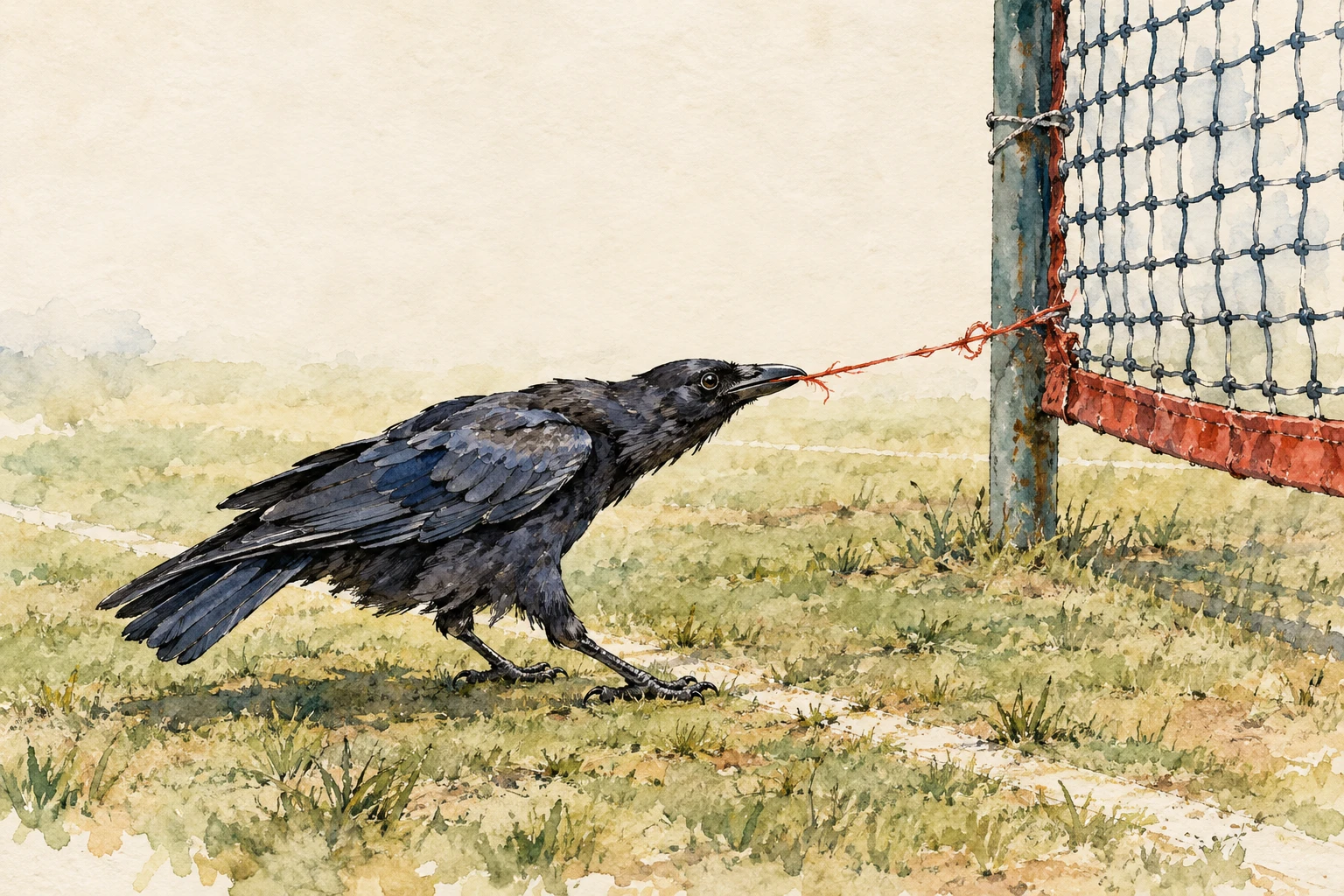
Crow Pulling Thread from a Tennis Net
On a neglected tennis court, a crow tugs a loose thread from the net. Blooming ink and broken fine lines reveal a small struggle amid generous open paper.
Remix this referenceCrow Pulling Thread from a Tennis Net
- Form language
- Reduce forms to uneven, interlocking silhouettes and a few structural strokes; minor contours may vary within an observational drawing language.
- Contour
- Alternate hairline pen passages with brush edges that swell, skip and disappear; let contours remain selectively open.
- Mark-making
- Use quick hooked pen marks and dragged, nearly dry brush strokes, with natural variations in pressure and spacing.
- Surface rendering
- Let diluted ink bloom into absorbent paper with occasional pooled edges and untouched reserves; alternate merged washes with abruptly broken transitions.
Priority
Make editorial ink wash visibly fluid through absorbent blooms and lively pen-to-brush variation.
What to avoid & what to check
Exact prompt for this example
MODULE OWNERSHIP
subject: Subject count, type, stable proportions and landmarks, resting face geometry, hair shape, physical materials, garment construction and permanent marks. No emotion, movement, color assignment or rendering recipe.
expression: Facial soft-tissue displacement and pupil direction, muscle coordination, regional intensity, asymmetry and onset/peak/release. No head/body pose, stable appearance, skin color or rendering.
gesture: Head/neck/body/limb orientation, joint movement, support, contact and pose-caused occlusion using existing anatomy. No eye/pupil movement, emotion, identity, props inventory or camera.
props: Prop count, type, construction, physical material and scale relative to the subject. Holding/contact belongs to gesture, position to composition, color to palette.
scene: Environment elements, terrain, backdrop/floor presence and structural detail. No canvas positions, camera, lighting, assigned colors or render texture.
camera: Projection, focal-length impression, camera elevation/yaw/roll, viewing distance and crop. No actor pose, world placement, lighting or canvas aspect ratio.
composition: Normalized 0-100% canvas positions, scale in frame, depth/overlap, focal hierarchy and margins. No joint pose, camera projection, rendering, subject/prop inventory or emotion.
palette: Color anchors, hue/saturation/value ranges, colors assigned to parts and approximate color coverage. No illumination direction, shading algorithm, physical material or layout.
lighting: Light-source direction/softness/intensity, ambient illumination, physical shadow direction/length and highlight position. Absence of directional illumination is allowed. No shading technique, palette or material changes.
style: Reusable form abstraction, contour weight/taper/edge quality, medium and mark scale/density/direction, surface rendering and tonal transition technique. No fixed subject proportions, anatomy, identity, expression, pose, palette, light-source direction, camera or layout.
output: Image count, aspect ratio, size, file/alpha requirements and global lettering/logo/watermark restrictions. No background scenery, crop, style, identity or pose.

SUBJECT
inventory: One adult crow, actor A; no other animals or people.
geometry: Compact corvid build, a stout tapering bill, broad wing panels and a fan-shaped tail.
resting-face: Small round lateral eyes and a straight bill seam; retain an avian face without human features, including eyebrows.
appearance: Layered feathers and scaly feet; no garments, accessories or permanent identifying marks.

PRIORITY


AVOID


CHECK


EXPRESSION — ACTOR A
brows: No expressive brow displacement.
lids: The visible eye stays naturally open, without a squint or startled widening.
cheeks: The facial feather area stays settled, without a lifted cheek gesture.
nose: No readable nostril displacement is prescribed.
mouth: The bill edges remain nearly closed, without a wide gape.
jaw: No expressive lower-bill drop or sideways displacement.
gaze: Direct the visible pupil toward the strand near the bill tip.
coordination: Keep the eye and bill restrained together; no exaggerated facial asymmetry.
timing: Hold a steady neutral facial state at apex, with no visible onset or release.

PRIORITY


AVOID


CHECK


GESTURE
head: A extends its neck forward, keeping the bill aligned with the taut strand.
torso: The body leans away from the net in a small backward tug; folded wings stay against the flanks.
limbs: Both feet brace on the ground, one slightly ahead; the tail lifts just clear of the grass.
contact: The bill pinches and pulls the loose strand.

PRIORITY


AVOID


CHECK


PROPS
inventory: One tennis net with two support posts and one loose strand from its lower binding; ordinary court scale.
construction: Knotted cord mesh, woven binding tape and slender metal posts; a frayed section releases the single strand. The strand's other end remains attached to the lower binding.

PRIORITY


AVOID


CHECK


SCENE
inventory: A neglected outdoor grass tennis court with a worn chalk line and sparse grass tufts; no buildings.
structure: Uneven turf forms a continuous ground plane; the court boundary and distant surroundings remain unspecified.

PRIORITY


AVOID


CHECK


CAMERA
projection: Natural perspective with a normal-lens impression and little depth exaggeration.
viewpoint: A low oblique side view, slightly above the crow's back, reveals the bill contact and ground beneath its feet.
crop: A medium-wide view includes the whole crow and a partial net; the distant post lies outside the crop.

PRIORITY


AVOID


CHECK


COMPOSITION
placement: Set the crow in the lower-right area at a modest scale; let the net continue beyond the right edge.
depth: The crow and strand form the primary focal connection; the net recedes behind them and the court remains subordinate.
spacing: Leave the upper left broadly open; keep the bill-to-thread connection distinct from the mesh, with irregular visual pauses.

PRIORITY


AVOID


CHECK


PALETTE
colors: Warm bone, blue-black, mist blue, muted moss and a small rust-red accent; keep most chroma restrained.
assignment: Bone for paper, blue-black for the crow, mist blue for mesh, moss for turf, and rust red for binding and strand.
balance: The pale paper field dominates; concentrate the deepest values in the crow and keep red a narrow accent.

PRIORITY


AVOID


CHECK


LIGHTING
sources: Broad, soft daylight comes from the upper left with ample ambient fill.
shadows: Short, soft ground shadows fall toward the lower right; mesh shadows are barely perceptible.
highlights: Subtle highlights touch the upper bill and shoulder feathers, without conspicuous glints.

PRIORITY


AVOID


CHECK


STYLE GUIDE
form-language: Reduce forms to uneven, interlocking silhouettes and a few structural strokes; minor contours may vary within an observational drawing language.
contour: Alternate hairline pen passages with brush edges that swell, skip and disappear; let contours remain selectively open.
mark-making: Use quick hooked pen marks and dragged, nearly dry brush strokes, with natural variations in pressure and spacing.
surface-rendering: Let diluted ink bloom into absorbent paper with occasional pooled edges and untouched reserves; alternate merged washes with abruptly broken transitions.

PRIORITY
Make editorial ink wash visibly fluid through absorbent blooms and lively pen-to-brush variation.

AVOID


CHECK


OUTPUT
format: One finished illustration.
restrictions: Deliver one 1800 × 1200 image, 3:2 landscape, opaque PNG; no lettering, logos or watermarks.

PRIORITY


AVOID


CHECK
Model information comes from image provenance. The same prompt may produce a different result.