Text to imageCharacterStyle guide
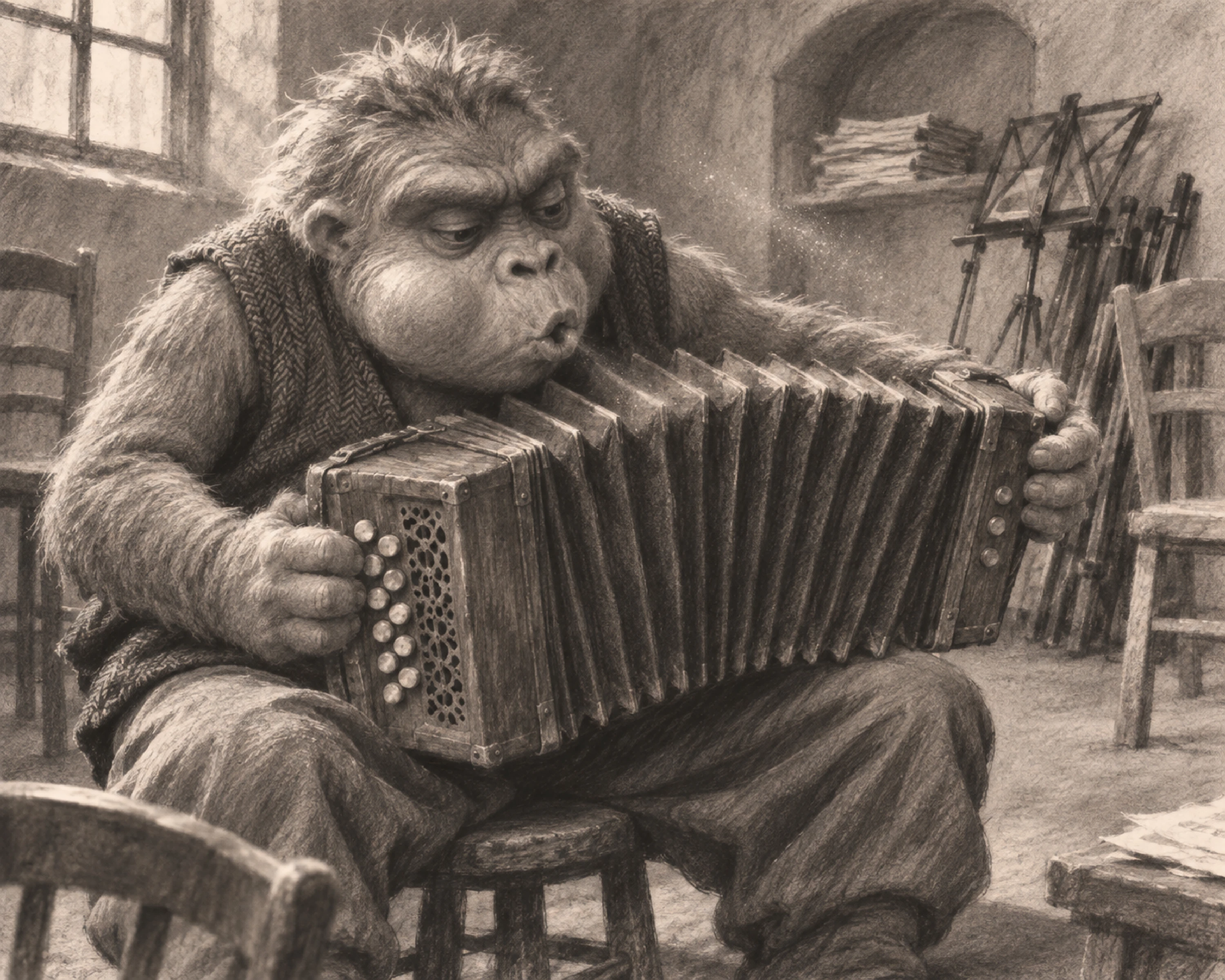
A Creature Blowing Dust from an Accordion
A waistcoated creature blows into an accordion fold. Puffed cheeks and escaping dust emerge through rubbed charcoal and erased light among overlapping instruments and chairs.
Remix this referenceA Creature Blowing Dust from an Accordion
- Form language
- Observe volumes as connected weight-bearing masses; simplify incidental details while allowing small irregularities to remain believable.
- Contour
- Use searching, broken charcoal contours that thicken at pressure points and dissolve into neighboring tones elsewhere.
- Mark-making
- Alternate broad side-stick sweeps with a few pointed strokes; let loose directional marks register the artist's changing pressure.
- Surface rendering
- Rub charcoal into soft connected half-tones, retain granular deposits, and lift light with irregular eraser strokes rather than polished blends.
Priority
Make observational charcoal, visible smudging and erased light the defining treatment.
What to avoid & what to check
Exact prompt for this example
MODULE OWNERSHIP
subject: Subject count, type, stable proportions and landmarks, resting face geometry, hair shape, physical materials, garment construction and permanent marks. No emotion, movement, color assignment or rendering recipe.
expression: Facial soft-tissue displacement and pupil direction, muscle coordination, regional intensity, asymmetry and onset/peak/release. No head/body pose, stable appearance, skin color or rendering.
gesture: Head/neck/body/limb orientation, joint movement, support, contact and pose-caused occlusion using existing anatomy. No eye/pupil movement, emotion, identity, props inventory or camera.
props: Prop count, type, construction, physical material and scale relative to the subject. Holding/contact belongs to gesture, position to composition, color to palette.
scene: Environment elements, terrain, backdrop/floor presence and structural detail. No canvas positions, camera, lighting, assigned colors or render texture.
camera: Projection, focal-length impression, camera elevation/yaw/roll, viewing distance and crop. No actor pose, world placement, lighting or canvas aspect ratio.
composition: Normalized 0-100% canvas positions, scale in frame, depth/overlap, focal hierarchy and margins. No joint pose, camera projection, rendering, subject/prop inventory or emotion.
palette: Color anchors, hue/saturation/value ranges, colors assigned to parts and approximate color coverage. No illumination direction, shading algorithm, physical material or layout.
lighting: Light-source direction/softness/intensity, ambient illumination, physical shadow direction/length and highlight position. Absence of directional illumination is allowed. No shading technique, palette or material changes.
style: Reusable form abstraction, contour weight/taper/edge quality, medium and mark scale/density/direction, surface rendering and tonal transition technique. No fixed subject proportions, anatomy, identity, expression, pose, palette, light-source direction, camera or layout.
output: Image count, aspect ratio, size, file/alpha requirements and global lettering/logo/watermark restrictions. No background scenery, crop, style, identity or pose.

SUBJECT
inventory: A is one original adult creature with a compact pear-shaped body, sturdy legs and broad square palms.
geometry: A broad domed skull narrows into a blunt muzzle; small low-set ears and a short crown brush are stable landmarks.
resting-face: Wide-set eyes, a heavy continuous brow, loose cheek pads and a broad flexible mouth define the resting face.
appearance: Fine dense fur covers the body; wiry crown hair contrasts with a sleeveless woven waistcoat and roomy cloth trousers.

PRIORITY


AVOID


CHECK


EXPRESSION — ACTOR A
brows: The inner brow draws together slightly, with one side fractionally lower.
lids: Upper lids lower in concentration while the lower lids remain gently firm.
cheeks: Both cheeks inflate, with the nearer cheek visibly fuller.
nose: The nostrils flare slightly without wrinkling the bridge.
mouth: Lips purse into a small rounded opening with one corner held tighter.
jaw: The jaw lowers only enough to sustain the rounded mouth opening.
gaze: Both pupils aim at the nearest open bellows crease.
coordination: A mildly tightened upper face accompanies fuller cheeks and a firmly pursed mouth.
timing: Catch the apex of a sustained exhale, before the cheeks soften.

PRIORITY


AVOID


CHECK


GESTURE
head: A extends the neck and bows the head toward the open bellows without hiding the mouth.
torso: The seated torso pitches forward and twists slightly toward the instrument's nearer end.
limbs: One arm braces an end case while the other draws the opposite case outward; the knees spread for support.
contact: Palms grip the end cases, the accordion spans the thighs, and the stool supports the seated weight.

PRIORITY


AVOID


CHECK


PROPS
inventory: One handmade button accordion, broad enough to span A's lap.
construction: Wooden end cases enclose cloth-covered folding bellows, simple round buttons and a perforated grille.

PRIORITY


AVOID


CHECK


SCENE
inventory: A small music storeroom contains a low stool, spare wooden chairs, folded music stands and a thin escaping dust plume.
structure: A shallow plaster alcove and bare floor enclose the room; chair backs and folded stands make an irregular framework.

PRIORITY


AVOID


CHECK


CAMERA
projection: Natural perspective with a normal-lens impression and modest depth compression.
viewpoint: Use a three-quarter view from slightly above the creature's eye level, without camera roll.
crop: Include the crown, body and instrument; let foreground furniture be cut by the lower edges.

PRIORITY


AVOID


CHECK


COMPOSITION
placement: A's face sits above and left of the midpoint; the expanded accordion sweeps across the lower right.
depth: A foreground chair arc overlaps a lower leg; the accordion overlaps the torso, with the storeroom framework behind.
spacing: Give the face first attention, then the opening bellows; keep a small clear interval around the dust plume.

PRIORITY


AVOID


CHECK


PALETTE
colors: Warm ivory, soft ash gray and deep charcoal black form a nearly monochrome range.
assignment: Keep fur in middle grays, waistcoat and bellows near black, and exposed paper and dust near ivory.
balance: Middle values dominate, with concentrated dark accents and a few small pale passages.

PRIORITY


AVOID


CHECK


LIGHTING
sources: A broad window source from the upper left crosses the room, supported by weak ambient illumination.
shadows: Soft shadows gather beneath the instrument and stool, extending toward the lower right.
highlights: Light catches the nearer cheek, upper knuckles, bellows ridges and drifting dust.

PRIORITY


AVOID


CHECK


STYLE GUIDE
form-language: Observe volumes as connected weight-bearing masses; simplify incidental details while allowing small irregularities to remain believable.
contour: Use searching, broken charcoal contours that thicken at pressure points and dissolve into neighboring tones elsewhere.
mark-making: Alternate broad side-stick sweeps with a few pointed strokes; let loose directional marks register the artist's changing pressure.
surface-rendering: Rub charcoal into soft connected half-tones, retain granular deposits, and lift light with irregular eraser strokes rather than polished blends.

PRIORITY
Make observational charcoal, visible smudging and erased light the defining treatment.

AVOID


CHECK


OUTPUT
format: One finished image, landscape 5:4, 3000 × 2400 pixels, opaque PNG.
restrictions: No lettering, logos or watermarks.

PRIORITY


AVOID


CHECK
Model information comes from image provenance. The same prompt may produce a different result.