Text to imageAnimationStyle guide
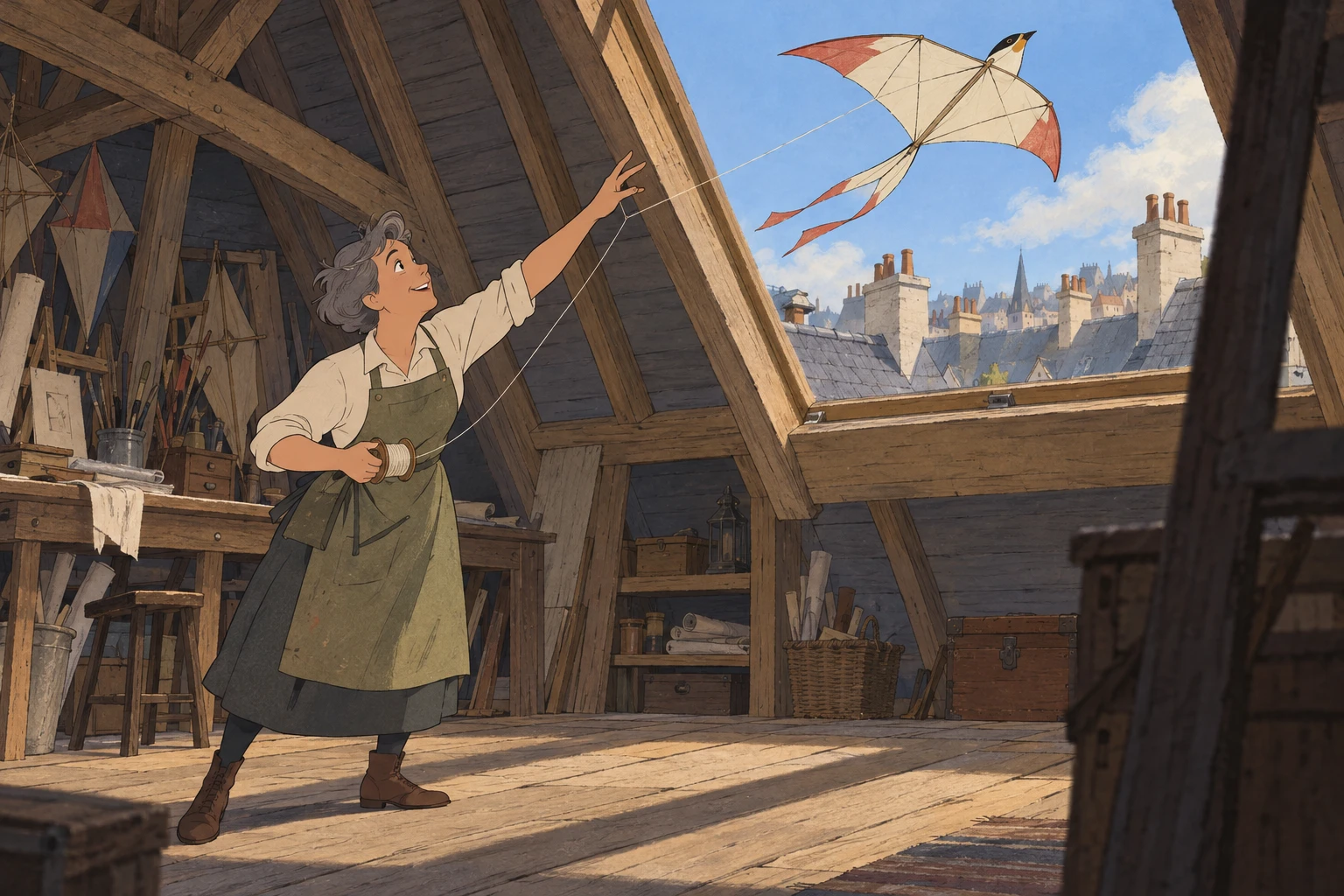
Kite Maker at the Roof Hatch
In an attic workshop, a maker launches a swallow-shaped kite through an open roof hatch. Irregular pencil contours and slightly misregistered cel fills animate the moment it first catches the wind.
Remix this referenceKite Maker at the Roof Hatch
- Form language
- Reduce forms to legible interlocking masses with selective angular breaks; let small details vary within the same economical shape language.
- Contour
- Use lively pencil-derived contours with slight weight irregularity, occasional tapered ends and imperfect joins instead of uniformly polished ink.
- Mark-making
- Retain selective short doubled traces and broken graphite-like strokes; sparse interior marks follow local surfaces with natural variation.
- Surface rendering
- Use flat cel fills with few tonal steps and slight line-to-fill misregistration; broader painted fields retain uneven gouache edges and thin wash variation.
Priority
Rendering medium: hand-drawn 2D xerographic cel-animation illustration; formal rendering reference: Walt Disney Studios · 1960s · One Hundred and One Dalmatians (1961)
What to avoid & what to check
Exact prompt for this example
MODULE OWNERSHIP
subject: Subject count, type, stable proportions and landmarks, resting face geometry, hair shape, physical materials, garment construction and permanent marks. No emotion, movement, color assignment or rendering recipe.
expression: Facial soft-tissue displacement and pupil direction, muscle coordination, regional intensity, asymmetry and onset/peak/release. No head/body pose, stable appearance, skin color or rendering.
gesture: Head/neck/body/limb orientation, joint movement, support, contact and pose-caused occlusion using existing anatomy. No eye/pupil movement, emotion, identity, props inventory or camera.
props: Prop count, type, construction, physical material and scale relative to the subject. Holding/contact belongs to gesture, position to composition, color to palette.
scene: Environment elements, terrain, backdrop/floor presence and structural detail. No canvas positions, camera, lighting, assigned colors or render texture.
camera: Projection, focal-length impression, camera elevation/yaw/roll, viewing distance and crop. No actor pose, world placement, lighting or canvas aspect ratio.
composition: Normalized 0-100% canvas positions, scale in frame, depth/overlap, focal hierarchy and margins. No joint pose, camera projection, rendering, subject/prop inventory or emotion.
palette: Color anchors, hue/saturation/value ranges, colors assigned to parts and approximate color coverage. No illumination direction, shading algorithm, physical material or layout.
lighting: Light-source direction/softness/intensity, ambient illumination, physical shadow direction/length and highlight position. Absence of directional illumination is allowed. No shading technique, palette or material changes.
style: Reusable form abstraction, contour weight/taper/edge quality, medium and mark scale/density/direction, surface rendering and tonal transition technique. No fixed subject proportions, anatomy, identity, expression, pose, palette, light-source direction, camera or layout.
output: Image count, aspect ratio, size, file/alpha requirements and global lettering/logo/watermark restrictions. No background scenery, crop, style, identity or pose.

SUBJECT
inventory: One original middle-aged human woman, actor A, a kite maker.
geometry: A compact, sturdy build with a broad ribcage, substantial hands and a softly squared chin.
resting-face: Broad-set oval eyes, straight brows, a rounded nose tip and a wide mouth with a shallow upper-lip bow.
appearance: Short wiry hair with a swept forelock; a woven shirt, canvas bib apron and leather ankle boots.

PRIORITY


AVOID


CHECK


EXPRESSION — ACTOR A
brows: Both brows lift gently, with the nearer brow slightly higher.
lids: Upper lids open modestly; raised lower lids lightly narrow the outer corners.
cheeks: Cheeks rise into rounded cushions, slightly stronger on the nearer side.
nose: Nose wings remain relaxed without wrinkling.
mouth: Corners draw upward and outward; parted lips reveal a narrow glimpse of upper teeth.
jaw: The jaw releases slightly beneath the smile.
gaze: Both pupils track the kite's rising wingtip.
coordination: Cheek lift supports the lower lids while the mouth opens without stretching into laughter.
timing: Hold the brief apex of delight as the kite catches air.

PRIORITY


AVOID


CHECK


GESTURE
head: A lifts her chin and turns her neck toward her extended hand.
torso: Her torso stretches diagonally upward with a slight rightward twist and an uneven shoulder line.
limbs: One arm reaches high with opening fingers; the other bends close to her waist; her knees remain softly bent.
contact: The raised fingertips just release the kite spar; the lower hand grips the spool; both boots support her on the floor.

PRIORITY


AVOID


CHECK


PROPS
inventory: One swallow-shaped kite and one line spool; the kite spans roughly A's outstretched arms, the spool fits her palm.
construction: The kite has translucent paper wings, slender bamboo spars and a forked paper tail; cotton line winds around a wooden spool.

PRIORITY


AVOID


CHECK


SCENE
inventory: An attic workshop with a plank floor, exposed roof beams, a built-in workbench, storage recesses and an open roof hatch.
structure: Sloping rafters enclose a tall hatch opening; beyond it, uneven tiled rooftops and chimney stacks extend into open sky.

PRIORITY


AVOID


CHECK


CAMERA
projection: Natural perspective with a moderately wide lens impression and restrained edge distortion.
viewpoint: View from inside the attic at chest height, looking slightly upward and obliquely across the room; no roll.
crop: A medium-wide full-figure view includes the kite's complete silhouette and generous architectural context.

PRIORITY


AVOID


CHECK


COMPOSITION
placement: A occupies the lower-left third; the kite rises near 70% canvas width in the upper-right opening.
depth: A cropped foreground beam overlaps the room; A and the kite lead, with successive roof planes receding beyond.
spacing: Leave breathing room around the reaching hand and kite; the face-to-hand-to-wing diagonal carries the focal sequence.

PRIORITY


AVOID


CHECK


PALETTE
colors: Use warm ochre, slate blue, muted olive, coral red and creamy ivory, with charcoal accents.
assignment: Ochre woodwork, slate roofs and sky, olive apron, ivory shirt and kite, coral kite tips, warm beige skin and gray hair.
balance: Muted ochre and blue dominate; ivory opens the value range and coral supplies a small, vivid accent.

PRIORITY


AVOID


CHECK


LIGHTING
sources: Broad, soft daylight enters from above and right through the hatch, balanced by weaker ambient fill inside.
shadows: Soft shadows fall leftward into the room; beam shadows form broad bands across the floor.
highlights: Gentle highlights touch the raised hand, upper cheek and hatch-facing edges of the kite.

PRIORITY


AVOID


CHECK


STYLE GUIDE
form-language: Reduce forms to legible interlocking masses with selective angular breaks; let small details vary within the same economical shape language.
contour: Use lively pencil-derived contours with slight weight irregularity, occasional tapered ends and imperfect joins instead of uniformly polished ink.
mark-making: Retain selective short doubled traces and broken graphite-like strokes; sparse interior marks follow local surfaces with natural variation.
surface-rendering: Use flat cel fills with few tonal steps and slight line-to-fill misregistration; broader painted fields retain uneven gouache edges and thin wash variation.

PRIORITY
Rendering medium: hand-drawn 2D xerographic cel-animation illustration; formal rendering reference: Walt Disney Studios · 1960s · One Hundred and One Dalmatians (1961)

AVOID


CHECK


OUTPUT
format: One finished image, 3:2 landscape, 1536 × 1024 pixels, opaque PNG.
restrictions: No lettering, logos, signatures or watermarks.

PRIORITY


AVOID


CHECK


FINAL INTEGRATION
expression + gesture + composition: Facial acting and the release gesture cooperate with the focal sequence to make the launch readable.
style + lighting + palette: Translate the illumination and color relationships through the chosen tonal steps while preserving the drawing's irregular vitality.
Art direction
디즈니 / Walt Disney Studios · 1960s · 101마리 달마시안(1961) / One Hundred and One Dalmatians (1961) ↗- Use legible form masses with selective angular simplification
- Sketch-like contours with small weight irregularities instead of polished ink uniformity
- Retain selective short doubled contour traces and broken pencil-like marks
- Flat fills with few tonal levels and slight line-to-fill edge misregistration
Model information comes from image provenance. The same prompt may produce a different result.