Text to imageCalligraphyStyle guide
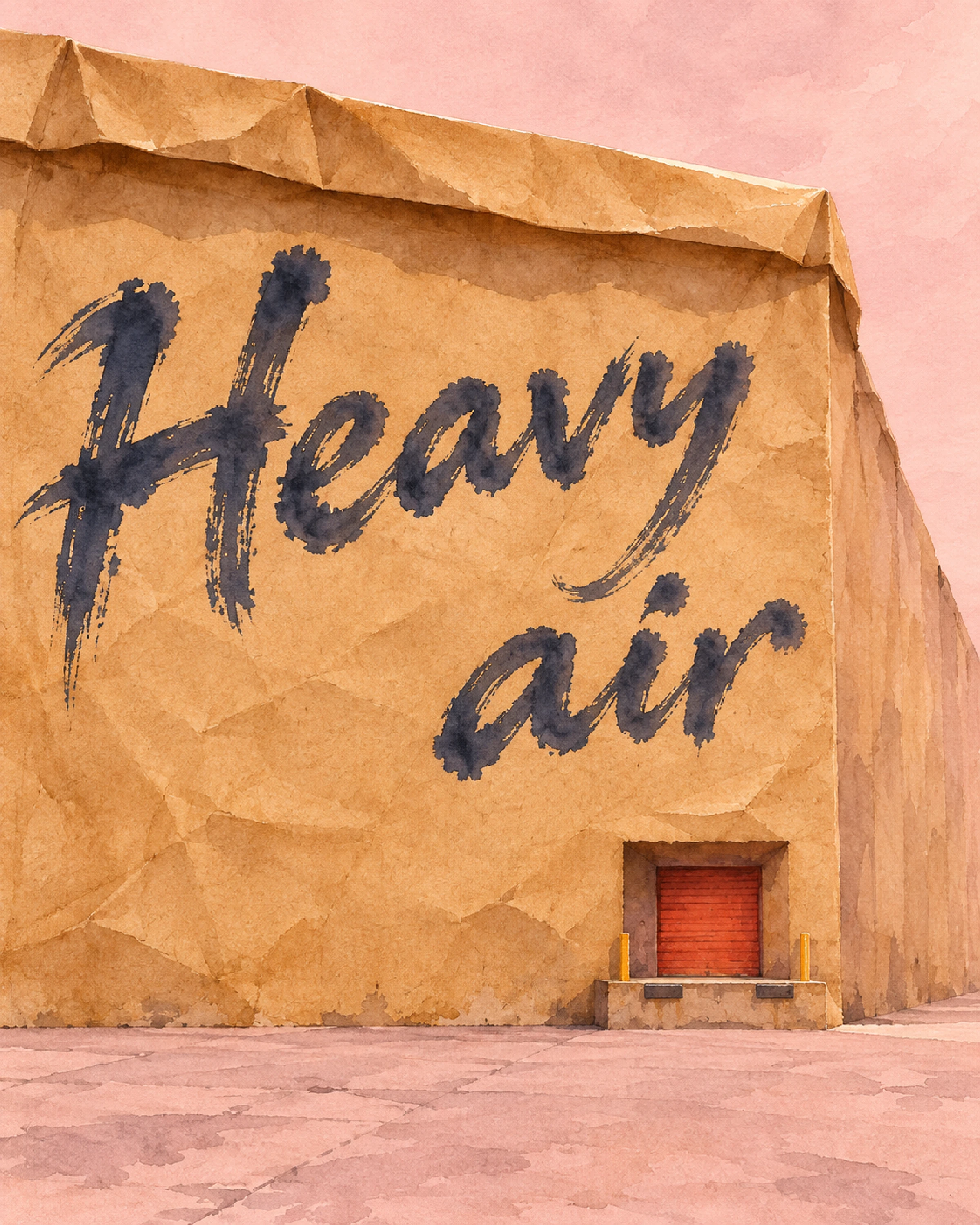
Brush Lettering on a Paper Sack Warehouse
An enormous paper sack becomes a tiny freight warehouse. Dry-brush lettering stretches beneath its folded mouth, while a little loading entrance reveals the surprising scale.
Remix this referenceBrush Lettering on a Paper Sack Warehouse
- Form language
- Reduce architecture to broad, slightly irregular planes; let minor structural details vary within a spare handmade vocabulary.
- Contour
- Give brush strokes frayed, intermittently broken edges and tapering exits; describe architectural edges with quieter incomplete lines.
- Mark-making
- Alternate loaded presses with fast dry pulls; visible bristle channels follow each stroke, creating an expressive but readable rhythm.
- Surface rendering
- Combine pooled ink with exposed paper breaks; use thin uneven washes and softly bleeding transitions for the surrounding planes.
Priority
Dry-brush calligraphy with broken ink edges must remain visibly hand-written.
What to avoid & what to check
Exact prompt for this example
MODULE OWNERSHIP
subject: Subject count, type, stable proportions and landmarks, resting face geometry, hair shape, physical materials, garment construction and permanent marks. No emotion, movement, color assignment or rendering recipe.
expression: Facial soft-tissue displacement and pupil direction, muscle coordination, regional intensity, asymmetry and onset/peak/release. No head/body pose, stable appearance, skin color or rendering.
gesture: Head/neck/body/limb orientation, joint movement, support, contact and pose-caused occlusion using existing anatomy. No eye/pupil movement, emotion, identity, props inventory or camera.
props: Prop count, type, construction, physical material and scale relative to the subject. Holding/contact belongs to gesture, position to composition, color to palette.
scene: Environment elements, terrain, backdrop/floor presence and structural detail. No canvas positions, camera, lighting, assigned colors or render texture.
camera: Projection, focal-length impression, camera elevation/yaw/roll, viewing distance and crop. No actor pose, world placement, lighting or canvas aspect ratio.
composition: Normalized 0-100% canvas positions, scale in frame, depth/overlap, focal hierarchy and margins. No joint pose, camera projection, rendering, subject/prop inventory or emotion.
palette: Color anchors, hue/saturation/value ranges, colors assigned to parts and approximate color coverage. No illumination direction, shading algorithm, physical material or layout.
lighting: Light-source direction/softness/intensity, ambient illumination, physical shadow direction/length and highlight position. Absence of directional illumination is allowed. No shading technique, palette or material changes.
style: Reusable form abstraction, contour weight/taper/edge quality, medium and mark scale/density/direction, surface rendering and tonal transition technique. No fixed subject proportions, anatomy, identity, expression, pose, palette, light-source direction, camera or layout.
output: Image count, aspect ratio, size, file/alpha requirements and global lettering/logo/watermark restrictions. No background scenery, crop, style, identity or pose.

SUBJECT
inventory: One two-word calligraphic inscription; no human or animal subjects.
geometry: Write "Heavy air" with open lowercase counters, a recognizable capital H, and clearly separated words.
resting-face: No faces or facial geometry apply.
appearance: The inscription consists of absorbed ink, without a separate raised body.

PRIORITY


AVOID


CHECK


PROPS
inventory: No separate props.
construction: No prop construction applies.

PRIORITY


AVOID


CHECK


SCENE
inventory: A paper-sack warehouse, a paved service yard, and an open sky form an otherwise empty freight setting.
structure: The warehouse has paper walls; the sack's folded mouth becomes a roof parapet, while a miniature recessed loading door and dock turn its base into architecture.

PRIORITY


AVOID


CHECK


CAMERA
projection: Use restrained perspective with a normal-lens impression and little convergence.
viewpoint: Look from slightly below the facade's midpoint, with a gentle yaw revealing one side wall.
crop: Show the complete inscription, folded roof edge, loading entrance, and a short stretch of yard.

PRIORITY


AVOID


CHECK


COMPOSITION
placement: Let the facade dominate off center; place the two words in a loose descending arrangement, with the tiny dock below their right end.
depth: The inscription leads, the recessed dock supplies the scale revelation, and the side wall carries the eye into depth.
spacing: Keep generous breathing room around the words and an uneven wedge of sky beside the warehouse.

PRIORITY


AVOID


CHECK


PALETTE
colors: Use smoky indigo, warm kraft ocher, pale shell pink, and a small vermilion accent.
assignment: Assign indigo to the lettering, ocher to the warehouse, shell pink to sky and yard, and vermilion to the loading door.
balance: Let warm pale colors prevail, with dense lettering and the small door providing the strongest value and saturation accents.

PRIORITY


AVOID


CHECK


LIGHTING
sources: Broad, soft daylight arrives from the upper right with gentle ambient fill.
shadows: The folded rim casts a soft downward-left shadow; the loading recess remains visibly deeper in shade.
highlights: A subdued highlight follows the upper-right fold without glossy reflections.

PRIORITY


AVOID


CHECK


STYLE GUIDE
form-language: Reduce architecture to broad, slightly irregular planes; let minor structural details vary within a spare handmade vocabulary.
contour: Give brush strokes frayed, intermittently broken edges and tapering exits; describe architectural edges with quieter incomplete lines.
mark-making: Alternate loaded presses with fast dry pulls; visible bristle channels follow each stroke, creating an expressive but readable rhythm.
surface-rendering: Combine pooled ink with exposed paper breaks; use thin uneven washes and softly bleeding transitions for the surrounding planes.

PRIORITY
Dry-brush calligraphy with broken ink edges must remain visibly hand-written.

AVOID


CHECK


OUTPUT
format: One finished image, portrait 4:5, 2400 × 3000 pixels, opaque PNG.
restrictions: Allow primary lettering; forbid additional text, logos, and watermarks.

PRIORITY


AVOID


CHECK


FINAL INTEGRATION
scene + composition: Let the familiar loading entrance make the warehouse's impossible scale immediately understandable.
subject + scene: The inscription is absorbed directly into the warehouse's paper wall.
subject + output: The authorized primary lettering is exactly "Heavy air".
Model information comes from image provenance. The same prompt may produce a different result.