Text to imageArt stylesStyle guide
One Banana · Ballpoint Loop Shading
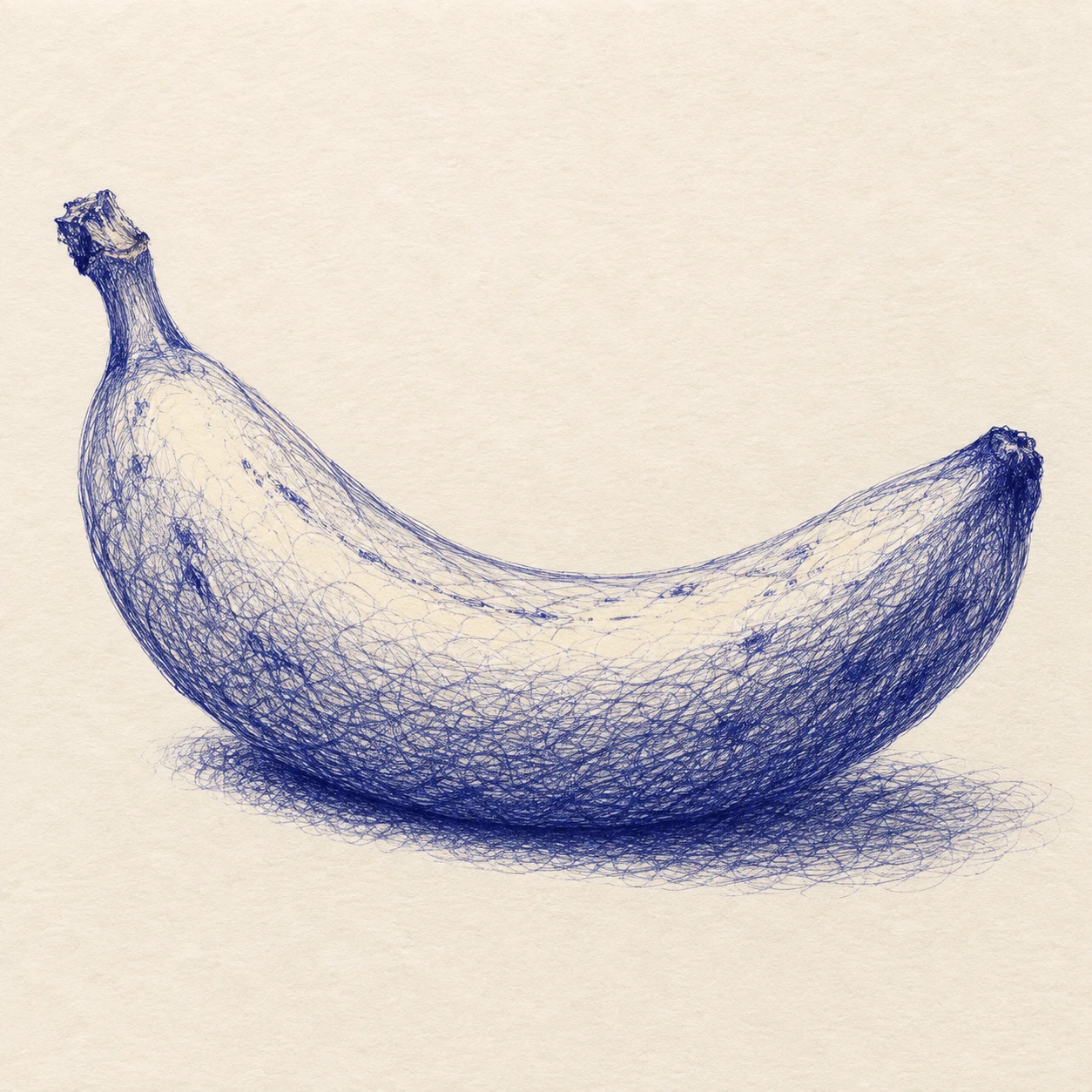
A drawing that models a banana and its shadow through the density of overlapping blue ballpoint loops.
One Banana · Ballpoint Loop Shading
- Shape & line
- Build the banana's crescent silhouette with irregular, overlapping pen loops; keep the outer contour lightly interrupted and let loops follow the lengthwise curve, tightening around the stem and tapered tip.
- Color & light
- Use blue ink alone against warm ivory paper. Place the light at image upper-left, leave a broad paper-colored highlight on the upper-left-facing peel, and increase loop overlap across the underside and image-right-facing end to create darker blue values.
- Texture & material
- Preserve individual wiry strokes, small gaps, and occasional darker ink overlaps so the surface reads as ballpoint on lightly grained paper. Suggest a few peel ridges with elongated loop clusters; keep shading visibly loop-based instead of smoothing it into a wash.
- Composition
- Keep the banana large enough for its loop marks to remain readable. Attach a low cast shadow directly beneath its resting belly and extend it toward image lower-right; use dense loops at contact and progressively looser loops along the shadow's outer edge.
Priority
Make overlapping ballpoint loops the main source of both form and tonal variation.
What to avoid & what to check
Avoid smooth digital gradients, parallel hatch shading, and a uniformly heavy outline.
Check that one banana reads clearly, its highlight remains open paper, and its shadow touches the underside.
Exact prompt for this example
SUBJECT
Draw exactly one whole, unpeeled banana with a short attached stem. Its curved body rests on an otherwise empty paper-colored surface; the stem points toward the upper-left of the image and the opposite tip curves toward the upper-right.

COMPOSITION
Use a slightly elevated side view in a square frame. Center the banana across the lower-middle of the image, leaving generous blank paper above and clear space around both tips.

STYLE GUIDE
1. Shape & line
Build the banana's crescent silhouette with irregular, overlapping pen loops; keep the outer contour lightly interrupted and let loops follow the lengthwise curve, tightening around the stem and tapered tip.

2. Color & light
Use blue ink alone against warm ivory paper. Place the light at image upper-left, leave a broad paper-colored highlight on the upper-left-facing peel, and increase loop overlap across the underside and image-right-facing end to create darker blue values.

3. Texture & material
Preserve individual wiry strokes, small gaps, and occasional darker ink overlaps so the surface reads as ballpoint on lightly grained paper. Suggest a few peel ridges with elongated loop clusters; keep shading visibly loop-based instead of smoothing it into a wash.

4. Composition
Keep the banana large enough for its loop marks to remain readable. Attach a low cast shadow directly beneath its resting belly and extend it toward image lower-right; use dense loops at contact and progressively looser loops along the shadow's outer edge.

PRIORITY
Preserve the requested identity, count, action, composition and output settings. Apply the style rules within those constraints; a style reference must not replace the subject or layout. Within the style: Make overlapping ballpoint loops the main source of both form and tonal variation.

AVOID
Avoid smooth digital gradients, parallel hatch shading, and a uniformly heavy outline.

OUTPUT
Produce one square image of a blue ballpoint drawing on warm ivory paper, with no lettering, labels, signature, or watermark.

SELF-CHECK
Check that one banana reads clearly, its highlight remains open paper, and its shadow touches the underside.
Model information comes from image provenance. The same prompt may produce a different result.