Text to imageCharacterStyle guide
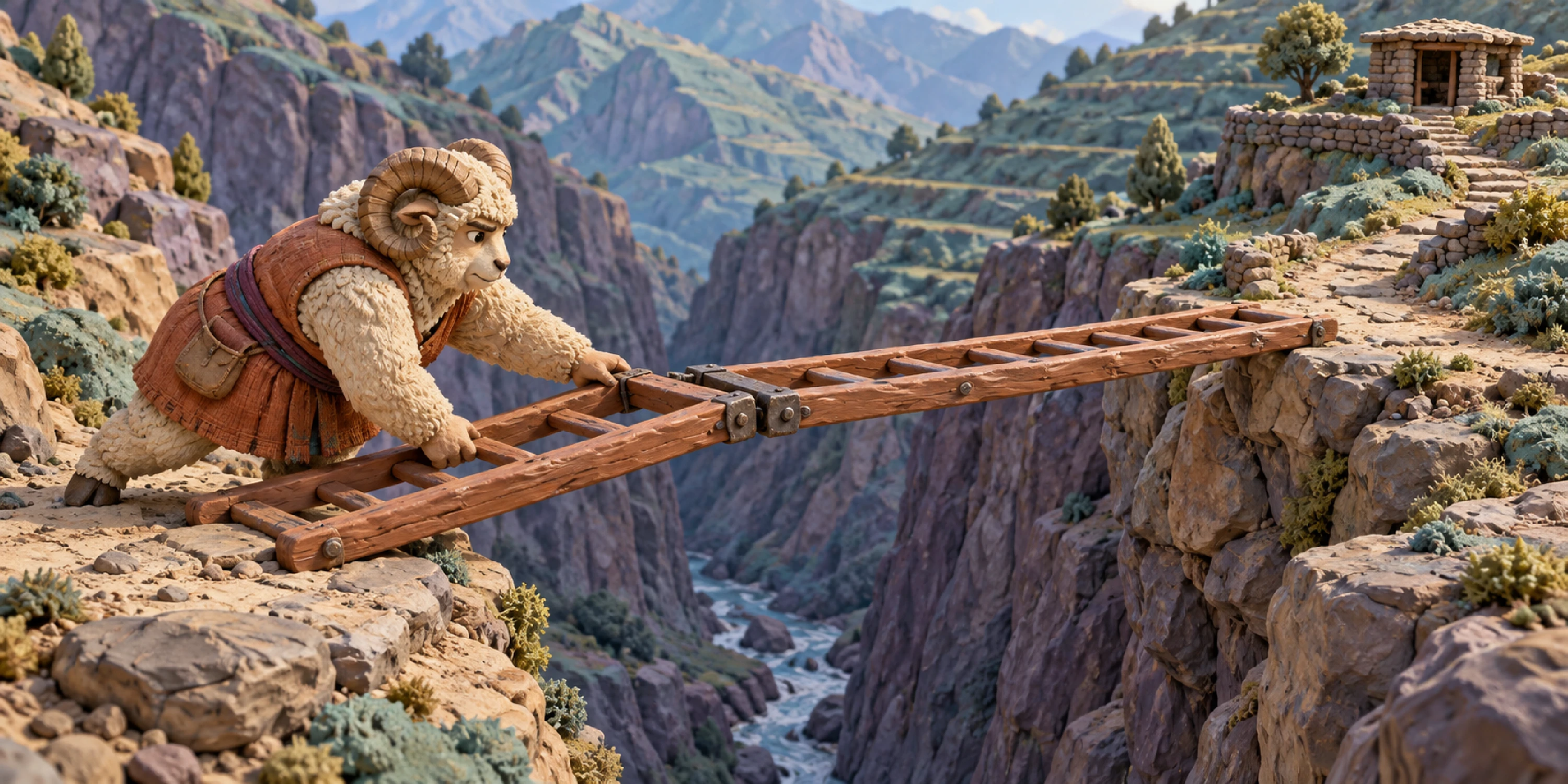
Ram Bridgewright Unfolding a Ladder
A curly-horned ram bridgewright unfolds a ladder across a broken mountain path. In a handmade clay panorama, the route continues over a ravine toward a distant shelter.
Remix this referenceRam Bridgewright Unfolding a Ladder
- Form language
- Build a sculptural clay miniature from rounded masses and pressed slabs; simplify small details while allowing handmade variation.
- Contour
- Use softly compressed edges and slightly lumpy silhouettes; occasional sharp tool cuts interrupt the rounded boundaries.
- Mark-making
- Retain uneven thumb sweeps and broad modeling-tool grooves; vary their spacing naturally instead of repeating a stamped texture.
- Surface rendering
- Render mostly matte clay with gently rubbed high points and soft tonal turns; preserve small dents rather than polishing every surface.
Priority
Make the image visibly read as a hand-built sculptural clay miniature.
What to avoid & what to check
Exact prompt for this example
MODULE OWNERSHIP
subject: Subject count, type, stable proportions and landmarks, resting face geometry, hair shape, physical materials, garment construction and permanent marks. No emotion, movement, color assignment or rendering recipe.
expression: Facial soft-tissue displacement and pupil direction, muscle coordination, regional intensity, asymmetry and onset/peak/release. No head/body pose, stable appearance, skin color or rendering.
gesture: Head/neck/body/limb orientation, joint movement, support, contact and pose-caused occlusion using existing anatomy. No eye/pupil movement, emotion, identity, props inventory or camera.
props: Prop count, type, construction, physical material and scale relative to the subject. Holding/contact belongs to gesture, position to composition, color to palette.
scene: Environment elements, terrain, backdrop/floor presence and structural detail. No canvas positions, camera, lighting, assigned colors or render texture.
camera: Projection, focal-length impression, camera elevation/yaw/roll, viewing distance and crop. No actor pose, world placement, lighting or canvas aspect ratio.
composition: Normalized 0-100% canvas positions, scale in frame, depth/overlap, focal hierarchy and margins. No joint pose, camera projection, rendering, subject/prop inventory or emotion.
palette: Color anchors, hue/saturation/value ranges, colors assigned to parts and approximate color coverage. No illumination direction, shading algorithm, physical material or layout.
lighting: Light-source direction/softness/intensity, ambient illumination, physical shadow direction/length and highlight position. Absence of directional illumination is allowed. No shading technique, palette or material changes.
style: Reusable form abstraction, contour weight/taper/edge quality, medium and mark scale/density/direction, surface rendering and tonal transition technique. No fixed subject proportions, anatomy, identity, expression, pose, palette, light-source direction, camera or layout.
output: Image count, aspect ratio, size, file/alpha requirements and global lettering/logo/watermark restrictions. No background scenery, crop, style, identity or pose.

SUBJECT
inventory: One original adult anthropomorphic ram woman, a traveling bridgewright.
geometry: A sturdy barrel-shaped body, short broad muzzle, compact limbs, mitten-like hands and tightly coiled horns.
resting-face: Wide-set eyes beneath low brow ridges, rounded cheeks, a broad nose and a simple horizontal mouth.
appearance: Dense wool, ridged horns and a bare muzzle; a woven sleeveless tunic with a broad sash and patch pocket.

PRIORITY


AVOID


CHECK


EXPRESSION — ACTOR A
brows: Inner brows draw down, with the nearer brow slightly lower.
lids: Upper lids lower slightly while the lower lids tighten.
cheeks: The nearer cheek bunches subtly above a firm mouth corner.
nose: Nostrils widen slightly without wrinkling the nose bridge.
mouth: Lips press together, with one corner pulled slightly sideways.
jaw: The jaw stays closed with modest tension along the lower muzzle.
gaze: Both pupils aim toward the ladder's approaching far end.
coordination: Concentrate effort around brows and lids; keep mouth tension quieter.
timing: Hold concentration at its apex, before any facial release.

PRIORITY


AVOID


CHECK


GESTURE
head: The neck extends slightly and the chin lowers toward the unfolding ladder.
torso: The torso leans forward from a low crouch, turning slightly toward the ravine.
limbs: One knee bears weight while the opposite foot braces; one arm pushes forward and the other steadies the near rail.
contact: Both hands grip the ladder rails; its near section rests on the ledge while the hinged section opens outward.

PRIORITY


AVOID


CHECK


PROPS
inventory: One folding wooden ladder, long enough when opened to bridge several character heights.
construction: Two ladder sections join with simple metal hinges; thick timber rails support irregularly spaced rungs.

PRIORITY


AVOID


CHECK


SCENE
inventory: A mountain footpath, a narrow ravine, terraced slopes, sparse shrubs and a small stone trail shelter.
structure: The broken path resumes across the cleft, bends around exposed rock and climbs through shallow terraces to the shelter.

PRIORITY


AVOID


CHECK


CAMERA
projection: Moderate wide-angle perspective with readable environmental depth.
viewpoint: View from slightly above the character's head, obliquely across the ravine, with no camera roll.
crop: Show the whole character, the ladder's full reach and enough distant terrain to reveal the destination.

PRIORITY


AVOID


CHECK


COMPOSITION
placement: Anchor the character in the left third; the ladder leads inward and the winding route finishes at the upper right.
depth: The face and working hands lead attention; overlapping ledges carry it toward the smaller distant shelter.
spacing: Leave open air beneath the ladder and a broad upper margin; keep the route distinct from neighboring terrain.

PRIORITY


AVOID


CHECK


PALETTE
colors: Oat cream, iron rust, dusty turquoise and muted plum define the color family.
assignment: Use oat cream for wool, rust for the tunic and ladder, turquoise for terraces, and plum for ravine walls.
balance: Muted turquoise and plum occupy most of the image; cream and rust form the smaller warm accents.

PRIORITY


AVOID


CHECK


LIGHTING
sources: A broad soft source shines from upper right, supported by gentle ambient illumination.
shadows: Soft shadows fall leftward; sheltered cracks and the ravine remain noticeably deeper.
highlights: Broad highlights touch the horn crowns, upper muzzle, ladder rails and exposed terrace lips.

PRIORITY


AVOID


CHECK


STYLE GUIDE
form-language: Build a sculptural clay miniature from rounded masses and pressed slabs; simplify small details while allowing handmade variation.
contour: Use softly compressed edges and slightly lumpy silhouettes; occasional sharp tool cuts interrupt the rounded boundaries.
mark-making: Retain uneven thumb sweeps and broad modeling-tool grooves; vary their spacing naturally instead of repeating a stamped texture.
surface-rendering: Render mostly matte clay with gently rubbed high points and soft tonal turns; preserve small dents rather than polishing every surface.

PRIORITY
Make the image visibly read as a hand-built sculptural clay miniature.

AVOID


CHECK


OUTPUT
format: One opaque PNG, 3000 × 1500 pixels, panoramic 2:1.
restrictions: Deliver one image at 2:1, 3000 × 1500 pixels, as an opaque PNG; no lettering, logos or watermarks.

PRIORITY


AVOID


CHECK
Model information comes from image provenance. The same prompt may produce a different result.