Text to imageComicsStyle guide
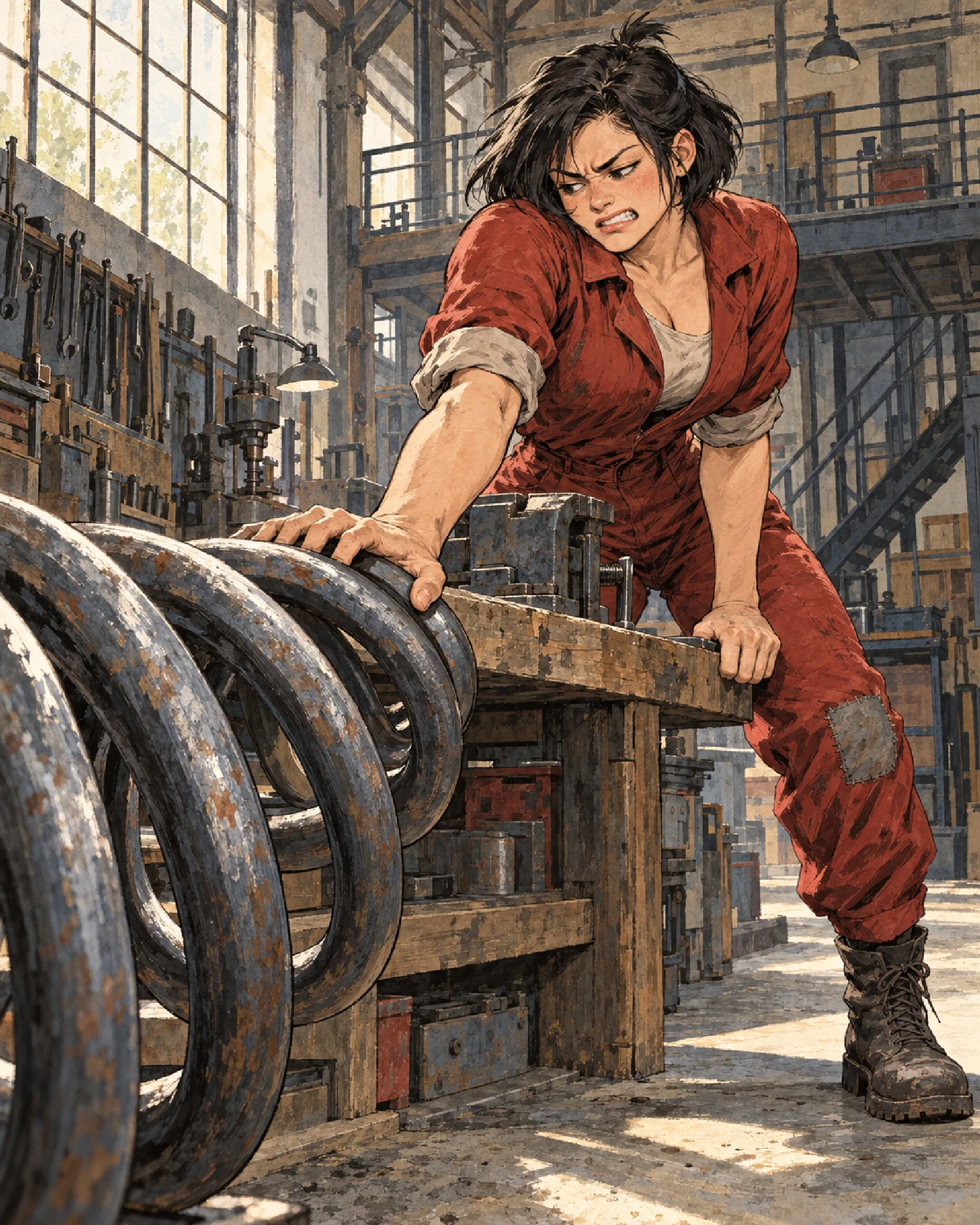
A Mechanic Pinning an Escaped Spring
Inside a deep repair workshop, a mechanic braces an enormous escaped spring with her palm. Split brush lines, pooled ink and sparse washes give this single comic illustration elastic energy and comic tension.
Remix this referenceA Mechanic Pinning an Escaped Spring
- Form language
- Simplify forms into forceful wedges and elastic arcs, alternating broad masses with abrupt small notches; incidental shapes may vary coherently.
- Contour
- Use pressure-loaded brush contours that swell, split and taper sharply, leaving occasional dry gaps instead of uniformly enclosing every shape.
- Mark-making
- Combine long wrist-driven sweeps with short, uneven hatch clusters; let bristles fray naturally and keep quieter passages sparsely marked.
- Surface rendering
- Pool ink into connected dark shapes, feather selected edges into translucent wash, and retain exposed paper with uneven wash blooms.
Priority
Rendering medium: expressive brush-ink manga illustration with selective watercolor wash.
What to avoid & what to check
Exact prompt for this example
MODULE OWNERSHIP
subject: Subject count, type, stable proportions and landmarks, resting face geometry, hair shape, physical materials, garment construction and permanent marks. No emotion, movement, color assignment or rendering recipe.
expression: Facial soft-tissue displacement and pupil direction, muscle coordination, regional intensity, asymmetry and onset/peak/release. No head/body pose, stable appearance, skin color or rendering.
gesture: Head/neck/body/limb orientation, joint movement, support, contact and pose-caused occlusion using existing anatomy. No eye/pupil movement, emotion, identity, props inventory or camera.
props: Prop count, type, construction, physical material and scale relative to the subject. Holding/contact belongs to gesture, position to composition, color to palette.
scene: Environment elements, terrain, backdrop/floor presence and structural detail. No canvas positions, camera, lighting, assigned colors or render texture.
camera: Projection, focal-length impression, camera elevation/yaw/roll, viewing distance and crop. No actor pose, world placement, lighting or canvas aspect ratio.
composition: Normalized 0-100% canvas positions, scale in frame, depth/overlap, focal hierarchy and margins. No joint pose, camera projection, rendering, subject/prop inventory or emotion.
palette: Color anchors, hue/saturation/value ranges, colors assigned to parts and approximate color coverage. No illumination direction, shading algorithm, physical material or layout.
lighting: Light-source direction/softness/intensity, ambient illumination, physical shadow direction/length and highlight position. Absence of directional illumination is allowed. No shading technique, palette or material changes.
style: Reusable form abstraction, contour weight/taper/edge quality, medium and mark scale/density/direction, surface rendering and tonal transition technique. No fixed subject proportions, anatomy, identity, expression, pose, palette, light-source direction, camera or layout.
output: Image count, aspect ratio, size, file/alpha requirements and global lettering/logo/watermark restrictions. No background scenery, crop, style, identity or pose.

SUBJECT
inventory: One adult woman mechanic, actor A; no other figures.
geometry: A sturdy, compact build with broad palms, an oblong face and a short, uneven bob with one blunt crown tuft.
resting-face: Wide-set almond eyes, straight brows, a blunt nose and a broad mouth above a square chin define her resting face.
appearance: Canvas coveralls have rolled sleeves and a patched knee; plain leather work boots complete her clothing.

PRIORITY


AVOID


CHECK


EXPRESSION — ACTOR A
brows: Both brows draw inward and down; the left brow presses slightly lower.
lids: Upper lids narrow the eyes while the lower lids tighten upward.
cheeks: Cheeks tense subtly beside the mouth without lifting into a smile.
nose: Nostrils widen slightly; the nose bridge remains unwrinkled.
mouth: Lips part narrowly over clenched teeth, with the left corner pulled farther sideways.
jaw: The jaw stays firmly closed, with a small visible tension at its corners.
gaze: Both pupils look down-left toward her left palm.
coordination: The narrowed eyes and sideways mouth tension work together as concentrated effort.
timing: Hold the apex of effort, just as the mouth tightens into its uneven grimace.

PRIORITY


AVOID


CHECK


GESTURE
head: A lowers her chin and turns her head slightly left, keeping her neck visibly connected to the forward lean.
torso: Her torso pitches over the bench with a small twist through the shoulders and hips set back for balance.
limbs: Her left arm bears downward, the right elbow bends back, and bent knees spread above firmly planted boots.
contact: The heel of her left palm presses a bowed spring turn; her right hand grips the bench edge and both boots support her.

PRIORITY


AVOID


CHECK


PROPS
inventory: One oversized steel compression spring and one bench vise; the spring's coil diameter is roughly torso-wide.
construction: The spring is continuous round rod with broad open coils; the cast-metal vise has a screw spindle and plain jaws.

PRIORITY


AVOID


CHECK


SCENE
inventory: An old repair workshop contains a fixed timber workbench, recessed storage bays, a raised service gallery and a concrete floor.
structure: Exposed roof trusses, an open gallery stair and a tall gridded window give the room a layered industrial interior.

PRIORITY


AVOID


CHECK


CAMERA
projection: Use perspective with a moderately wide lens impression and readable depth rather than extreme distortion.
viewpoint: View diagonally across the workbench from waist height, with a level horizon and no roll.
crop: A medium-wide view includes her full figure, the working surface and enough of the room to feel enclosed.

PRIORITY


AVOID


CHECK


COMPOSITION
placement: A occupies the right half at about two-thirds frame height; her left palm near center leads to her face in the upper-right third.
depth: The spring swells through the lower-left foreground, overlapping the bench; the vise sits farther back and the gallery recedes behind A.
spacing: Keep a clear opening around palm and face; crop the nearest spring arc at the left edge and leave breathing room above the figure.

PRIORITY


AVOID


CHECK


PALETTE
colors: Use warm ivory, near-black, muted oxide red and a restrained blue-gray, with generally low saturation.
assignment: Ivory carries paper and skin; near-black anchors hair and boots, oxide red marks the coveralls, and blue-gray belongs to metal and room accents.
balance: Let ivory and ink dominate; red forms the main color presence while blue-gray remains sparse and subdued.

PRIORITY


AVOID


CHECK


LIGHTING
sources: Broad, soft daylight enters from the high window at upper left, with weak ambient fill inside the room.
shadows: Cast shadows extend softly toward the lower right, with deeper shade beneath the workbench and gallery.
highlights: Small highlights favor upper-left-facing spring edges, the left-hand knuckles and the window-facing cheek.

PRIORITY


AVOID


CHECK


STYLE GUIDE
form-language: Simplify forms into forceful wedges and elastic arcs, alternating broad masses with abrupt small notches; incidental shapes may vary coherently.
contour: Use pressure-loaded brush contours that swell, split and taper sharply, leaving occasional dry gaps instead of uniformly enclosing every shape.
mark-making: Combine long wrist-driven sweeps with short, uneven hatch clusters; let bristles fray naturally and keep quieter passages sparsely marked.
surface-rendering: Pool ink into connected dark shapes, feather selected edges into translucent wash, and retain exposed paper with uneven wash blooms.

PRIORITY
Rendering medium: expressive brush-ink manga illustration with selective watercolor wash.

AVOID


CHECK


OUTPUT
format: One finished illustration, portrait 4:5, 1600 × 2000 pixels, opaque PNG.
restrictions: Use a single uninterrupted image without panel borders, dialogue, lettering, logos or watermarks.

PRIORITY


AVOID


CHECK


FINAL INTEGRATION
expression + gesture: Coordinate facial exertion with the visible support and contact so the effort reads as one held instant.
composition + style: Let variation in mark density support the established focal hierarchy without losing the layered setting.
Model information comes from image provenance. The same prompt may produce a different result.