Text to imageAnimationStyle guide
Lemon Tree in the Lift
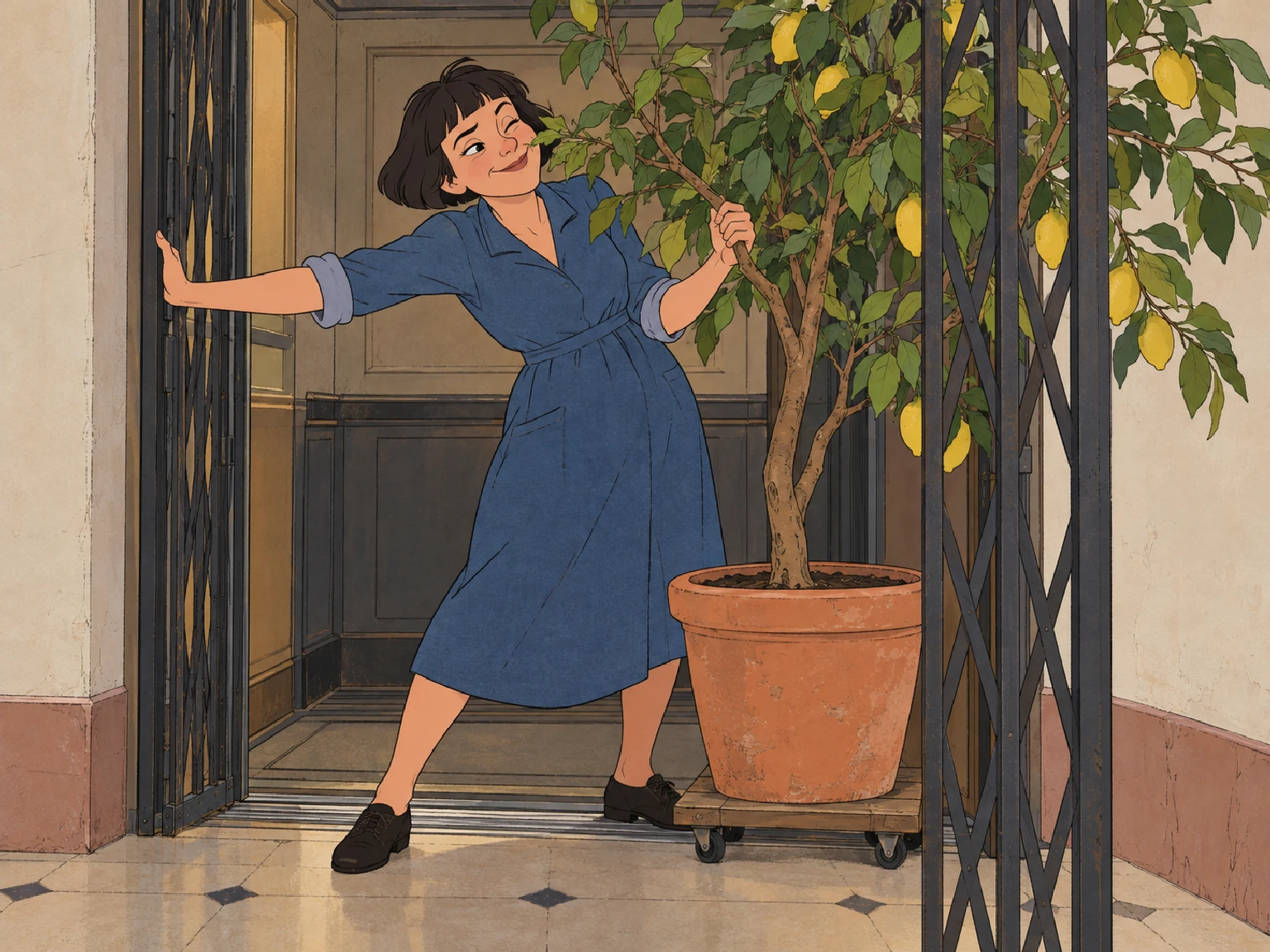
An attendant ushers a lemon tree into an old apartment lift, ducking a cheek-tickling branch amid overlapping leaves and folding ironwork.
Remix this referenceLemon Tree in the Lift
- Form language
- Build legible masses with selective angular simplification; let small secondary shapes vary within the same economical drawing language.
- Contour
- Use sketch-like contours with slight weight fluctuations, tapered stroke ends and occasional open joins.
- Mark-making
- Retain selective short doubled contour traces and broken pencil marks; intersperse broader, loose brush strokes with naturally varied pressure.
- Surface rendering
- Combine flat cel fills and a few stepped tones with lightly brushed paint fields; allow slight line-to-fill misregistration and uneven paint edges.
Priority
Rendering medium: hand-drawn 2D xerographic cel-animation illustration; formal rendering reference: Walt Disney Studios · 1960s · One Hundred and One Dalmatians (1961)
What to avoid & what to check
Exact prompt for this example
MODULE OWNERSHIP
subject: Subject count, type, stable proportions and landmarks, resting face geometry, hair shape, physical materials, garment construction and permanent marks. No emotion, movement, color assignment or rendering recipe.
expression: Facial soft-tissue displacement and pupil direction, muscle coordination, regional intensity, asymmetry and onset/peak/release. No head/body pose, stable appearance, skin color or rendering.
gesture: Head/neck/body/limb orientation, joint movement, support, contact and pose-caused occlusion using existing anatomy. No eye/pupil movement, emotion, identity, props inventory or camera.
props: Prop count, type, construction, physical material and scale relative to the subject. Holding/contact belongs to gesture, position to composition, color to palette.
scene: Environment elements, terrain, backdrop/floor presence and structural detail. No canvas positions, camera, lighting, assigned colors or render texture.
camera: Projection, focal-length impression, camera elevation/yaw/roll, viewing distance and crop. No actor pose, world placement, lighting or canvas aspect ratio.
composition: Normalized 0-100% canvas positions, scale in frame, depth/overlap, focal hierarchy and margins. No joint pose, camera projection, rendering, subject/prop inventory or emotion.
palette: Color anchors, hue/saturation/value ranges, colors assigned to parts and approximate color coverage. No illumination direction, shading algorithm, physical material or layout.
lighting: Light-source direction/softness/intensity, ambient illumination, physical shadow direction/length and highlight position. Absence of directional illumination is allowed. No shading technique, palette or material changes.
style: Reusable form abstraction, contour weight/taper/edge quality, medium and mark scale/density/direction, surface rendering and tonal transition technique. No fixed subject proportions, anatomy, identity, expression, pose, palette, light-source direction, camera or layout.
output: Image count, aspect ratio, size, file/alpha requirements and global lettering/logo/watermark restrictions. No background scenery, crop, style, identity or pose.

SUBJECT
inventory: One adult woman, actor A, and one young lemon tree without anthropomorphic features.
geometry: A has a long trunk, sturdy limbs and broad hands; the tree has a slender forked trunk and an irregular leafy crown.
resting-face: A has a broad oval face, a rounded nose, low cheekbones and a wide mouth with a shallow upper-lip bow.
appearance: A wears a woven work dress with rolled cuffs and leather shoes; her bob has a blunt fringe. The tree has leathery leaves and scattered lemons.

PRIORITY


AVOID


CHECK


EXPRESSION — ACTOR A
brows: The right brow lifts slightly; the left remains relaxed.
lids: The right lids squeeze together more than the left.
cheeks: Both cheeks lift, with a stronger bunch on the right.
nose: The nose stays relaxed without a pronounced wrinkle.
mouth: The lips part in a small crooked smile, higher at the right corner.
jaw: The jaw releases just enough for the parted lips.
gaze: Pupils turn toward the leafy branch beside her.
coordination: The uneven eye squeeze and crooked smile read as one involuntary ticklish reaction.
timing: Catch the apex of the brief reaction before the smile opens into laughter.

PRIORITY


AVOID


CHECK


GESTURE
head: A tips her head left and draws her neck back from a twig brushing her right cheek.
torso: Her torso bends sideways through the narrow gap between the tree and the gate.
limbs: Her left arm reaches to the gate, her right elbow bends around the branch, and both feet remain apart on the landing.
contact: Her left palm holds the gate open while her right hand gathers the branch; its finest twig touches her cheek.

PRIORITY


AVOID


CHECK


PROPS
inventory: One knee-high planter and one low wheeled plant dolly large enough for its base.
construction: The planter is thick terracotta with a rolled lip; the dolly is a simple timber platform on small casters.

PRIORITY


AVOID


CHECK


SCENE
inventory: An old apartment lift opening onto a tiled landing, with plaster walls and a shallow lift cabin.
structure: A partly folded lattice gate frames the entrance; worn skirting and a recessed cabin panel suggest everyday use.

PRIORITY


AVOID


CHECK


CAMERA
projection: Moderately wide perspective with natural depth and restrained edge distortion.
viewpoint: View from the landing at eye level, obliquely into the lift, with a level horizon.
crop: Include A's full figure and the complete planter; allow the highest foliage to leave the frame.

PRIORITY


AVOID


CHECK


COMPOSITION
placement: A occupies the left third and the tree spreads across the right half; the cheek-and-twig encounter is the first read.
depth: Foreground gate bars overlap outer foliage; A and the planter share the middle depth against the recessed cabin.
spacing: Keep breathing room around the face while leaves, forearm and gate interlock below; the planter anchors the lower frame.

PRIORITY


AVOID


CHECK


PALETTE
colors: Use warm ivory, dusty apricot, deep blue, sap green and lemon yellow, with charcoal-dark accents.
assignment: Ivory walls, apricot skin and planter, blue dress, green foliage, yellow fruit, and dark hair, shoes and ironwork.
balance: Pale architectural colors dominate; blue and green carry the larger colored masses, with yellow as sparse punctuation.

PRIORITY


AVOID


CHECK


LIGHTING
sources: Broad soft daylight enters from the upper left of the landing, with gentle ambient fill inside the lift.
shadows: Soft short shadows fall toward the right, with deeper contact shadows beneath the planter and shoes.
highlights: Subdued highlights touch upper-left leaf surfaces and the planter rim.

PRIORITY


AVOID


CHECK


STYLE GUIDE
form-language: Build legible masses with selective angular simplification; let small secondary shapes vary within the same economical drawing language.
contour: Use sketch-like contours with slight weight fluctuations, tapered stroke ends and occasional open joins.
mark-making: Retain selective short doubled contour traces and broken pencil marks; intersperse broader, loose brush strokes with naturally varied pressure.
surface-rendering: Combine flat cel fills and a few stepped tones with lightly brushed paint fields; allow slight line-to-fill misregistration and uneven paint edges.

PRIORITY
Rendering medium: hand-drawn 2D xerographic cel-animation illustration; formal rendering reference: Walt Disney Studios · 1960s · One Hundred and One Dalmatians (1961)

AVOID


CHECK


OUTPUT
format: One finished image, 4:3 aspect ratio, 1536 × 1152 pixels, opaque PNG; no lettering, logos or watermarks.
restrictions: One finished image, 4:3 aspect ratio, 1536 × 1152 pixels, opaque PNG; no lettering, logos or watermarks.

PRIORITY


AVOID


CHECK
Art direction
디즈니 / Walt Disney Studios · 1960s · 101마리 달마시안(1961) / One Hundred and One Dalmatians (1961) ↗- Use legible form masses with selective angular simplification
- Sketch-like contours with small weight irregularities instead of polished ink uniformity
- Retain selective short doubled contour traces and broken pencil-like marks
- Flat fills with few tonal levels and slight line-to-fill edge misregistration
Model information comes from image provenance. The same prompt may produce a different result.