Text to imageArt stylesStyle guide
One Tomato · Pointillist Optical Color Mixing
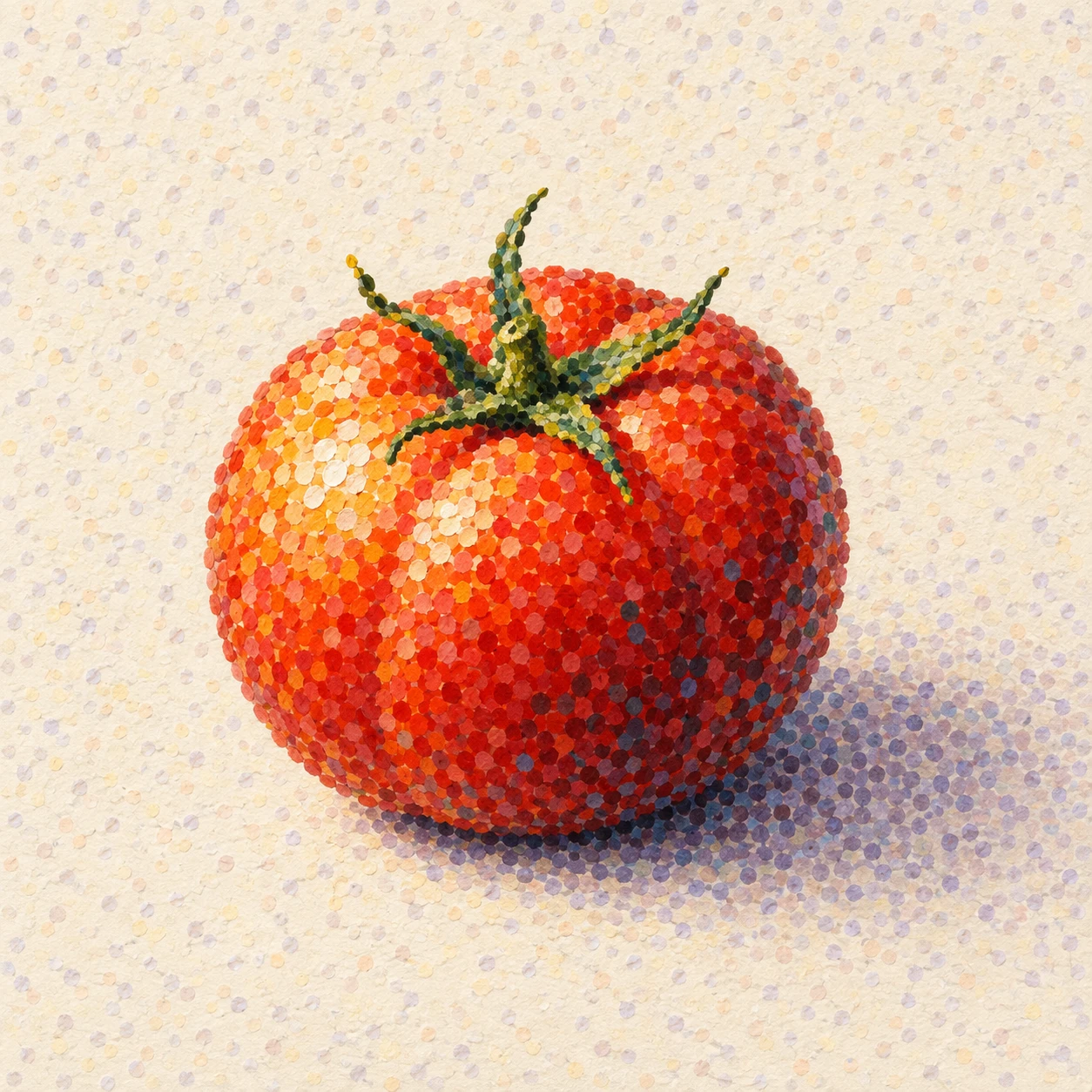
A pointillist study that builds a red tomato’s rounded form and lighting from closely spaced, separate dots of color.
One Tomato · Pointillist Optical Color Mixing
- Shape & line
- Build the tomato’s rounded silhouette from clusters of small painted dots rather than a continuous outline. Let the dots describe its shallow lobes, and shape the calyx into a few tapered green points that remain readable at a glance.
- Color & light
- Place the light at upper image-left: cluster pale yellow and orange dots on the upper-left surface, red and vermilion dots across the middle, and burgundy with sparse blue-green dots on the lower-right surface. Keep neighboring colors visibly separate so they blend optically from a distance; carry a muted violet dotted shadow from the contact point toward image-right.
- Texture & material
- Use discrete, slightly irregular opaque paint dabs on matte paper, leaving small paper gaps between them. Make the dots denser in the darker passages and more open in the light, while keeping individual marks visible instead of smearing them into smooth gradients.
- Composition
- Keep the strongest dot contrast and clearest silhouette around the tomato, then use quieter cream and pale lavender dots across the surrounding field. Compress the darkest shadow dots directly beneath the lower edge to establish contact, and spread them more loosely as the shadow extends to image-right.
Priority
Prioritize separate colored dots that merge into a rounded tomato when viewed from a distance.
What to avoid & what to check
Avoid blended gradients, black contour lines, and a uniform digital dot grid.
Check that individual color dots remain visible and the left-lit tomato rests convincingly on its rightward shadow.
Exact prompt for this example
SUBJECT
Show exactly one ripe red tomato with a small attached green calyx, resting on a pale cream tabletop. Keep its gently lobed body recognizable and its calyx connected to the top.

COMPOSITION
Use a square, slightly elevated three-quarter view. Place the whole tomato just below center, occupying roughly half the image width, with open background around it and enough tabletop to show its cast shadow extending toward image-right.

STYLE GUIDE
1. Shape & line
Build the tomato’s rounded silhouette from clusters of small painted dots rather than a continuous outline. Let the dots describe its shallow lobes, and shape the calyx into a few tapered green points that remain readable at a glance.

2. Color & light
Place the light at upper image-left: cluster pale yellow and orange dots on the upper-left surface, red and vermilion dots across the middle, and burgundy with sparse blue-green dots on the lower-right surface. Keep neighboring colors visibly separate so they blend optically from a distance; carry a muted violet dotted shadow from the contact point toward image-right.

3. Texture & material
Use discrete, slightly irregular opaque paint dabs on matte paper, leaving small paper gaps between them. Make the dots denser in the darker passages and more open in the light, while keeping individual marks visible instead of smearing them into smooth gradients.

4. Composition
Keep the strongest dot contrast and clearest silhouette around the tomato, then use quieter cream and pale lavender dots across the surrounding field. Compress the darkest shadow dots directly beneath the lower edge to establish contact, and spread them more loosely as the shadow extends to image-right.

PRIORITY
Preserve the requested identity, count, action, composition and output settings. Apply the style rules within those constraints; a style reference must not replace the subject or layout. Within the style: Prioritize separate colored dots that merge into a rounded tomato when viewed from a distance.

AVOID
Avoid blended gradients, black contour lines, and a uniform digital dot grid.

OUTPUT
Create one square image of a pointillist painting on matte paper, with no text, lettering, signature, border, or watermark.

SELF-CHECK
Check that individual color dots remain visible and the left-lit tomato rests convincingly on its rightward shadow.
Model information comes from image provenance. The same prompt may produce a different result.