Text to imageCharacterStyle guide
A Tiny Pianist Riding a Pedal
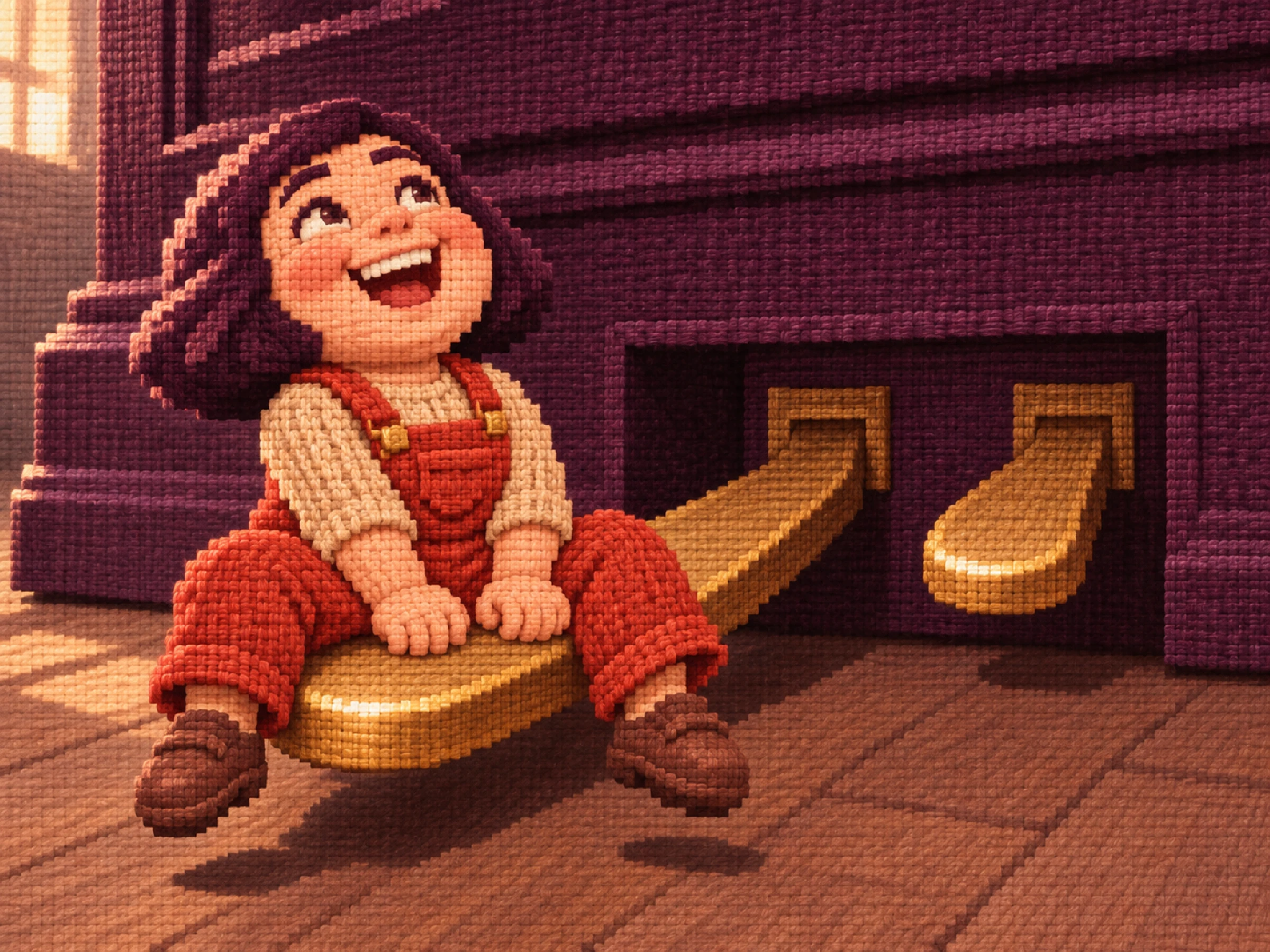
A tiny pianist sits astride an enormous piano pedal, gleefully pressing it with her weight. Woven pixel clusters and stepped edges turn a familiar practice room into an adventurous character scene.
Remix this referenceA Tiny Pianist Riding a Pedal
- Form language
- Build forms from interlocking rectangular pixel clusters, simplifying small details into woven blocks that remain legible at a glance.
- Contour
- Keep deliberate stair-step edges with occasional single-cell notches; separate shapes through cluster boundaries rather than smooth outlines.
- Mark-making
- Visible warp-and-weft crossings sit within coarse pixel units; vary thread thickness naturally without dissolving the low-resolution structure.
- Surface rendering
- Translate tonal changes into stepped bands and sparse interleaved cells, retaining a softly fibrous surface rather than airbrushed transitions.
Priority
Make woven construction and deliberate low-resolution edges equally visible.
What to avoid & what to check
Exact prompt for this example
MODULE OWNERSHIP
subject: Subject count, type, stable proportions and landmarks, resting face geometry, hair shape, physical materials, garment construction and permanent marks. No emotion, movement, color assignment or rendering recipe.
expression: Facial soft-tissue displacement and pupil direction, muscle coordination, regional intensity, asymmetry and onset/peak/release. No head/body pose, stable appearance, skin color or rendering.
gesture: Head/neck/body/limb orientation, joint movement, support, contact and pose-caused occlusion using existing anatomy. No eye/pupil movement, emotion, identity, props inventory or camera.
props: Prop count, type, construction, physical material and scale relative to the subject. Holding/contact belongs to gesture, position to composition, color to palette.
scene: Environment elements, terrain, backdrop/floor presence and structural detail. No canvas positions, camera, lighting, assigned colors or render texture.
camera: Projection, focal-length impression, camera elevation/yaw/roll, viewing distance and crop. No actor pose, world placement, lighting or canvas aspect ratio.
composition: Normalized 0-100% canvas positions, scale in frame, depth/overlap, focal hierarchy and margins. No joint pose, camera projection, rendering, subject/prop inventory or emotion.
palette: Color anchors, hue/saturation/value ranges, colors assigned to parts and approximate color coverage. No illumination direction, shading algorithm, physical material or layout.
lighting: Light-source direction/softness/intensity, ambient illumination, physical shadow direction/length and highlight position. Absence of directional illumination is allowed. No shading technique, palette or material changes.
style: Reusable form abstraction, contour weight/taper/edge quality, medium and mark scale/density/direction, surface rendering and tonal transition technique. No fixed subject proportions, anatomy, identity, expression, pose, palette, light-source direction, camera or layout.
output: Image count, aspect ratio, size, file/alpha requirements and global lettering/logo/watermark restrictions. No background scenery, crop, style, identity or pose.

SUBJECT
inventory: Actor A is one original adult woman, a miniature pianist.
geometry: She has a compact sturdy build, a broad oval head, a short nose, and large rounded hands and shoes.
resting-face: Her resting face has straight thick brows, widely spaced eyes, full cheeks, and a broad level mouth.
appearance: A blunt bob flares at the jaw; she wears woven-cloth bib overalls over a knitted shirt and soft leather shoes.

PRIORITY


AVOID


CHECK


EXPRESSION — ACTOR A
brows: Both brows lift gently, with one arch slightly higher.
lids: Upper lids open while the lower lids rise into a smiling squeeze.
cheeks: Cheeks bunch upward beneath the eyes.
nose: Nostrils remain relaxed without a nose wrinkle.
mouth: The mouth opens into a wide smile with the upper teeth visible.
jaw: The jaw drops freely with no clenched tension.
gaze: Pupils aim upward toward the piano keyboard.
coordination: Lifted cheeks and mouth corners carry the delight; the brow lift stays lighter.
timing: Catch the apex of her delight as the smile reaches its fullest opening.

PRIORITY


AVOID


CHECK


GESTURE
head: A tips her head back slightly, keeping her face open to view.
torso: She sits astride the pedal and leans back as her weight depresses it.
limbs: Her knees spread comfortably and both feet hang clear of the floor; her hands curl around the pedal edges.
contact: The pedal supports her seat and hands; its near edge partly hides the underside of her overalls.

PRIORITY


AVOID


CHECK


PROPS
inventory: No separate props.
construction: No prop construction applies.

PRIORITY


AVOID


CHECK


SCENE
inventory: An upright piano's lower cabinet, attached brass pedals, and a wooden practice-room floor.
structure: The piano has a recessed pedal opening and heavy base molding above broad floorboards. One pedal is long enough to seat A.

PRIORITY


AVOID


CHECK


CAMERA
projection: Use perspective with a moderately wide-lens impression and readable near-to-far enlargement.
viewpoint: Place the camera near floor height, oblique to the piano front, with a slight upward view and no roll.
crop: Show A's whole figure and the occupied pedal; crop the piano to its lower cabinet, keeping the keyboard outside the frame.

PRIORITY


AVOID


CHECK


COMPOSITION
placement: Set A left of center, with the occupied pedal extending diagonally from the right rear into the lower foreground.
depth: A's face leads, the pedal explains the scale, and the looming cabinet forms the deepest large mass.
spacing: Leave open floor around her feet and clear space around her face silhouette.

PRIORITY


AVOID


CHECK


PALETTE
colors: Use midnight plum, honey gold, pale peach, and bright vermilion, with muted brown as a supporting neutral.
assignment: Make the piano and hair plum, pedals gold, skin peach, overalls vermilion, and floor and shoes brown.
balance: Let dark plum establish the broad field, with the small vermilion figure and gold pedal supplying concentrated color.

PRIORITY


AVOID


CHECK


LIGHTING
sources: Soft window light arrives from the upper left, supported by low ambient room light.
shadows: The cabinet casts a broad shadow toward the right; small contact shadows secure A to the pedal.
highlights: Light catches the upper-left cheek and pedal rim, with a restrained gleam along the pedal top.

PRIORITY


AVOID


CHECK


STYLE GUIDE
form-language: Build forms from interlocking rectangular pixel clusters, simplifying small details into woven blocks that remain legible at a glance.
contour: Keep deliberate stair-step edges with occasional single-cell notches; separate shapes through cluster boundaries rather than smooth outlines.
mark-making: Visible warp-and-weft crossings sit within coarse pixel units; vary thread thickness naturally without dissolving the low-resolution structure.
surface-rendering: Translate tonal changes into stepped bands and sparse interleaved cells, retaining a softly fibrous surface rather than airbrushed transitions.

PRIORITY
Make woven construction and deliberate low-resolution edges equally visible.

AVOID


CHECK


OUTPUT
format: Deliver one finished illustration, landscape 4:3 aspect ratio, 2400 × 1800 pixels, opaque PNG.
restrictions: No lettering, logos, watermarks, borders, or interface elements.

PRIORITY


AVOID


CHECK


FINAL INTEGRATION
expression + style: Keep the facial acting readable when translated into woven clusters; finer marks may vary within that language.
gesture + scene + composition: Make the support relationship and the surprising scale understandable together in a single view.
Model information comes from image provenance. The same prompt may produce a different result.