Text to imageArt stylesStyle guide
Crab Turning the Tide Clock
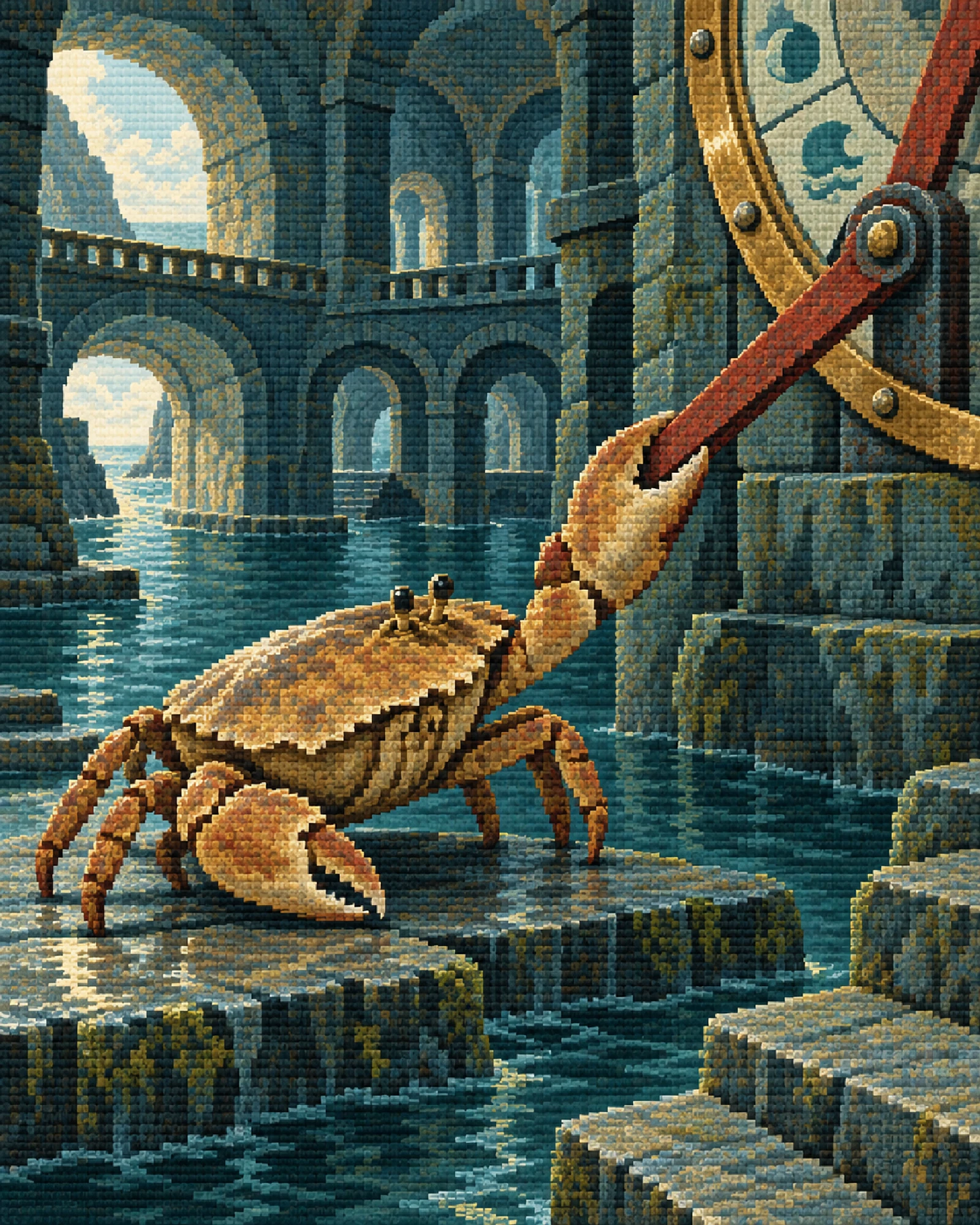
An oversized crab pulls a long operating lever inside a flooded clock chamber. Interlocking pixel bands and stepped edges give the layered setting the depth of an old tapestry.
Remix this referenceCrab Turning the Tide Clock
- Form language
- Translate forms into interlocking block clusters, using broad stepped planes for large masses and small notches for essential distinctions.
- Contour
- Build deliberate low-resolution stair-step edges; vary their runs naturally, using broken dark segments instead of continuous outlines.
- Mark-making
- Interlace short horizontal and vertical pixel bars like loose warp and weft; allow natural spacing variation and quieter passages.
- Surface rendering
- Turn tones through interwoven neighboring-value blocks with occasional skipped cells; retain crisp pixel edges without embossed thread effects.
Priority
Make the woven medium visible through pixel shapes and tonal interlacing throughout the image.
What to avoid & what to check
Exact prompt for this example
MODULE OWNERSHIP
subject: Subject count, type, stable proportions and landmarks, resting face geometry, hair shape, physical materials, garment construction and permanent marks. No emotion, movement, color assignment or rendering recipe.
expression: Facial soft-tissue displacement and pupil direction, muscle coordination, regional intensity, asymmetry and onset/peak/release. No head/body pose, stable appearance, skin color or rendering.
gesture: Head/neck/body/limb orientation, joint movement, support, contact and pose-caused occlusion using existing anatomy. No eye/pupil movement, emotion, identity, props inventory or camera.
props: Prop count, type, construction, physical material and scale relative to the subject. Holding/contact belongs to gesture, position to composition, color to palette.
scene: Environment elements, terrain, backdrop/floor presence and structural detail. No canvas positions, camera, lighting, assigned colors or render texture.
camera: Projection, focal-length impression, camera elevation/yaw/roll, viewing distance and crop. No actor pose, world placement, lighting or canvas aspect ratio.
composition: Normalized 0-100% canvas positions, scale in frame, depth/overlap, focal hierarchy and margins. No joint pose, camera projection, rendering, subject/prop inventory or emotion.
palette: Color anchors, hue/saturation/value ranges, colors assigned to parts and approximate color coverage. No illumination direction, shading algorithm, physical material or layout.
lighting: Light-source direction/softness/intensity, ambient illumination, physical shadow direction/length and highlight position. Absence of directional illumination is allowed. No shading technique, palette or material changes.
style: Reusable form abstraction, contour weight/taper/edge quality, medium and mark scale/density/direction, surface rendering and tonal transition technique. No fixed subject proportions, anatomy, identity, expression, pose, palette, light-source direction, camera or layout.
output: Image count, aspect ratio, size, file/alpha requirements and global lettering/logo/watermark restrictions. No background scenery, crop, style, identity or pose.

SUBJECT
inventory: One oversized shore crab, actor A, without clothing or additional creatures.
geometry: A broad oval carapace, paired eyestalks, compact walking legs and unequal pincers establish recognizable crab construction.
resting-face: Small eyes terminate short stalks; mouthparts sit recessed beneath the front shell rim.
appearance: A has a chitinous shell, worn pincer tips and a few irregular chips along the carapace rim.

PRIORITY


AVOID


CHECK


EXPRESSION — ACTOR A
brows: No brow action is prescribed.
lids: No eyelid action is prescribed.
cheeks: No cheek displacement is prescribed.
nose: No nasal action is prescribed.
mouth: Keep the visible mouthparts quiet, without spreading or chewing.
jaw: No visible jaw opening is prescribed.
gaze: No pupil-direction control applies to A's compound eyes.
coordination: No additional coordinated facial action is prescribed.
timing: Hold this quiet facial state at the peak of the pull.

PRIORITY


AVOID


CHECK


GESTURE
head: No independently posed head or neck applies.
torso: A braces its body low and tips the front of its shell toward the mechanism.
limbs: The larger claw reaches upward into a downward pull; the other claw and visible walking legs spread to brace.
contact: The raised pincer grips the lever end while the supporting limbs press against the stone ledge.

PRIORITY


AVOID


CHECK


PROPS
inventory: One wall-mounted tide-clock assembly, including its dial, pointer and long operating lever.
construction: A brass-ring dial wider than A's outstretched claws connects to a hardwood lever through a heavy iron pivot.

PRIORITY


AVOID


CHECK


SCENE
inventory: A sea-worn stone clock chamber contains a partially flooded floor, raised ledges, tiered galleries and an arched sea opening.
structure: Successive archways link the galleries; shallow channels divide the ledges, and broken steps descend into water.

PRIORITY


AVOID


CHECK


CAMERA
projection: Use perspective with a moderately wide focal-length impression and readable architectural recession.
viewpoint: Look obliquely across the chamber from just above ledge height, with a slight upward pitch and level roll.
crop: Keep the whole crab visible while cropping the nearest steps and part of the clock dial.

PRIORITY


AVOID


CHECK


COMPOSITION
placement: A spans about half the canvas width in the lower left; the dial occupies the upper right and extends beyond the edge.
depth: Near steps overlap the lower chamber; A precedes the clock wall, with successive galleries receding beyond both.
spacing: Make the pincer-lever junction the first read, the dial second; leave an open water interval beside the reaching claw.

PRIORITY


AVOID


CHECK


PALETTE
colors: Use deep petrol teal, muted ochre, pale celadon and a restrained brick-red accent.
assignment: Assign teal to stone and water, ochre to A and the dial ring, celadon to dial insets, and brick red to the lever.
balance: Teal occupies most of the image; ochre forms the main contrasting mass, with pale and red areas kept scarce.

PRIORITY


AVOID


CHECK


LIGHTING
sources: Broad daylight enters from the upper left; gentle ambient fill keeps the deeper galleries visible.
shadows: Soft shadows extend down and right beneath the crab, ledges and projecting mechanism.
highlights: Broad highlights touch upper-left shell ridges and ring edges; water reflections remain subdued.

PRIORITY


AVOID


CHECK


STYLE GUIDE
form-language: Translate forms into interlocking block clusters, using broad stepped planes for large masses and small notches for essential distinctions.
contour: Build deliberate low-resolution stair-step edges; vary their runs naturally, using broken dark segments instead of continuous outlines.
mark-making: Interlace short horizontal and vertical pixel bars like loose warp and weft; allow natural spacing variation and quieter passages.
surface-rendering: Turn tones through interwoven neighboring-value blocks with occasional skipped cells; retain crisp pixel edges without embossed thread effects.

PRIORITY
Make the woven medium visible through pixel shapes and tonal interlacing throughout the image.

AVOID


CHECK


OUTPUT
format: Deliver one opaque PNG illustration, 1600 × 2000 pixels, in a 4:5 aspect ratio.
restrictions: No lettering, numerals, logos or watermarks.

PRIORITY


AVOID


CHECK


FINAL INTEGRATION
gesture + props + composition: Let operating contact connect the crab and mechanism into one readable action.
style + lighting + palette: Use the woven tonal language to carry the established illumination and color relationships.
Model information comes from image provenance. The same prompt may produce a different result.