Text to imageCharacterStyle guide
Hare Signaler in the Hollow Tree
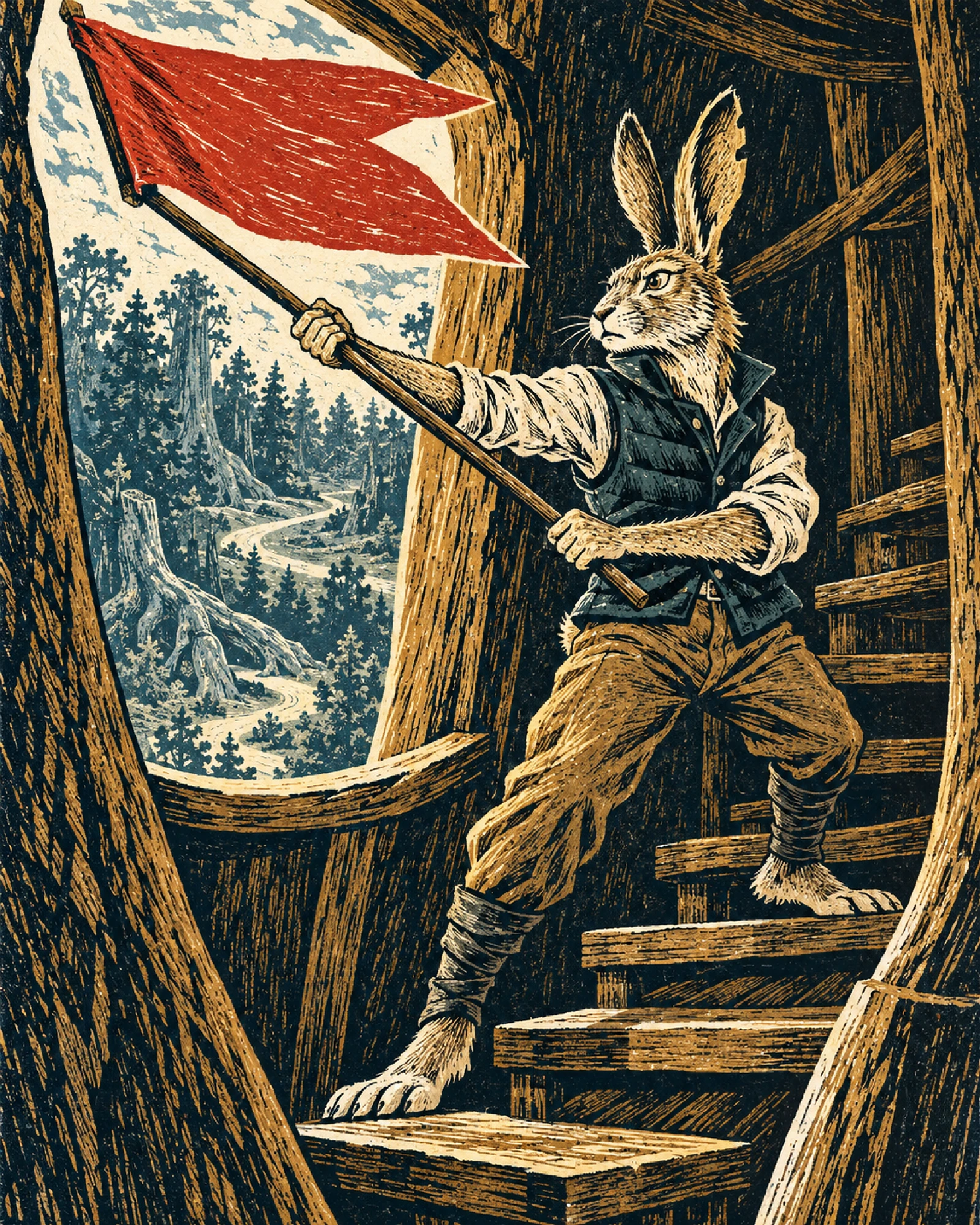
A hare signaler braces on stairs inside a hollow tree, sweeping a swallowtail flag through an open window. Bold linocut marks carry the movement through the timber interior and branching forest paths.
Remix this referenceHare Signaler in the Hollow Tree
- Form language
- Build forms from interlocking wedges and swelling arcs, simplifying small features while preserving expressive silhouettes.
- Contour
- Use bold, slightly wavering relief edges; let contours thicken, taper and occasionally break where cuts meet.
- Mark-making
- Carve rhythmic hooked gouges and short chisel dashes in changing clusters; allow individual cuts to vary naturally.
- Surface rendering
- Suggest hand-pulled linocut through uneven ink bite and exposed paper flecks; vary cut spacing to turn broad ink masses.
Priority
Preserve the force and handmade irregularity of a bold carved relief print.
What to avoid & what to check
Exact prompt for this example
MODULE OWNERSHIP
subject: Subject count, type, stable proportions and landmarks, resting face geometry, hair shape, physical materials, garment construction and permanent marks. No emotion, movement, color assignment or rendering recipe.
expression: Facial soft-tissue displacement and pupil direction, muscle coordination, regional intensity, asymmetry and onset/peak/release. No head/body pose, stable appearance, skin color or rendering.
gesture: Head/neck/body/limb orientation, joint movement, support, contact and pose-caused occlusion using existing anatomy. No eye/pupil movement, emotion, identity, props inventory or camera.
props: Prop count, type, construction, physical material and scale relative to the subject. Holding/contact belongs to gesture, position to composition, color to palette.
scene: Environment elements, terrain, backdrop/floor presence and structural detail. No canvas positions, camera, lighting, assigned colors or render texture.
camera: Projection, focal-length impression, camera elevation/yaw/roll, viewing distance and crop. No actor pose, world placement, lighting or canvas aspect ratio.
composition: Normalized 0-100% canvas positions, scale in frame, depth/overlap, focal hierarchy and margins. No joint pose, camera projection, rendering, subject/prop inventory or emotion.
palette: Color anchors, hue/saturation/value ranges, colors assigned to parts and approximate color coverage. No illumination direction, shading algorithm, physical material or layout.
lighting: Light-source direction/softness/intensity, ambient illumination, physical shadow direction/length and highlight position. Absence of directional illumination is allowed. No shading technique, palette or material changes.
style: Reusable form abstraction, contour weight/taper/edge quality, medium and mark scale/density/direction, surface rendering and tonal transition technique. No fixed subject proportions, anatomy, identity, expression, pose, palette, light-source direction, camera or layout.
output: Image count, aspect ratio, size, file/alpha requirements and global lettering/logo/watermark restrictions. No background scenery, crop, style, identity or pose.

SUBJECT
inventory: One adult anthropomorphic hare, actor A.
geometry: A compact torso, long hind feet and tall ears; one ear has a small permanent notch.
resting-face: Oval eyes sit above a wedge-shaped muzzle with broad cheek planes and a naturally split upper lip.
appearance: Short dense fur, cheek tufts, a padded wool vest with a turned collar, canvas trousers and ankle gaiters.

PRIORITY


AVOID


CHECK


EXPRESSION — ACTOR A
brows: Brow ridges draw inward, with the nearer ridge slightly lower.
lids: Upper lids lower slightly; lower lids tighten without closing the eyes.
cheeks: Cheek pads gather subtly toward the muzzle.
nose: Nostrils widen slightly without wrinkling the nose bridge.
mouth: Lips part narrowly, with firm corners and no smile.
jaw: The jaw releases just enough to support the parted lips.
gaze: Pupils aim beyond the window toward the distant forest path.
coordination: Focused eyes carry stronger tension than the mouth; keep the slight brow asymmetry.
timing: Hold the apex of concentration during the decisive signal.

PRIORITY


AVOID


CHECK


GESTURE
head: A turns the head toward the opening, neck extended slightly above the collar.
torso: The torso twists into the flag sweep while the hips remain braced over the stairs.
limbs: The left arm extends outward, the right elbow draws toward the ribs, and hind feet brace on separate treads.
contact: Both hands grip the staff apart during an upward sweep; the cloth trails the motion.

PRIORITY


AVOID


CHECK


PROPS
inventory: One signal flag on a staff longer than the hare's torso.
construction: A plain wooden staff carries a broad wool flag with a deep swallowtail cut.

PRIORITY


AVOID


CHECK


SCENE
inventory: A hollow-tree lookout with an internal stair, an open lookout window and forest paths beyond.
structure: Thick curved trunk walls enclose irregular timber treads; root buttresses divide the paths outside.

PRIORITY


AVOID


CHECK


CAMERA
projection: Moderately wide perspective with restrained depth exaggeration.
viewpoint: Look from just below chest height at a three-quarter angle, with no camera roll.
crop: A full-figure environmental view; nearby trunk walls continue beyond the image edges.

PRIORITY


AVOID


CHECK


COMPOSITION
placement: A occupies the right middle at roughly two-thirds frame height; the flag spans the upper-left opening.
depth: Foreground stair edges overlap the lower figure; the window reveals receding paths between layered trunks.
spacing: The face and gripping hands lead, then the flag; leave open space around the ears and a gap beneath the cloth.

PRIORITY


AVOID


CHECK


PALETTE
colors: Deep petrol, warm ivory, muted ochre and a concentrated vermilion accent.
assignment: Petrol unites vest and forest; ivory defines fur and sky, ochre the timber, and vermilion the flag.
balance: Petrol and ivory dominate; ochre bridges them while vermilion remains the smallest, most saturated family.

PRIORITY


AVOID


CHECK


LIGHTING
sources: Broad soft daylight enters from the upper left through the lookout opening, with gentle ambient fill.
shadows: Cast shadows fall down and right, extending behind the stair treads.
highlights: Light catches the upper-left ear edges, muzzle ridge and exposed knuckles.

PRIORITY


AVOID


CHECK


STYLE GUIDE
form-language: Build forms from interlocking wedges and swelling arcs, simplifying small features while preserving expressive silhouettes.
contour: Use bold, slightly wavering relief edges; let contours thicken, taper and occasionally break where cuts meet.
mark-making: Carve rhythmic hooked gouges and short chisel dashes in changing clusters; allow individual cuts to vary naturally.
surface-rendering: Suggest hand-pulled linocut through uneven ink bite and exposed paper flecks; vary cut spacing to turn broad ink masses.

PRIORITY
Preserve the force and handmade irregularity of a bold carved relief print.

AVOID


CHECK


OUTPUT
format: One finished image, portrait 4:5, 1600 × 2000 pixels, opaque PNG.
restrictions: No lettering, logos, signatures or watermarks.

PRIORITY


AVOID


CHECK


FINAL INTEGRATION
gesture + composition: Keep the signaling action legible through the layered setting, with clear separation at essential contacts.
expression + style: Simplify facial marks without losing the coordinated acting; incidental cuts may vary.
Model information comes from image provenance. The same prompt may produce a different result.