Text to imageIllustrationStyle guide
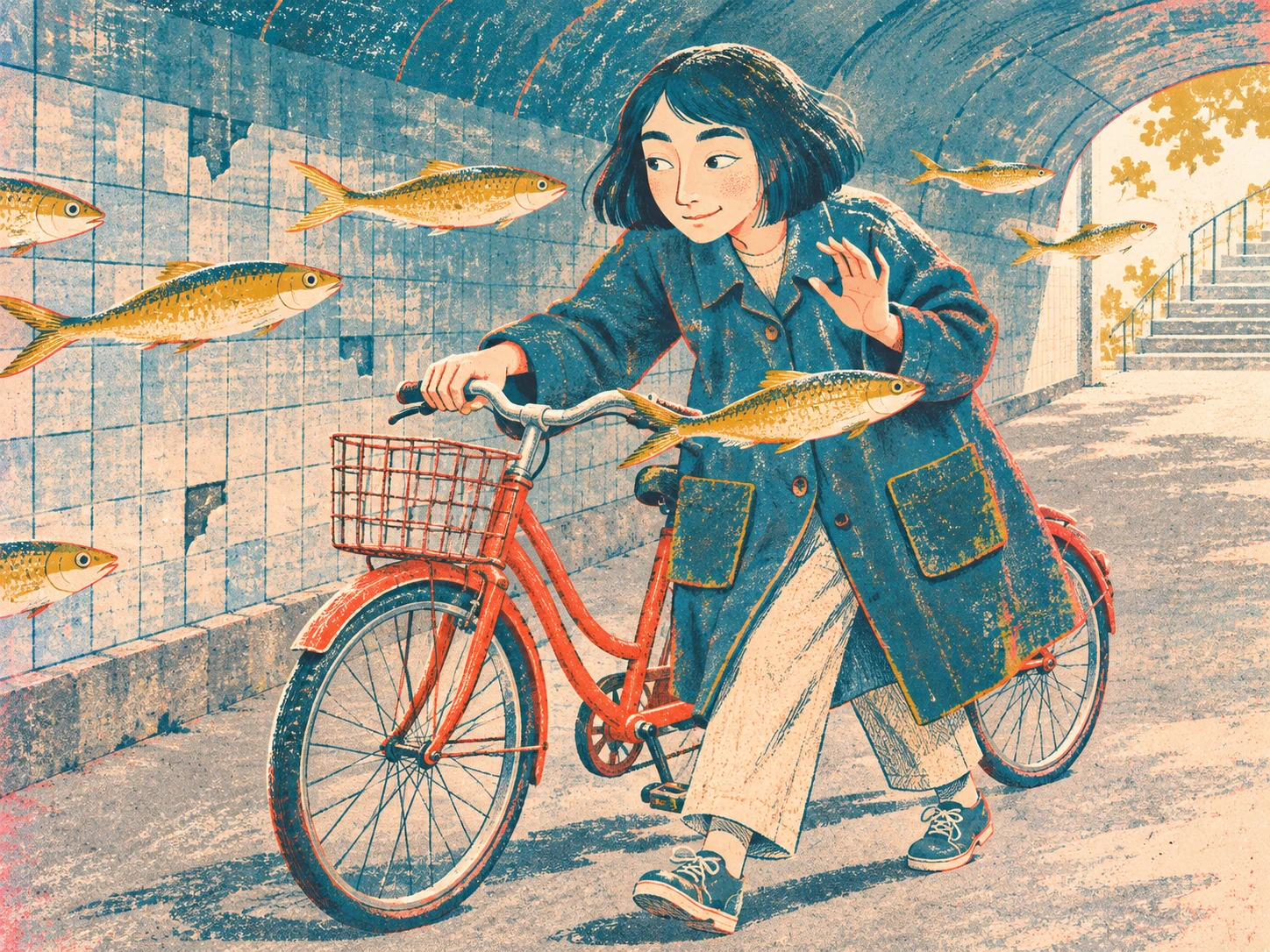
Wheeling a Bicycle Through Floating Herring
A woman wheels her bicycle through floating herring in a dry pedestrian tunnel. Overlapping fish and wheels, grainy ink, and playful registration offsets transform an ordinary commute into a lively riso illustration.
Remix this referenceWheeling a Bicycle Through Floating Herring
- Form language
- Reduce forms to supple cut-stencil masses and selective interior notches; let small shapes vary within the same handmade vocabulary.
- Contour
- Alternate ink-defined edges with broken, slightly blunt contour strokes; small registration offsets leave playful doubled edges.
- Mark-making
- Use uneven riso grain, loose short hatching, and occasional roller streaks; vary the marks naturally instead of repeating a texture stamp.
- Surface rendering
- Build tone through translucent ink overlaps and porous halftone patches, retaining paper breaks and imperfect ink density.
Priority
Make grain, overprinting, and playful registration offsets visibly define the riso treatment.
What to avoid & what to check
Exact prompt for this example
MODULE OWNERSHIP
subject: Subject count, type, stable proportions and landmarks, resting face geometry, hair shape, physical materials, garment construction and permanent marks. No emotion, movement, color assignment or rendering recipe.
expression: Facial soft-tissue displacement and pupil direction, muscle coordination, regional intensity, asymmetry and onset/peak/release. No head/body pose, stable appearance, skin color or rendering.
gesture: Head/neck/body/limb orientation, joint movement, support, contact and pose-caused occlusion using existing anatomy. No eye/pupil movement, emotion, identity, props inventory or camera.
props: Prop count, type, construction, physical material and scale relative to the subject. Holding/contact belongs to gesture, position to composition, color to palette.
scene: Environment elements, terrain, backdrop/floor presence and structural detail. No canvas positions, camera, lighting, assigned colors or render texture.
camera: Projection, focal-length impression, camera elevation/yaw/roll, viewing distance and crop. No actor pose, world placement, lighting or canvas aspect ratio.
composition: Normalized 0-100% canvas positions, scale in frame, depth/overlap, focal hierarchy and margins. No joint pose, camera projection, rendering, subject/prop inventory or emotion.
palette: Color anchors, hue/saturation/value ranges, colors assigned to parts and approximate color coverage. No illumination direction, shading algorithm, physical material or layout.
lighting: Light-source direction/softness/intensity, ambient illumination, physical shadow direction/length and highlight position. Absence of directional illumination is allowed. No shading technique, palette or material changes.
style: Reusable form abstraction, contour weight/taper/edge quality, medium and mark scale/density/direction, surface rendering and tonal transition technique. No fixed subject proportions, anatomy, identity, expression, pose, palette, light-source direction, camera or layout.
output: Image count, aspect ratio, size, file/alpha requirements and global lettering/logo/watermark restrictions. No background scenery, crop, style, identity or pose.

SUBJECT
inventory: One adult woman, actor A, and a small school of ordinary herring; no other people.
geometry: A has a long nose and small chin; the herring have slender bodies, pointed snouts, and forked tails.
resting-face: A has thick, gently arched brows, almond-shaped eyes, and a narrow upper lip.
appearance: A has a blunt bob, a cotton coat with broad patch pockets, trousers, and lace-up shoes; herring have fine scales.

PRIORITY


AVOID


CHECK


EXPRESSION — ACTOR A
brows: One outer brow lifts slightly; the inner brows stay loose.
lids: Upper lids remain relaxed; one lower lid rises faintly.
cheeks: A small cheek lift begins on the smiling side.
nose: The nose stays relaxed, without wrinkling or nostril flare.
mouth: Closed lips form a small uneven smile, with one corner rising first.
jaw: The jaw remains loose beneath lightly touching lips.
gaze: Both pupils turn left toward the nearest herring.
coordination: The slight brow lift accompanies the uneven smile without widening the eyes.
timing: Catch the onset: the mouth corner has risen before the cheek lift fully develops.

PRIORITY


AVOID


CHECK


GESTURE
head: A dips her head slightly beneath the passing fish, keeping her face turned toward the viewer's side.
torso: Her torso inclines forward as she walks beside the bicycle.
limbs: One foot advances; her right arm guides the bicycle and her left palm opens near her chest. Fish tails flex gently.
contact: Her right hand grips the handlebar; the bicycle tires and supporting foot meet the floor. Her left hand clears the fish.

PRIORITY


AVOID


CHECK


PROPS
inventory: One everyday city bicycle, sized for A, with an integrated front basket.
construction: A step-through steel frame, rubber tires, simple mudguards, and an open wire basket.

PRIORITY


AVOID


CHECK


SCENE
inventory: A dry pedestrian underpass with tiled walls, a concrete floor, and an open exit.
structure: The tunnel has a shallow barrel vault, a low wall curb, and occasional missing tiles; there is no water.

PRIORITY


AVOID


CHECK


CAMERA
projection: Natural perspective with a normal-lens impression and modest depth compression.
viewpoint: View from standing eye height, obliquely across the tunnel, with a level horizon.
crop: A medium-wide view includes the complete woman and bicycle, with only part of the surrounding tunnel.

PRIORITY


AVOID


CHECK


COMPOSITION
placement: A is near 60% canvas width; the bicycle spans the lower middle, while the exit opens in the upper right.
depth: A's face leads, followed by the fish ribbon and bicycle; foreground fish overlap her coat and parts of the frame.
spacing: Leave breathing room around the face; stagger fish through broad gaps, with a few silhouettes cut by the left edge.

PRIORITY


AVOID


CHECK


PALETTE
colors: Use petrol blue, lively vermilion, warm mustard, and pale cream, with clear value separation.
assignment: Petrol blue anchors the coat, hair, and tunnel; vermilion marks the bicycle; mustard animates the fish; cream carries skin and open areas.
balance: Cream and blue occupy broad areas; the warmer hues appear as concentrated accents, with darker mixtures at overlaps.

PRIORITY


AVOID


CHECK


LIGHTING
sources: Broad, soft daylight arrives from the upper right, with gentle ambient illumination throughout the tunnel.
shadows: Short, soft shadows fall toward the lower left beneath the woman, bicycle, and nearby fish.
highlights: Restrained highlights touch the light-facing cheek, fish backs, and upper handlebar edges.

PRIORITY


AVOID


CHECK


STYLE GUIDE
form-language: Reduce forms to supple cut-stencil masses and selective interior notches; let small shapes vary within the same handmade vocabulary.
contour: Alternate ink-defined edges with broken, slightly blunt contour strokes; small registration offsets leave playful doubled edges.
mark-making: Use uneven riso grain, loose short hatching, and occasional roller streaks; vary the marks naturally instead of repeating a texture stamp.
surface-rendering: Build tone through translucent ink overlaps and porous halftone patches, retaining paper breaks and imperfect ink density.

PRIORITY
Make grain, overprinting, and playful registration offsets visibly define the riso treatment.

AVOID


CHECK


OUTPUT
format: No separate format attribute applies.
restrictions: One finished illustration, landscape 4:3, 2400 × 1800 pixels, opaque PNG; no lettering, logos, or watermarks.

PRIORITY


AVOID


CHECK


FINAL INTEGRATION
style + composition: Let the print irregularities enrich the overlaps while preserving separation between the principal silhouettes.
expression + gesture: Keep the facial response and bodily action part of the same lightly interrupted moment.
composition + lighting: Align the daylight direction with the exit established by composition.
Model information comes from image provenance. The same prompt may produce a different result.