Text to imageCharacterStyle guide
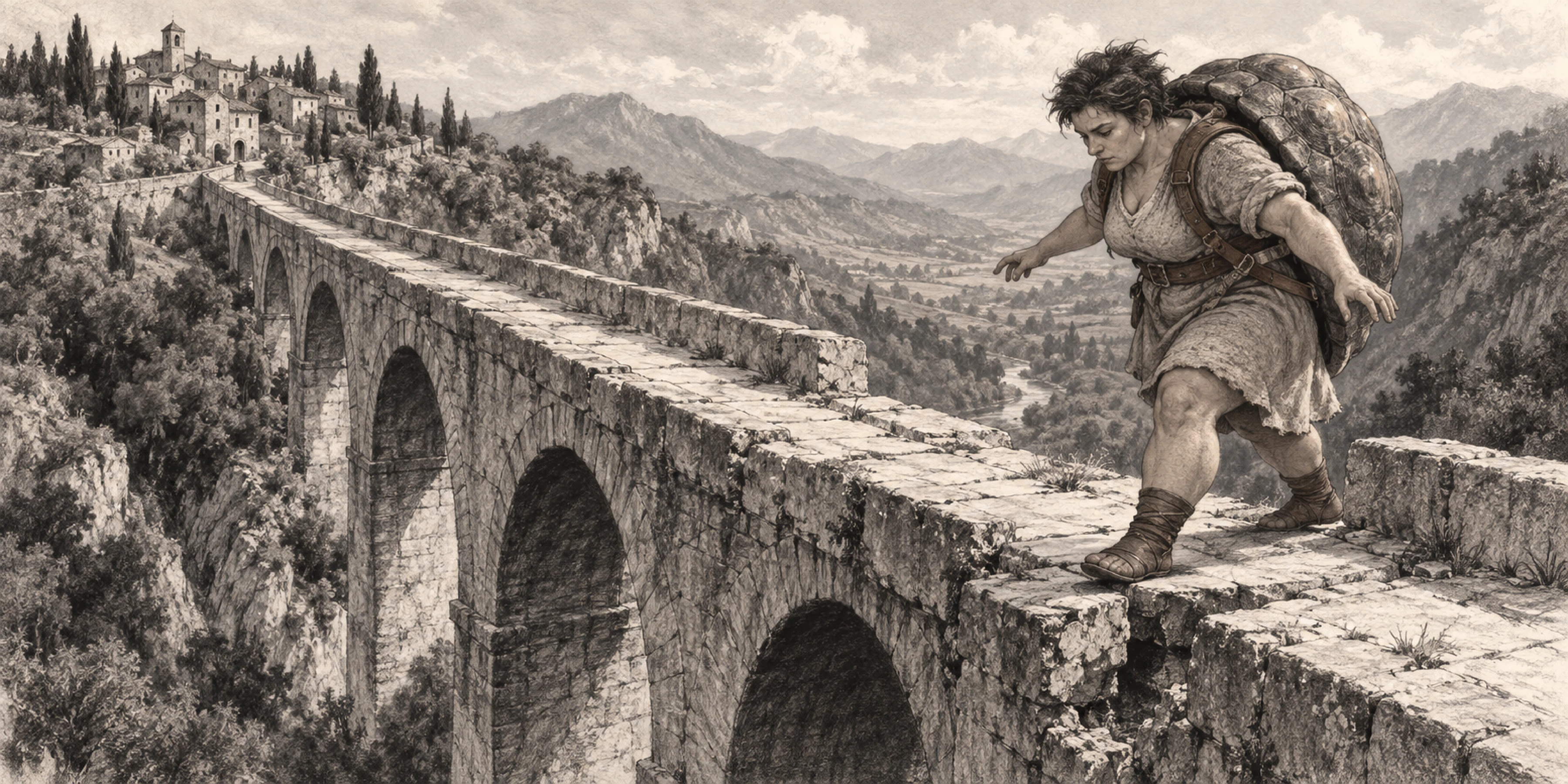
Tortoise Woman Crossing the Aqueduct
A tortoise woman crosses a broken joint in an old aqueduct on her way to a mountain village. Rubbed charcoal and erased light reveal her weight and the length of the journey.
Remix this referenceTortoise Woman Crossing the Aqueduct
- Form language
- Build observed volumes from weighted masses and selectively described planes; let small irregularities resist diagrammatic simplification.
- Contour
- Use searching, broken charcoal edges that thicken at pressure points and dissolve where neighboring tones meet.
- Mark-making
- Combine broad side-of-stick strokes, directional hatching and finger-smudged passages; allow revisions to remain faintly visible.
- Surface rendering
- Rub middle tones into the paper tooth, deepen selected passages with compressed charcoal and lift light with soft, irregular erasures.
Priority
Keep observational charcoal visibly tactile through smudged mass, searching edges and erased light.
What to avoid & what to check
Exact prompt for this example
MODULE OWNERSHIP
subject: Subject count, type, stable proportions and landmarks, resting face geometry, hair shape, physical materials, garment construction and permanent marks. No emotion, movement, color assignment or rendering recipe.
expression: Facial soft-tissue displacement and pupil direction, muscle coordination, regional intensity, asymmetry and onset/peak/release. No head/body pose, stable appearance, skin color or rendering.
gesture: Head/neck/body/limb orientation, joint movement, support, contact and pose-caused occlusion using existing anatomy. No eye/pupil movement, emotion, identity, props inventory or camera.
props: Prop count, type, construction, physical material and scale relative to the subject. Holding/contact belongs to gesture, position to composition, color to palette.
scene: Environment elements, terrain, backdrop/floor presence and structural detail. No canvas positions, camera, lighting, assigned colors or render texture.
camera: Projection, focal-length impression, camera elevation/yaw/roll, viewing distance and crop. No actor pose, world placement, lighting or canvas aspect ratio.
composition: Normalized 0-100% canvas positions, scale in frame, depth/overlap, focal hierarchy and margins. No joint pose, camera projection, rendering, subject/prop inventory or emotion.
palette: Color anchors, hue/saturation/value ranges, colors assigned to parts and approximate color coverage. No illumination direction, shading algorithm, physical material or layout.
lighting: Light-source direction/softness/intensity, ambient illumination, physical shadow direction/length and highlight position. Absence of directional illumination is allowed. No shading technique, palette or material changes.
style: Reusable form abstraction, contour weight/taper/edge quality, medium and mark scale/density/direction, surface rendering and tonal transition technique. No fixed subject proportions, anatomy, identity, expression, pose, palette, light-source direction, camera or layout.
output: Image count, aspect ratio, size, file/alpha requirements and global lettering/logo/watermark restrictions. No background scenery, crop, style, identity or pose.

SUBJECT
inventory: One original adult tortoise woman, actor A, with a human face and an integrated dorsal shell.
geometry: A compact human build, sturdy legs and a high domed shell establish a recognizable traveling silhouette.
resting-face: A broad jaw, low straight brows, deep-set eyes and a softly projecting lower lip define her face.
appearance: Her short wiry hair, scuted keratin shell, wool tunic and open-backed leather harness share a worn, practical character.

PRIORITY


AVOID


CHECK


EXPRESSION — ACTOR A
brows: Brows draw inward slightly without a deep central furrow.
lids: Lower lids tighten gently beneath attentive upper lids.
cheeks: Cheeks remain settled, without a smile lift.
nose: Nostrils remain neutral and the nose bridge stays smooth.
mouth: Lips meet in a soft, slightly compressed line.
jaw: The jaw firms lightly without exaggerated clenching.
gaze: Pupils settle downward toward the next secure foothold.
coordination: Small, balanced tensions convey practiced concentration rather than strain.
timing: Hold the quiet apex of concentration during the crossing.

PRIORITY


AVOID


CHECK


GESTURE
head: Her chin dips and her neck extends just enough to inspect the step.
torso: The torso inclines forward to counter the shell's rearward weight.
limbs: The leading leg reaches across the broken joint while the arms open slightly for balance.
contact: The rear foot supports her on intact stone as the leading toes first meet the opposite ledge.

PRIORITY


AVOID


CHECK


PROPS
inventory: No separate props.
construction: No prop construction applies.

PRIORITY


AVOID


CHECK


SCENE
inventory: A disused stone aqueduct crosses a steep valley toward a small mountain village, with scrub and exposed rock below.
structure: The dry channel has low parapets, repeated supporting arches and one narrow broken joint; its far end joins a village lane.

PRIORITY


AVOID


CHECK


CAMERA
projection: Use a gently wide perspective with restrained edge expansion.
viewpoint: Look diagonally along the aqueduct from slightly above its walking surface, with no camera roll.
crop: Include her entire figure within a panoramic view that follows the crossing to its distant destination.

PRIORITY


AVOID


CHECK


COMPOSITION
placement: Place the woman in the right third at nearly half the frame height; the aqueduct leads toward the upper-left village.
depth: Her silhouette overlaps the nearest parapet; successive arches diminish into the valley, making her the primary focus.
spacing: Leave open valley around her upper silhouette and a long uninterrupted interval between her and the village.

PRIORITY


AVOID


CHECK


PALETTE
colors: Use paper ivory, charcoal gray and deep black within a nearly neutral range.
assignment: Mid-grays describe shell and stone; deep black anchors hair and arch interiors; ivory remains in sky and exposed planes.
balance: Let pale and middle values dominate, with concentrated dark accents and gentle value separation in the distance.

PRIORITY


AVOID


CHECK


LIGHTING
sources: Broad, soft daylight comes from the upper right with abundant open-sky fill.
shadows: Soft shadows fall leftward beneath her body and the parapets; the arches retain deeper shade.
highlights: The shell crown, upper cheek and upward-facing stone edges receive the clearest light.

PRIORITY


AVOID


CHECK


STYLE GUIDE
form-language: Build observed volumes from weighted masses and selectively described planes; let small irregularities resist diagrammatic simplification.
contour: Use searching, broken charcoal edges that thicken at pressure points and dissolve where neighboring tones meet.
mark-making: Combine broad side-of-stick strokes, directional hatching and finger-smudged passages; allow revisions to remain faintly visible.
surface-rendering: Rub middle tones into the paper tooth, deepen selected passages with compressed charcoal and lift light with soft, irregular erasures.

PRIORITY
Keep observational charcoal visibly tactile through smudged mass, searching edges and erased light.

AVOID


CHECK


OUTPUT
format: One finished image, panoramic 2:1, 3600 × 1800 pixels, opaque PNG.
restrictions: No lettering, logos or watermarks.

PRIORITY


AVOID


CHECK


FINAL INTEGRATION
subject + gesture: Let the character's established construction inform the visible balance of the crossing.
scene + composition + camera: Make the environment readable as a continuous journey while retaining a legible character performance.
lighting + style: Use the medium's additive and subtractive methods to interpret the established illumination.
Model information comes from image provenance. The same prompt may produce a different result.