Text to imageAnimationStyle guide
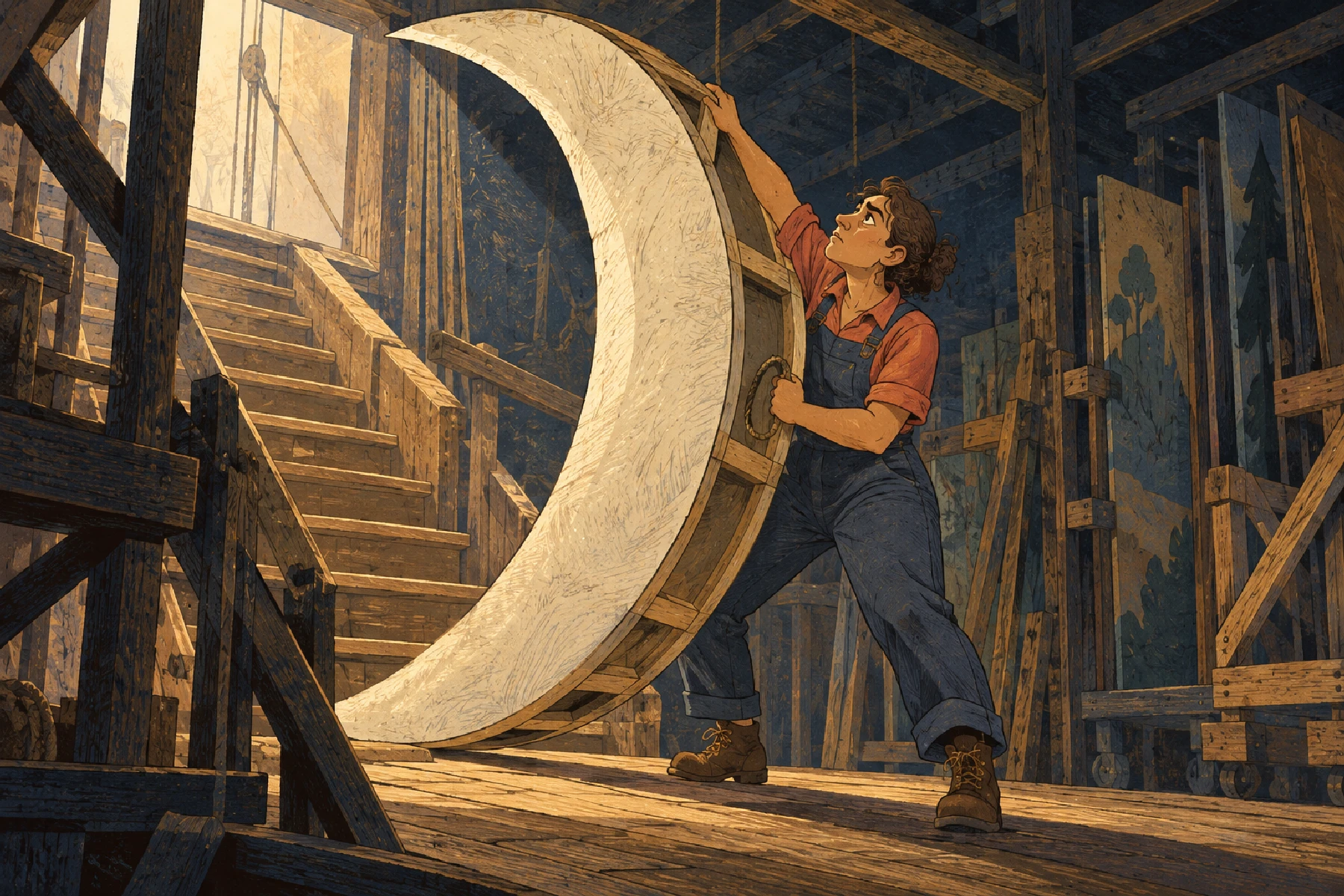
A Stagehand Lowering a Crescent Moon
Beneath a theatre stage, a stagehand eases a large crescent moon through a trapdoor. Its exposed framework and layers of stored scenery reveal the quiet labor after a performance.
Remix this referenceA Stagehand Lowering a Crescent Moon
- Form language
- Abstract forms into interlocking angular planes, allowing long curves to break into a few uneven facets.
- Contour
- Use slightly irregular carved contours: firm straight runs, blunt corners and occasional thin gaps where edges loosen.
- Mark-making
- Short parallel hatch groups follow individual planes; restrained scratches vary naturally in length and spacing.
- Surface rendering
- Build flat printed planes with lightly broken ink and limited paper grain; use hatched tonal regions instead of continuous modeling.
Priority
Rendering medium: 2D woodcut-print animated-film illustration; formal rendering reference: Cartoon Saloon · 2020s · Wolfwalkers (2020), town sequences
What to avoid & what to check
Exact prompt for this example
MODULE OWNERSHIP
subject: Subject count, type, stable proportions and landmarks, resting face geometry, hair shape, physical materials, garment construction and permanent marks. No emotion, movement, color assignment or rendering recipe.
expression: Facial soft-tissue displacement and pupil direction, muscle coordination, regional intensity, asymmetry and onset/peak/release. No head/body pose, stable appearance, skin color or rendering.
gesture: Head/neck/body/limb orientation, joint movement, support, contact and pose-caused occlusion using existing anatomy. No eye/pupil movement, emotion, identity, props inventory or camera.
props: Prop count, type, construction, physical material and scale relative to the subject. Holding/contact belongs to gesture, position to composition, color to palette.
scene: Environment elements, terrain, backdrop/floor presence and structural detail. No canvas positions, camera, lighting, assigned colors or render texture.
camera: Projection, focal-length impression, camera elevation/yaw/roll, viewing distance and crop. No actor pose, world placement, lighting or canvas aspect ratio.
composition: Normalized 0-100% canvas positions, scale in frame, depth/overlap, focal hierarchy and margins. No joint pose, camera projection, rendering, subject/prop inventory or emotion.
palette: Color anchors, hue/saturation/value ranges, colors assigned to parts and approximate color coverage. No illumination direction, shading algorithm, physical material or layout.
lighting: Light-source direction/softness/intensity, ambient illumination, physical shadow direction/length and highlight position. Absence of directional illumination is allowed. No shading technique, palette or material changes.
style: Reusable form abstraction, contour weight/taper/edge quality, medium and mark scale/density/direction, surface rendering and tonal transition technique. No fixed subject proportions, anatomy, identity, expression, pose, palette, light-source direction, camera or layout.
output: Image count, aspect ratio, size, file/alpha requirements and global lettering/logo/watermark restrictions. No background scenery, crop, style, identity or pose.

SUBJECT
inventory: One adult human stagehand, actor A; no other figures.
geometry: A has a sturdy build, broad hands, a long rectangular face, a wedge-shaped nose and prominent ears.
resting-face: Straight brows, shallow upper-lid folds and a broad mouth with a slightly fuller lower lip define the resting face.
appearance: Short clustered curls, canvas bib overalls over a rolled-sleeve shirt, and leather work boots; no permanent markings.

PRIORITY


AVOID


CHECK


EXPRESSION — ACTOR A
brows: Inner brows draw down and inward, slightly more strongly on the left.
lids: Upper lids lower slightly while lower lids tighten without closing the eyes.
cheeks: Cheeks remain mostly slack, with slight tension beside the mouth.
nose: Nostrils widen subtly; the bridge stays unwrinkled.
mouth: Lips press together, with the left corner tucked inward.
jaw: The jaw stays closed with modest tension beneath the ears.
gaze: Pupils track the crescent's upper tip.
coordination: Brow and lid tension carry the effort; the mouth stays restrained.
timing: Hold the apex of sustained concentration, before the lips release.

PRIORITY


AVOID


CHECK


GESTURE
head: A lifts her chin and turns her head toward the descending crescent, keeping her face visible.
torso: She leans sideways beneath the inner curve, shoulders uneven and torso counterbalancing its weight.
limbs: Both knees flex; one arm reaches high while the other bends close to her chest.
contact: One palm guides the upper horn, the other grips a handle; her shoulder supports the inner curve and both boots bear on the landing.

PRIORITY


AVOID


CHECK


PROPS
inventory: One theatrical crescent moon, somewhat taller than A.
construction: A thin plywood face is supported by exposed timber ribs, with two rope loop handles attached to the frame.

PRIORITY


AVOID


CHECK


SCENE
inventory: A theatre understage workshop with ceiling joists, an open stage trapdoor, timber stairs and racks of stored scenic panels.
structure: The stairs connect a broad landing to the stage opening; irregular panel edges and cross-braces make the workshop feel used.

PRIORITY


AVOID


CHECK


CAMERA
projection: Moderate wide-angle perspective with readable depth and restrained near-field enlargement.
viewpoint: View across the landing from slightly below A's waist, with a gentle upward pitch and level roll.
crop: An environmental full-figure view includes the whole crescent; foreground braces are cropped at the frame edges, while nearby joists and scenic panels may be cropped.

PRIORITY


AVOID


CHECK


COMPOSITION
placement: A occupies the lower-right region near 65% width; the crescent sweeps through the middle toward the upper-left opening.
depth: Foreground braces overlap distant panel racks; A and the crescent share the clear middle layer.
spacing: The supporting gesture leads, followed by the crescent and workshop depth; leave breathing room around the hands and face.

PRIORITY


AVOID


CHECK


PALETTE
colors: Use soot blue, weathered ochre, chalk cream and a small muted coral accent.
assignment: Soot blue clothes the overalls and recesses; ochre belongs to timber and skin, cream to the moon, coral to the shirt.
balance: Keep most hues subdued and values broadly separated; cream provides the largest pale interval.

PRIORITY


AVOID


CHECK


LIGHTING
sources: Broad stage light falls through the opening from above-left, with weak ambient light throughout the workshop.
shadows: Soft-edged shadows fall down and right; the crescent casts a broad curved shadow across the landing.
highlights: Upper-left edges of the face, hands and crescent receive broad highlights with no sharp glints.

PRIORITY


AVOID


CHECK


STYLE GUIDE
form-language: Abstract forms into interlocking angular planes, allowing long curves to break into a few uneven facets.
contour: Use slightly irregular carved contours: firm straight runs, blunt corners and occasional thin gaps where edges loosen.
mark-making: Short parallel hatch groups follow individual planes; restrained scratches vary naturally in length and spacing.
surface-rendering: Build flat printed planes with lightly broken ink and limited paper grain; use hatched tonal regions instead of continuous modeling.

PRIORITY
Rendering medium: 2D woodcut-print animated-film illustration; formal rendering reference: Cartoon Saloon · 2020s · Wolfwalkers (2020), town sequences

AVOID


CHECK


OUTPUT
format: One finished image, landscape 3:2, 1800 × 1200 pixels, opaque PNG.
restrictions: No lettering, logos or watermarks.

PRIORITY


AVOID


CHECK


FINAL INTEGRATION
gesture + composition + props: Let the prop's construction and the supporting contact remain legible within the layered arrangement.
lighting + style: Translate the physical light into the specified printed tonal language while retaining its directional clarity.
Art direction
카툰 살롱 / Cartoon Saloon · 2020s · 울프워커스(2020)의 도시 장면 / Wolfwalkers (2020), town sequences ↗- Transfer the angular planar abstraction of the town sequences to generic form surfaces
- Slightly irregular straight and angular contours resembling carved lines
- Short parallel hatch groups and restrained scratched marks
- Flat planes with limited paper texture and hatched tonal regions, without continuous modeling
Model information comes from image provenance. The same prompt may produce a different result.