Text to imageLandscapeStyle guide
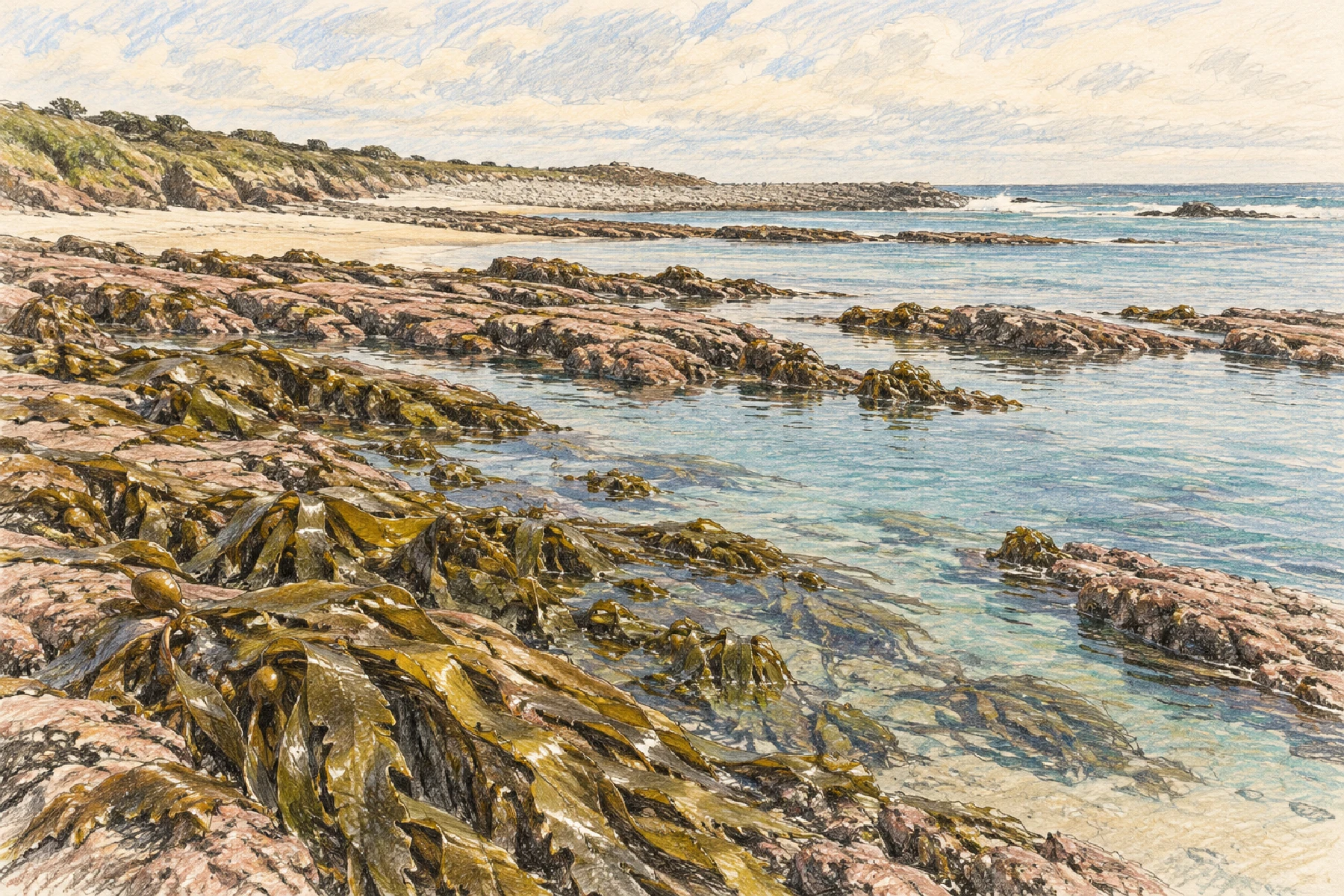
Kelp Beds at Low Tide
An exposed kelp bed and spacious tidal pools, drawn with searching pencil lines and loosely layered colored pencil.
Remix this referenceKelp Beds at Low Tide
- Form language
- Reduce complex masses to interlocking ribbons and broken slabs, keeping local irregularities rather than diagrammatic repetition.
- Contour
- Use searching graphite contours with doubled passages, blunt pressure changes and occasional edges lost into the paper.
- Mark-making
- Lay colored pencil in loose directional strokes; let broad side-rubbing alternate with a few wiry, sharply pressed accents.
- Surface rendering
- Let paper tooth interrupt pigment layers; build tone through uneven overlaps and lift small passages with visible eraser scuffs.
Priority
Preserve the rough pencil and colored-pencil sketchbook character throughout the finished drawing.
What to avoid & what to check
Exact prompt for this example
MODULE OWNERSHIP
subject: Subject count, type, stable proportions and landmarks, resting face geometry, hair shape, physical materials, garment construction and permanent marks. No emotion, movement, color assignment or rendering recipe.
expression: Facial soft-tissue displacement and pupil direction, muscle coordination, regional intensity, asymmetry and onset/peak/release. No head/body pose, stable appearance, skin color or rendering.
gesture: Head/neck/body/limb orientation, joint movement, support, contact and pose-caused occlusion using existing anatomy. No eye/pupil movement, emotion, identity, props inventory or camera.
props: Prop count, type, construction, physical material and scale relative to the subject. Holding/contact belongs to gesture, position to composition, color to palette.
scene: Environment elements, terrain, backdrop/floor presence and structural detail. No canvas positions, camera, lighting, assigned colors or render texture.
camera: Projection, focal-length impression, camera elevation/yaw/roll, viewing distance and crop. No actor pose, world placement, lighting or canvas aspect ratio.
composition: Normalized 0-100% canvas positions, scale in frame, depth/overlap, focal hierarchy and margins. No joint pose, camera projection, rendering, subject/prop inventory or emotion.
palette: Color anchors, hue/saturation/value ranges, colors assigned to parts and approximate color coverage. No illumination direction, shading algorithm, physical material or layout.
lighting: Light-source direction/softness/intensity, ambient illumination, physical shadow direction/length and highlight position. Absence of directional illumination is allowed. No shading technique, palette or material changes.
style: Reusable form abstraction, contour weight/taper/edge quality, medium and mark scale/density/direction, surface rendering and tonal transition technique. No fixed subject proportions, anatomy, identity, expression, pose, palette, light-source direction, camera or layout.
output: Image count, aspect ratio, size, file/alpha requirements and global lettering/logo/watermark restrictions. No background scenery, crop, style, identity or pose.

SUBJECT
inventory: An extensive kelp bed is the living subject; no people or animals.
geometry: Broad straplike blades join flexible stems with occasional bulbous floats and knotted holdfasts.
resting-face: No faces or facial geometry apply.
appearance: Leathery blades have irregular edges and occasional natural tears; individual plants may vary.

PRIORITY


AVOID


CHECK


PROPS
inventory: No separate props.
construction: No prop construction applies.

PRIORITY


AVOID


CHECK


SCENE
inventory: A low-tide coast with a ribbed rock shelf, shallow connected pools, wet sand and open sea.
structure: Rock ribs divide the pools into long irregular channels; a shingle spit encloses part of the bay.

PRIORITY


AVOID


CHECK


CAMERA
projection: Natural perspective with a moderately wide lens impression and restrained distance compression.
viewpoint: Look obliquely across the shore from a low bluff, with a gentle downward view and level roll.
crop: Use a broad landscape view; crop the nearest rock shelf while retaining the distant shoreline.

PRIORITY


AVOID


CHECK


COMPOSITION
placement: Concentrate kelp around the lower-left third; let a broad pool open across the right half.
depth: Overlapping kelp and rock lead toward smaller exposed shelves, then the distant spit and sea.
spacing: Make the kelp-pool boundary the main focus, with generous open water and an uninterrupted upper sky margin.

PRIORITY


AVOID


CHECK


PALETTE
colors: Use brass olive, dusty turquoise, muted rose and graphite, supported by warm ivory.
assignment: Assign olive to kelp, turquoise to pools, rose to exposed rock, and ivory to sky and sand.
balance: Keep most colors subdued and light; reserve the deepest graphite values for the kelp and rock crevices.

PRIORITY


AVOID


CHECK


LIGHTING
sources: Broad, soft daylight enters from the upper right beneath a thin cloud cover.
shadows: Rock ribs cast short, soft shadows toward the lower left; recesses retain gentle ambient light.
highlights: Small wet highlights catch the upper-right edges of blades and the exposed lips of pools.

PRIORITY


AVOID


CHECK


STYLE GUIDE
form-language: Reduce complex masses to interlocking ribbons and broken slabs, keeping local irregularities rather than diagrammatic repetition.
contour: Use searching graphite contours with doubled passages, blunt pressure changes and occasional edges lost into the paper.
mark-making: Lay colored pencil in loose directional strokes; let broad side-rubbing alternate with a few wiry, sharply pressed accents.
surface-rendering: Let paper tooth interrupt pigment layers; build tone through uneven overlaps and lift small passages with visible eraser scuffs.

PRIORITY
Preserve the rough pencil and colored-pencil sketchbook character throughout the finished drawing.

AVOID


CHECK


OUTPUT
format: One opaque PNG image, landscape 3:2, 1800 × 1200 pixels.
restrictions: No lettering, logos, signatures or watermarks.

PRIORITY


AVOID


CHECK


FINAL INTEGRATION
subject + scene + style: Keep botanical and geological forms recognizable while allowing the drawing language to simplify their detail.
Model information comes from image provenance. The same prompt may produce a different result.