Text to imageArt stylesStyle guide
A Crab Sheltering in a Heelprint
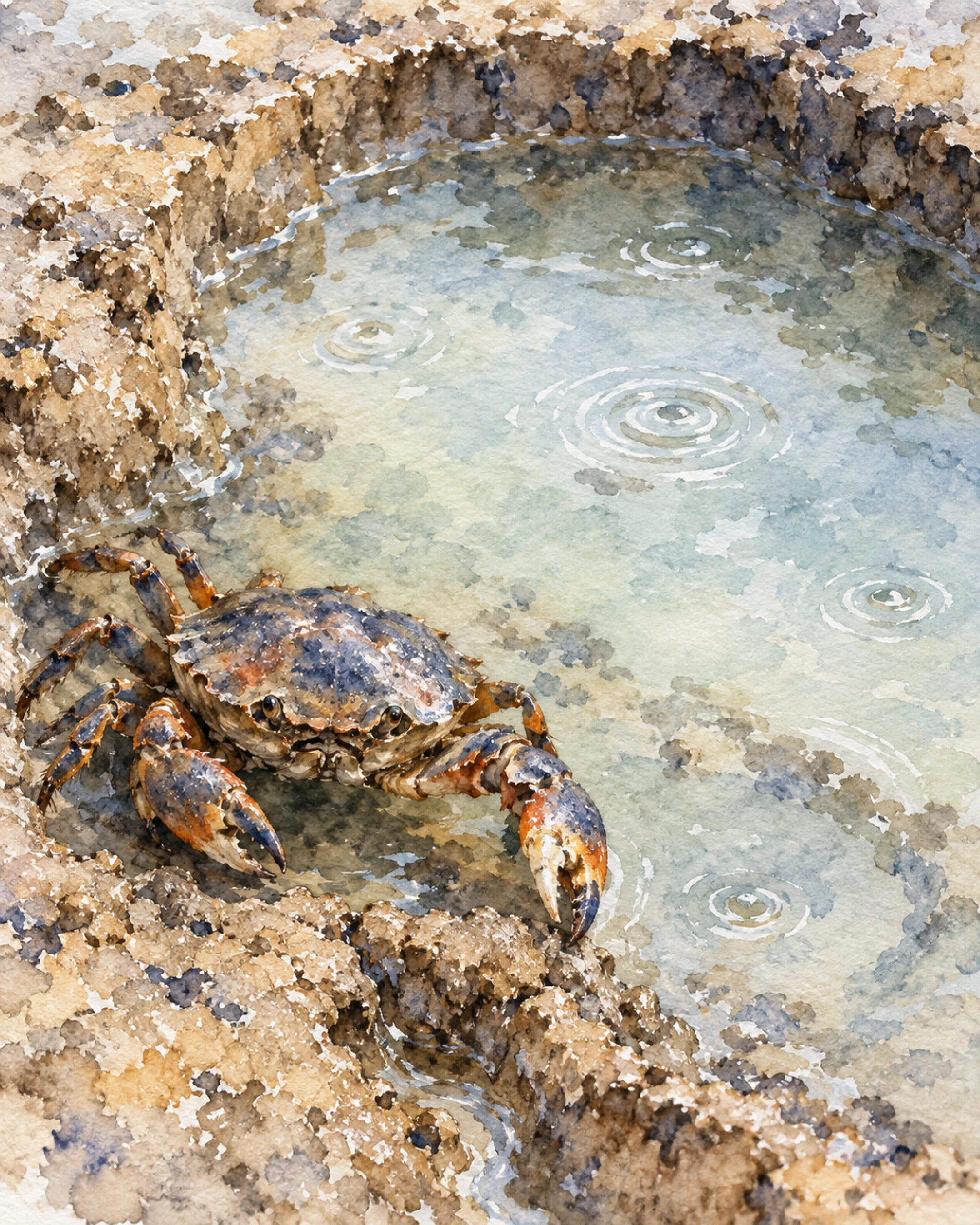
An intimate watercolor of a crab sheltering in a water-filled heelprint, its firm shell surrounded by blooming reflections and broken mud edges.
Remix this referenceA Crab Sheltering in a Heelprint
- Form language
- Reduce forms to interlocking wash masses, retaining a few firm landmarks while allowing minor shapes to dissolve.
- Contour
- Alternate crisp pigment rims with broken dry-brush edges and lost boundaries instead of enclosing every shape.
- Mark-making
- Interrupt broad wet strokes with sparse tapered touches; let blooms spread unevenly through damp passages.
- Surface rendering
- Build transparent watercolor layers with pooled pigment, soft backruns and exposed paper, preserving natural variation.
Priority
Make expressive watercolor blooms and broken edges integral to the finished image.
What to avoid & what to check
Exact prompt for this example
MODULE OWNERSHIP
subject: Subject count, type, stable proportions and landmarks, resting face geometry, hair shape, physical materials, garment construction and permanent marks. No emotion, movement, color assignment or rendering recipe.
expression: Facial soft-tissue displacement and pupil direction, muscle coordination, regional intensity, asymmetry and onset/peak/release. No head/body pose, stable appearance, skin color or rendering.
gesture: Head/neck/body/limb orientation, joint movement, support, contact and pose-caused occlusion using existing anatomy. No eye/pupil movement, emotion, identity, props inventory or camera.
props: Prop count, type, construction, physical material and scale relative to the subject. Holding/contact belongs to gesture, position to composition, color to palette.
scene: Environment elements, terrain, backdrop/floor presence and structural detail. No canvas positions, camera, lighting, assigned colors or render texture.
camera: Projection, focal-length impression, camera elevation/yaw/roll, viewing distance and crop. No actor pose, world placement, lighting or canvas aspect ratio.
composition: Normalized 0-100% canvas positions, scale in frame, depth/overlap, focal hierarchy and margins. No joint pose, camera projection, rendering, subject/prop inventory or emotion.
palette: Color anchors, hue/saturation/value ranges, colors assigned to parts and approximate color coverage. No illumination direction, shading algorithm, physical material or layout.
lighting: Light-source direction/softness/intensity, ambient illumination, physical shadow direction/length and highlight position. Absence of directional illumination is allowed. No shading technique, palette or material changes.
style: Reusable form abstraction, contour weight/taper/edge quality, medium and mark scale/density/direction, surface rendering and tonal transition technique. No fixed subject proportions, anatomy, identity, expression, pose, palette, light-source direction, camera or layout.
output: Image count, aspect ratio, size, file/alpha requirements and global lettering/logo/watermark restrictions. No background scenery, crop, style, identity or pose.

SUBJECT
inventory: One small shore crab, actor A.
geometry: A broad, low carapace, compact paired claws and jointed walking legs establish a recognizable shore crab.
resting-face: Short eyestalks and a small mouthpart cluster form simple facial landmarks; individual pupils are indistinct.
appearance: The hard shell has shallow pits and worn claw tips; minor shell irregularities may vary naturally.

PRIORITY


AVOID


CHECK


EXPRESSION — ACTOR A
brows: Brow movement is inapplicable; leave this channel unprescribed.
lids: Lid displacement is inapplicable; add no squinting or widening.
cheeks: Cheek displacement is inapplicable; leave this channel unprescribed.
nose: Nasal contraction is inapplicable; leave this channel unprescribed.
mouth: Visible mouthparts remain at rest without conspicuous opening or clenching.
jaw: No separate jaw displacement is prescribed.
gaze: Pupil direction remains unresolved; no readable gaze shift is prescribed.
coordination: Keep the visible mouthparts quiet without adding humanlike facial acting.
timing: Hold a neutral resting instant with no facial onset or release cue.

PRIORITY


AVOID


CHECK


GESTURE
head: No separate head turn; the front follows the body's slight lean toward the footprint rim.
torso: Keep the body low over the shallow water, turned across the length of the hollow.
limbs: Walking legs spread in a braced stance; one claw rises while the other stays near the shell.
contact: Several feet press into the soft floor, and the raised claw lightly hooks the muddy rim.

PRIORITY


AVOID


CHECK


PROPS
inventory: No separate props.
construction: No prop construction applies.

PRIORITY


AVOID


CHECK


SCENE
inventory: A rain-filled heelprint in tidal mud, with a shallow pool, crumbling rim and a few rain rings.
structure: The rounded heel basin narrows into an incomplete sole impression; tiny channels connect it to surrounding mud.

PRIORITY


AVOID


CHECK


CAMERA
projection: Natural close-focus perspective with a mild macro-lens impression.
viewpoint: Look steeply downward at a slight oblique angle, revealing the shallow basin wall.
crop: Crop tightly through the footprint perimeter; keep the shell complete while distant leg tips may leave frame.

PRIORITY


AVOID


CHECK


COMPOSITION
placement: Set the crab in the lower-left area, its shell the focal point beneath the sweeping footprint rim.
depth: The near mud lip overlaps a few feet; water opens behind the shell before meeting the far rim.
spacing: Reserve generous uninterrupted water above and to the right, balancing the compact crab and mud.

PRIORITY


AVOID


CHECK


PALETTE
colors: Use smoky indigo, clay ochre, muted rust and pale celadon as the principal anchors.
assignment: Assign rust and indigo to the crab, ochre to mud, and celadon with indigo traces to water.
balance: Pale water occupies the largest area; the crab carries the deepest darks and a restrained warm accent.

PRIORITY


AVOID


CHECK


LIGHTING
sources: Broad overcast daylight arrives from the upper left with generous ambient fill.
shadows: Short, soft shadows gather beneath the crab and along the lower-right side of the mud rim.
highlights: Small highlights touch the upper-left shell ridge and a few exposed water surfaces.

PRIORITY


AVOID


CHECK


STYLE GUIDE
form-language: Reduce forms to interlocking wash masses, retaining a few firm landmarks while allowing minor shapes to dissolve.
contour: Alternate crisp pigment rims with broken dry-brush edges and lost boundaries instead of enclosing every shape.
mark-making: Interrupt broad wet strokes with sparse tapered touches; let blooms spread unevenly through damp passages.
surface-rendering: Build transparent watercolor layers with pooled pigment, soft backruns and exposed paper, preserving natural variation.

PRIORITY
Make expressive watercolor blooms and broken edges integral to the finished image.

AVOID


CHECK


OUTPUT
format: One finished image, portrait 4:5, 2048 × 2560 pixels, opaque PNG.
restrictions: No lettering, logos or watermarks.

PRIORITY


AVOID


CHECK


FINAL INTEGRATION
style + subject: Let descriptive landmarks survive the freer passages so the medium and subject remain equally legible.
Model information comes from image provenance. The same prompt may produce a different result.