Text to imageProductStyle guide
Bellows Beside the Hillside Kiln
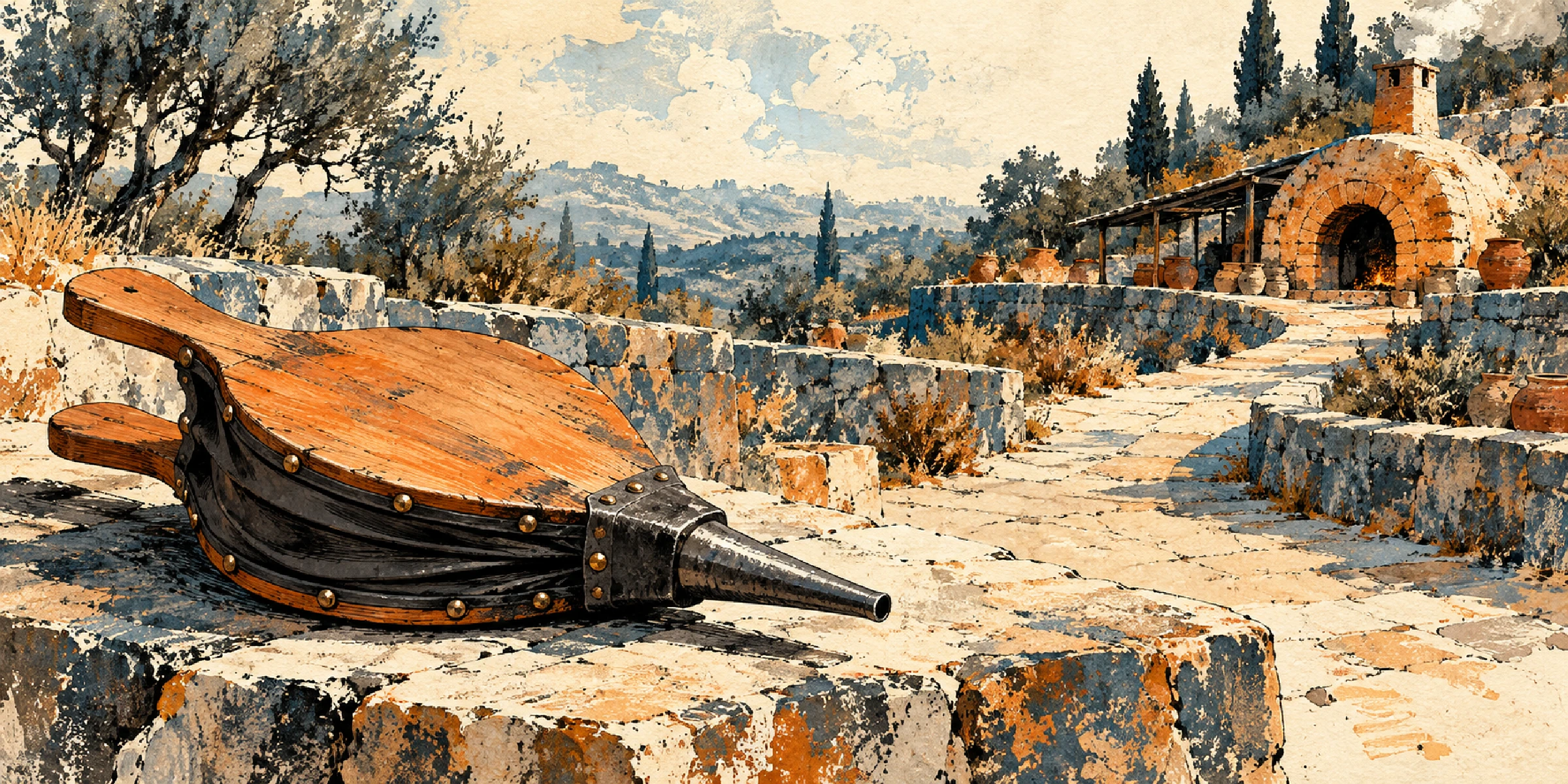
An experimental ink-and-print product illustration leads from leather bellows along a curving ramp to a hillside kiln.
Remix this referenceBellows Beside the Hillside Kiln
- Form language
- Simplify volumes into broad cut shapes, retaining a few descriptive internal divisions and slight handmade asymmetry.
- Contour
- Combine blunt brush-ink edges with occasional wiry nib lines; let contours thicken, break, and resume.
- Mark-making
- Use dragged ink, scraped interruptions, and loosely registered print layers; mark direction follows each surface's broad sweep.
- Surface rendering
- Build tone with translucent overprints and broken ink deposits, allowing paper to breathe through uneven transitions.
Priority
Make the meeting of fluid brush ink and imperfect print layers visibly define the image.
What to avoid & what to check
Exact prompt for this example
MODULE OWNERSHIP
subject: Subject count, type, stable proportions and landmarks, resting face geometry, hair shape, physical materials, garment construction and permanent marks. No emotion, movement, color assignment or rendering recipe.
expression: Facial soft-tissue displacement and pupil direction, muscle coordination, regional intensity, asymmetry and onset/peak/release. No head/body pose, stable appearance, skin color or rendering.
gesture: Head/neck/body/limb orientation, joint movement, support, contact and pose-caused occlusion using existing anatomy. No eye/pupil movement, emotion, identity, props inventory or camera.
props: Prop count, type, construction, physical material and scale relative to the subject. Holding/contact belongs to gesture, position to composition, color to palette.
scene: Environment elements, terrain, backdrop/floor presence and structural detail. No canvas positions, camera, lighting, assigned colors or render texture.
camera: Projection, focal-length impression, camera elevation/yaw/roll, viewing distance and crop. No actor pose, world placement, lighting or canvas aspect ratio.
composition: Normalized 0-100% canvas positions, scale in frame, depth/overlap, focal hierarchy and margins. No joint pose, camera projection, rendering, subject/prop inventory or emotion.
palette: Color anchors, hue/saturation/value ranges, colors assigned to parts and approximate color coverage. No illumination direction, shading algorithm, physical material or layout.
lighting: Light-source direction/softness/intensity, ambient illumination, physical shadow direction/length and highlight position. Absence of directional illumination is allowed. No shading technique, palette or material changes.
style: Reusable form abstraction, contour weight/taper/edge quality, medium and mark scale/density/direction, surface rendering and tonal transition technique. No fixed subject proportions, anatomy, identity, expression, pose, palette, light-source direction, camera or layout.
output: Image count, aspect ratio, size, file/alpha requirements and global lettering/logo/watermark restrictions. No background scenery, crop, style, identity or pose.

SUBJECT
inventory: One original hand bellows designed as a compact workshop product.
geometry: A broad pear-shaped chamber narrows into a short spout; two integral paddle grips extend from its rounded end.
resting-face: No face-bearing subjects.
appearance: Maple boards enclose a folded leather gusset, with a tapered steel spout and small brass attachment studs.

PRIORITY


AVOID


CHECK


PROPS
inventory: No separate props.
construction: No prop construction applies.

PRIORITY


AVOID


CHECK


SCENE
inventory: An outdoor pottery yard with a masonry ledge, a winding paved ramp, and a kiln embedded in a hillside.
structure: Retaining walls divide the sloping yard into terraces; the kiln has an arched firing opening and a squat chimney.

PRIORITY


AVOID


CHECK


CAMERA
projection: Moderately wide perspective with a natural 35 mm lens impression.
viewpoint: Look gently downward from ledge height, with a three-quarter view revealing the bellows' top and pleated side.
crop: Include the complete bellows and the kiln; let the yard continue beyond both lateral frame edges.

PRIORITY


AVOID


CHECK


COMPOSITION
placement: Anchor the bellows in the lower-left third at roughly 40% of canvas width; place the kiln toward the far right.
depth: The bellows leads the hierarchy; the ramp threads through overlapping terraces to the smaller, distant kiln.
spacing: Leave an open middle stretch along the ramp so the visual journey has a spacious pause.

PRIORITY


AVOID


CHECK


PALETTE
colors: Use soot black, burnt orange, faded petrol blue, and warm paper cream.
assignment: Orange marks the boards and kiln masonry; black defines leather; blue carries the terraces; cream opens the yard and sky.
balance: Cream remains broadly present, with concentrated black and orange around the product and softer blue elsewhere.

PRIORITY


AVOID


CHECK


LIGHTING
sources: Soft afternoon light enters from the upper right, balanced by open-sky ambient illumination.
shadows: Broad shadows extend toward the lower left beneath the bellows and along the retaining walls.
highlights: The upper board rim and spout shoulder receive restrained highlights.

PRIORITY


AVOID


CHECK


STYLE GUIDE
form-language: Simplify volumes into broad cut shapes, retaining a few descriptive internal divisions and slight handmade asymmetry.
contour: Combine blunt brush-ink edges with occasional wiry nib lines; let contours thicken, break, and resume.
mark-making: Use dragged ink, scraped interruptions, and loosely registered print layers; mark direction follows each surface's broad sweep.
surface-rendering: Build tone with translucent overprints and broken ink deposits, allowing paper to breathe through uneven transitions.

PRIORITY
Make the meeting of fluid brush ink and imperfect print layers visibly define the image.

AVOID


CHECK


OUTPUT
format: One finished image, panoramic 2:1, 2400 × 1200 pixels, opaque PNG.
restrictions: No lettering, logos, signatures, or watermarks.

PRIORITY


AVOID


CHECK
Model information comes from image provenance. The same prompt may produce a different result.