Text to imageCalligraphyStyle guide
Bramble Brush Lettering
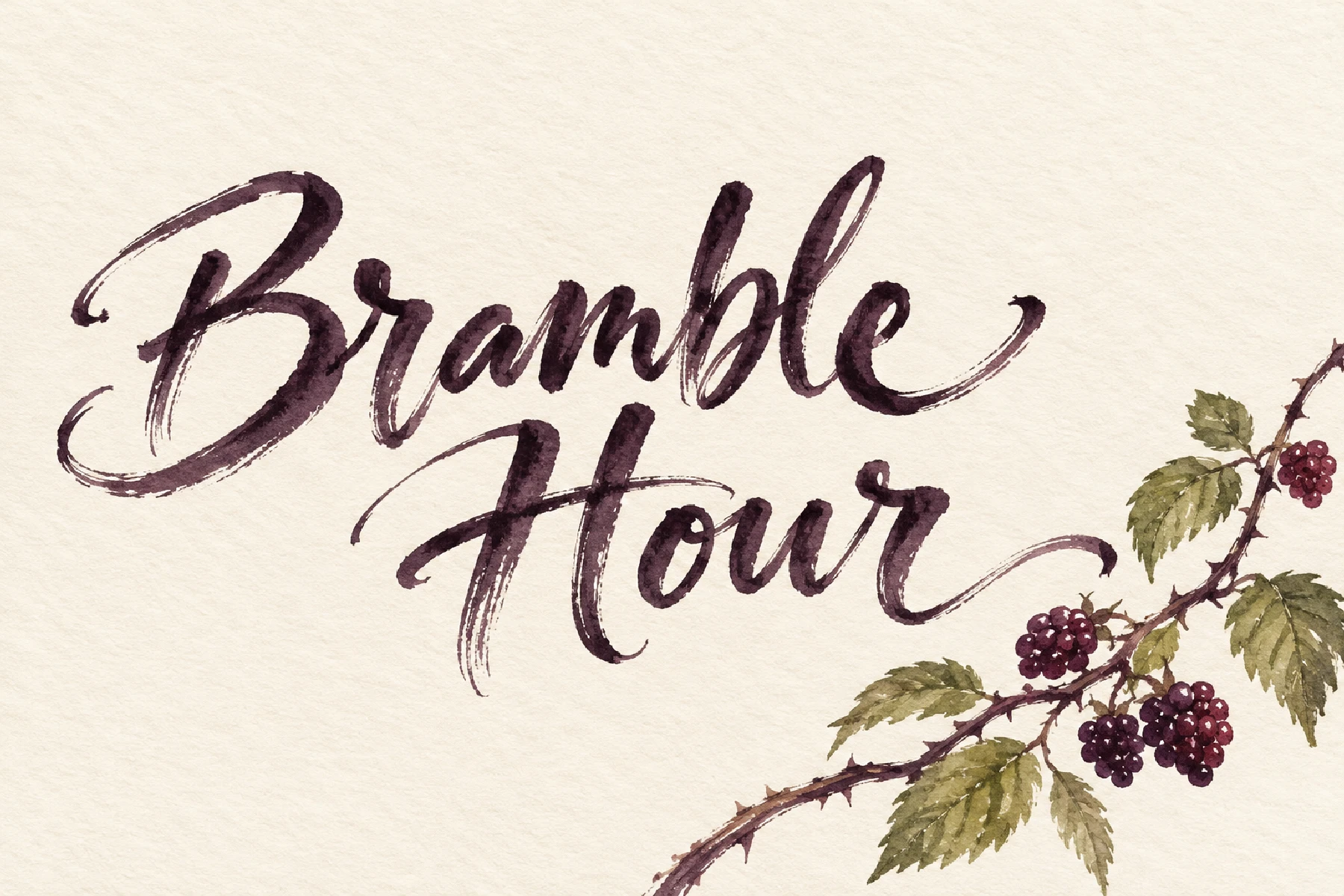
Two staggered lines of brush lettering meet a blackberry cane entering from the edge. Spacious paper surrounds weighty ink strokes and fine, bristled releases.
Remix this referenceBramble Brush Lettering
- Form language
- Use buoyant brush-script forms with compact joins and generous loops; simplify organic forms into a few broad brush silhouettes.
- Contour
- Let pressure swell strokes into blunt shoulders, then release into tapered, split-bristle edges.
- Mark-making
- Alternate loaded sweeps with quick dry drags and economical dabs, allowing natural variation within the same brush vocabulary.
- Surface rendering
- Let pooled ink, translucent thinning and occasional feathered absorption coexist; retain paper through broken strokes instead of adding uniform texture.
Priority
Emphasize brush calligraphy with expressive variation in ink density and stroke pressure.
What to avoid & what to check
Exact prompt for this example
MODULE OWNERSHIP
subject: Subject count, type, stable proportions and landmarks, resting face geometry, hair shape, physical materials, garment construction and permanent marks. No emotion, movement, color assignment or rendering recipe.
expression: Facial soft-tissue displacement and pupil direction, muscle coordination, regional intensity, asymmetry and onset/peak/release. No head/body pose, stable appearance, skin color or rendering.
gesture: Head/neck/body/limb orientation, joint movement, support, contact and pose-caused occlusion using existing anatomy. No eye/pupil movement, emotion, identity, props inventory or camera.
props: Prop count, type, construction, physical material and scale relative to the subject. Holding/contact belongs to gesture, position to composition, color to palette.
scene: Environment elements, terrain, backdrop/floor presence and structural detail. No canvas positions, camera, lighting, assigned colors or render texture.
camera: Projection, focal-length impression, camera elevation/yaw/roll, viewing distance and crop. No actor pose, world placement, lighting or canvas aspect ratio.
composition: Normalized 0-100% canvas positions, scale in frame, depth/overlap, focal hierarchy and margins. No joint pose, camera projection, rendering, subject/prop inventory or emotion.
palette: Color anchors, hue/saturation/value ranges, colors assigned to parts and approximate color coverage. No illumination direction, shading algorithm, physical material or layout.
lighting: Light-source direction/softness/intensity, ambient illumination, physical shadow direction/length and highlight position. Absence of directional illumination is allowed. No shading technique, palette or material changes.
style: Reusable form abstraction, contour weight/taper/edge quality, medium and mark scale/density/direction, surface rendering and tonal transition technique. No fixed subject proportions, anatomy, identity, expression, pose, palette, light-source direction, camera or layout.
output: Image count, aspect ratio, size, file/alpha requirements and global lettering/logo/watermark restrictions. No background scenery, crop, style, identity or pose.

SUBJECT
inventory: One English calligraphic phrase and one blackberry cane with a few leaves and berry clusters; no figures.
geometry: Keep "Bramble Hour" recognizable through open counters and distinct letters; the cane has toothed leaves and beadlike berry clusters.
resting-face: No faces are present.
appearance: The lettering is ink on absorbent paper; the cane has slender woody stems, thin leaves and fleshy berries.

PRIORITY


AVOID


CHECK


PROPS
inventory: No separate props.
construction: No prop construction applies.

PRIORITY


AVOID


CHECK


SCENE
inventory: An uninterrupted paper ground surrounds the lettering and botanical passage.
structure: No depicted room, terrain, horizon or floor.

PRIORITY


AVOID


CHECK


CAMERA
projection: Use a flat orthographic presentation without perspective convergence.
viewpoint: Look squarely at the paper, with no yaw, elevation tilt or roll.
crop: Show the complete phrase in a close view of the paper surface; exclude the sheet edges.

PRIORITY


AVOID


CHECK


COMPOSITION
placement: Set the words on two staggered lines left of center, with the second line beginning farther right.
depth: The lettering leads; the smaller cane remains separate from letter interiors, with no illusion of spatial depth.
spacing: Leave a broad upper-right interval; let the cane enter through the lower-right edge while preserving clear word spacing.

PRIORITY


AVOID


CHECK


PALETTE
colors: Use warm ivory, near-black aubergine, muted olive and a restrained ripe-mulberry accent.
assignment: Assign ivory to the paper, aubergine to lettering and stems, olive to leaves, and mulberry to berries.
balance: Keep the pale ground dominant, the lettering strongly dark, and botanical colors quiet and localized.

PRIORITY


AVOID


CHECK


LIGHTING
sources: Use even, diffuse illumination with no visible directional light source.
shadows: No cast shadows or dimensional letter shadows.
highlights: No distinct specular highlights.

PRIORITY


AVOID


CHECK


STYLE GUIDE
form-language: Use buoyant brush-script forms with compact joins and generous loops; simplify organic forms into a few broad brush silhouettes.
contour: Let pressure swell strokes into blunt shoulders, then release into tapered, split-bristle edges.
mark-making: Alternate loaded sweeps with quick dry drags and economical dabs, allowing natural variation within the same brush vocabulary.
surface-rendering: Let pooled ink, translucent thinning and occasional feathered absorption coexist; retain paper through broken strokes instead of adding uniform texture.

PRIORITY
Emphasize brush calligraphy with expressive variation in ink density and stroke pressure.

AVOID


CHECK


OUTPUT
format: One landscape image, 3:2 aspect ratio, 1800 × 1200 pixels, opaque PNG.
restrictions: Allow primary lettering; forbid additional text, logos and watermarks.

PRIORITY


AVOID


CHECK


FINAL INTEGRATION
subject + output: Carry the subject phrase "Bramble Hour" into the finished image under output's primary-lettering permission.
Model information comes from image provenance. The same prompt may produce a different result.