Text to imageArt stylesStyle guide
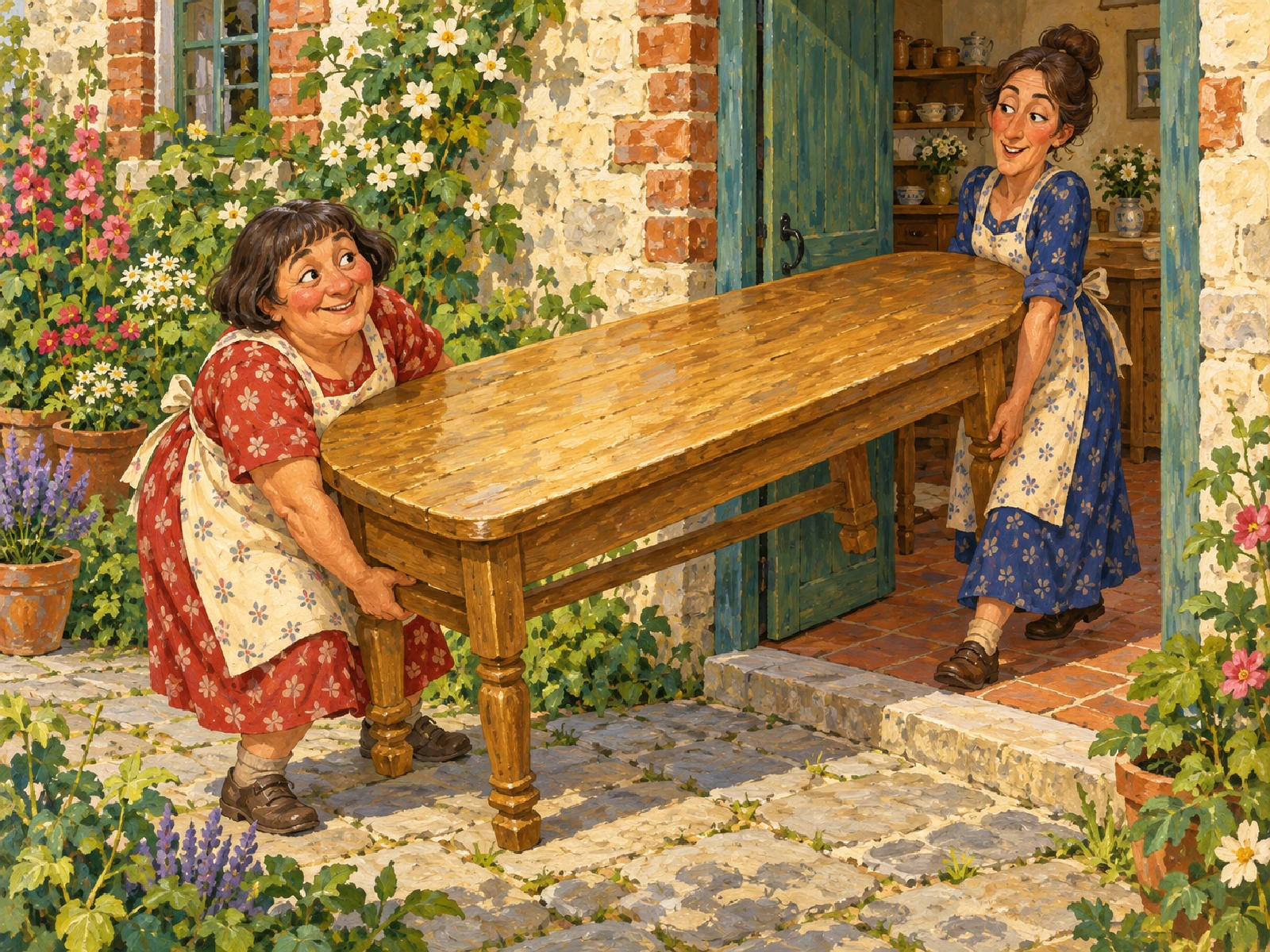
A Long Table Through the Garden Door
Two neighbors tilt a long dining table through a small garden door. Overlapping aprons, table legs, and flower beds become a lively narrative in decorative folk painting.
Remix this referenceA Long Table Through the Garden Door
- Form language
- Use naive folk simplification: broad interlocking shapes and decorative echoes, allowing small handmade irregularities.
- Contour
- Paint soft, slightly wobbly edges with selective blunt brush outlines that vary in pressure and occasionally open.
- Mark-making
- Use lively gouache dabs, short scalloped strokes, and irregular decorative repeats; let brush-load variations show.
- Surface rendering
- Layer matte opaque paint in uneven patches, with dry-bristle skips and broad tonal steps rather than polished blending.
Priority
Keep decorative simplification and visibly varied hand-painted marks equally present.
What to avoid & what to check
Exact prompt for this example
MODULE OWNERSHIP
subject: Subject count, type, stable proportions and landmarks, resting face geometry, hair shape, physical materials, garment construction and permanent marks. No emotion, movement, color assignment or rendering recipe.
expression: Facial soft-tissue displacement and pupil direction, muscle coordination, regional intensity, asymmetry and onset/peak/release. No head/body pose, stable appearance, skin color or rendering.
gesture: Head/neck/body/limb orientation, joint movement, support, contact and pose-caused occlusion using existing anatomy. No eye/pupil movement, emotion, identity, props inventory or camera.
props: Prop count, type, construction, physical material and scale relative to the subject. Holding/contact belongs to gesture, position to composition, color to palette.
scene: Environment elements, terrain, backdrop/floor presence and structural detail. No canvas positions, camera, lighting, assigned colors or render texture.
camera: Projection, focal-length impression, camera elevation/yaw/roll, viewing distance and crop. No actor pose, world placement, lighting or canvas aspect ratio.
composition: Normalized 0-100% canvas positions, scale in frame, depth/overlap, focal hierarchy and margins. No joint pose, camera projection, rendering, subject/prop inventory or emotion.
palette: Color anchors, hue/saturation/value ranges, colors assigned to parts and approximate color coverage. No illumination direction, shading algorithm, physical material or layout.
lighting: Light-source direction/softness/intensity, ambient illumination, physical shadow direction/length and highlight position. Absence of directional illumination is allowed. No shading technique, palette or material changes.
style: Reusable form abstraction, contour weight/taper/edge quality, medium and mark scale/density/direction, surface rendering and tonal transition technique. No fixed subject proportions, anatomy, identity, expression, pose, palette, light-source direction, camera or layout.
output: Image count, aspect ratio, size, file/alpha requirements and global lettering/logo/watermark restrictions. No background scenery, crop, style, identity or pose.

SUBJECT
inventory: Two original adult women: compact older neighbor A and taller middle-aged neighbor B.
geometry: A has a rounded head and sturdy build; B has an elongated head and a long narrow frame.
resting-face: A has hooded eyes, a rounded nose, and broad lips; B has arched brows, a long nose, and a narrow mouth.
appearance: Woven dresses and tied waist aprons; A has a short bob, B a coiled bun. Incidental folds may vary.

PRIORITY


AVOID


CHECK


EXPRESSION — ACTOR A
brows: Brows lift unevenly, with one outer end slightly higher.
lids: Lower lids rise into a cheerful squint without fully closing.
cheeks: Both cheeks bunch upward, more strongly beside the higher mouth corner.
nose: The nose stays relaxed, without a wrinkle across its bridge.
mouth: The mouth opens in a broad, slightly crooked smile.
jaw: The jaw drops slightly in an easy opening.
gaze: Pupils turn toward the table edge approaching the door jamb.
coordination: Raised cheeks and the uneven smile agree; the lids retain attentive tension.
timing: Hold the apex, with the smile fully spread and cheeks at their highest lift.

PRIORITY


AVOID


CHECK


EXPRESSION — ACTOR B
brows: Inner brows ease apart; one outer brow begins to lift.
lids: Upper lids remain open while the lower lids begin a slight rise.
cheeks: A small cheek lift begins beside the nearer mouth corner.
nose: Nostrils stay loose and the nose bridge remains unwrinkled.
mouth: Lips part narrowly as the nearer corner curls upward.
jaw: The jaw releases just enough to separate the lips.
gaze: Pupils turn toward A's face.
coordination: The first mouth-corner lift precedes the subtler cheek and lid response.
timing: Catch the onset before the restrained smile fully spreads.

PRIORITY


AVOID


CHECK


GESTURE
head: A dips her head toward the near table edge; B turns back toward A, exposing a three-quarter face.
torso: A bends sideways beneath the table end while B leans to counterbalance her backward step.
limbs: A braces with bent knees and lifted forearms; B steps backward with elbows drawn close.
contact: Both grip beneath opposite ends, tilting the table toward its long edge; the top partly hides B's torso.

PRIORITY


AVOID


CHECK


PROPS
inventory: One dining table, longer than either neighbor is tall.
construction: A solid timber plank top with rounded corners, sturdy legs, and a simple underframe.

PRIORITY


AVOID


CHECK


SCENE
inventory: A cottage garden, an open kitchen door, masonry walls, paving, flower beds, and a tiled interior.
structure: A narrow doorway interrupts a thick wall; a low threshold connects garden paving to kitchen floor.

PRIORITY


AVOID


CHECK


CAMERA
projection: Shallow oblique parallel projection with little apparent depth convergence.
viewpoint: A moderately elevated viewpoint from the garden, oblique to the doorway, with level roll.
crop: A medium-wide environmental view includes both full figures and the entire doorway.

PRIORITY


AVOID


CHECK


COMPOSITION
placement: The table crosses diagonally between A at lower left and B at upper right, threading the doorway.
depth: The overlapping table and figures are primary; the doorway frames them, with flowers overlapping the paving.
spacing: Leave clear gaps around both faces and table legs, with a loose garden margin around the busy passage.

PRIORITY


AVOID


CHECK


PALETTE
colors: Warm cream, brick red, leaf green, indigo, and honey ocher form a compact earthy palette.
assignment: Cream walls and aprons, ocher table, red dress for A, indigo dress for B, green plants, and warm brown skin.
balance: Cream and ocher dominate; red and indigo distinguish the figures among restrained greens.

PRIORITY


AVOID


CHECK


LIGHTING
sources: Broad daylight comes from high left, with generous ambient illumination inside the doorway.
shadows: Short soft shadows extend rightward beneath the figures and table; the doorway recess is gently darker.
highlights: Quiet highlights touch upper sleeves, hair crowns, and the exposed table rim.

PRIORITY


AVOID


CHECK


STYLE GUIDE
form-language: Use naive folk simplification: broad interlocking shapes and decorative echoes, allowing small handmade irregularities.
contour: Paint soft, slightly wobbly edges with selective blunt brush outlines that vary in pressure and occasionally open.
mark-making: Use lively gouache dabs, short scalloped strokes, and irregular decorative repeats; let brush-load variations show.
surface-rendering: Layer matte opaque paint in uneven patches, with dry-bristle skips and broad tonal steps rather than polished blending.

PRIORITY
Keep decorative simplification and visibly varied hand-painted marks equally present.

AVOID


CHECK


OUTPUT
format: One finished image, landscape 4:3, 1600 × 1200 pixels, opaque PNG.
restrictions: No lettering, logos, or watermarks.

PRIORITY


AVOID


CHECK


FINAL INTEGRATION
expression + gesture: Coordinate the two facial performances with their shared handling of the table.
composition + style: Let decorative rhythms connect the overlaps while preserving the action's readable separations.
Model information comes from image provenance. The same prompt may produce a different result.