Text to imageProductStyle guide
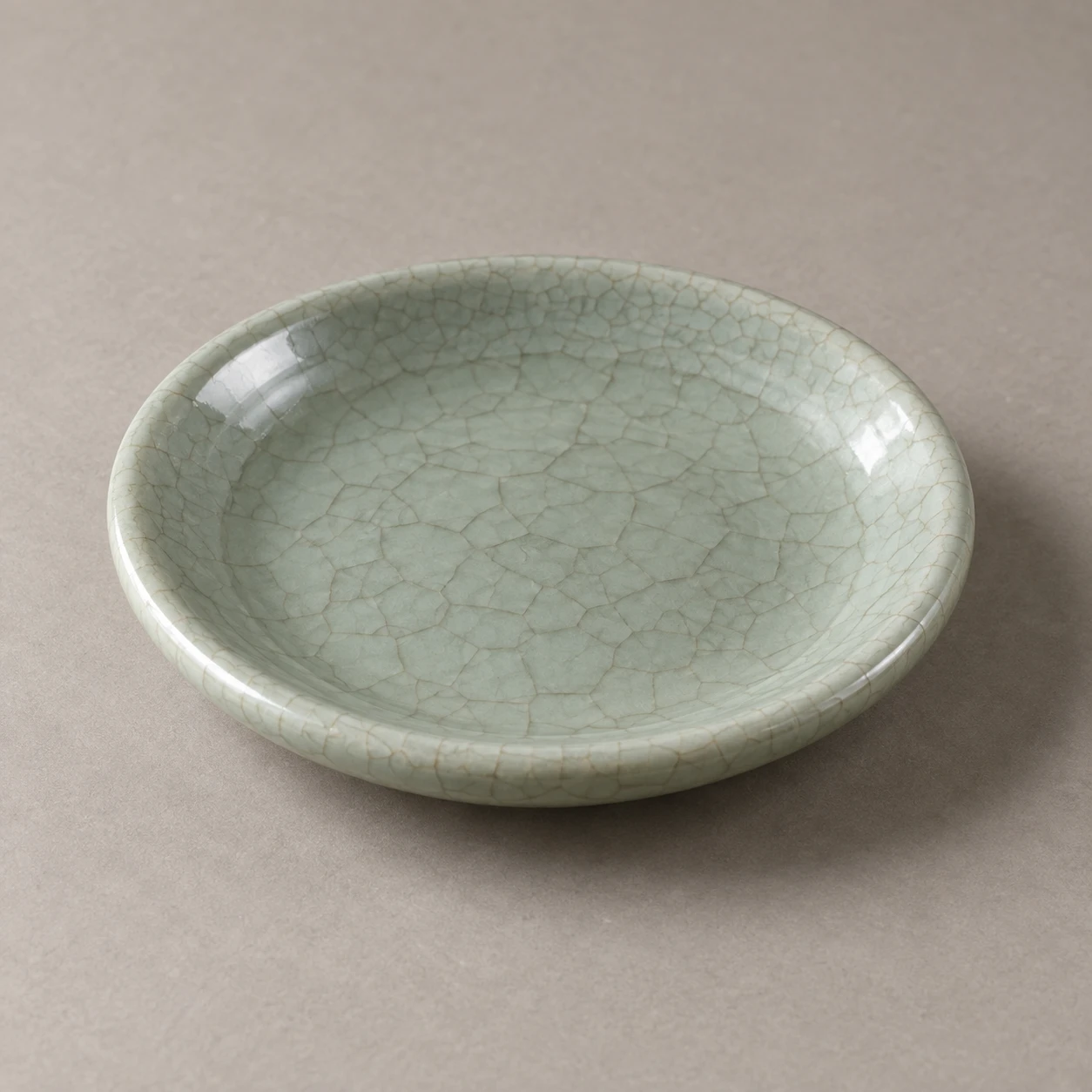
Celadon Saucer · Curvature-Following Crackle
Irregular glaze cracks compress toward the rim of a pale celadon saucer, revealing both its curved surface and the pattern beneath its gloss.
Celadon Saucer · Curvature-Following Crackle
- Shape & line
- Build the saucer from a shallow concave basin and a softly rounded raised rim. Keep the elliptical contours smooth and continuous, and let the near rim overlap a small portion of the basin so its depth is visible.
- Color & light
- Use pale gray-green celadon with slightly darker color in the deeper basin. Place a broad soft light at image upper left; show its pale reflection on the upper-left rim and a soft cast shadow extending toward image lower right on the tabletop.
- Texture & material
- Draw thin muted gray crackle lines as an uneven network of connected, mostly closed cells, mixing larger cells with smaller branching ones. Keep the lines beneath a smooth glossy glaze: the broad light reflection should soften their contrast without turning them into raised grooves or open breaks.
- Composition
- Make the crackle cells broad and readable in the central basin, then progressively flatten and crowd them toward the far rim at image top as the surface turns away. Carry the network over the rounded rim with a visible change of direction, keeping the pattern subordinate to the saucer's clear silhouette.
Priority
Prioritize a crackle network that visibly follows the saucer's curvature beneath glossy glaze.
What to avoid & what to check
Avoid uniform polygon grids, deep fractures, and rough exposed ceramic.
Check that the cells compress toward the far rim and remain visible beneath the softened reflection.
Exact prompt for this example
SUBJECT
One small, shallow celadon ceramic saucer with a gently raised circular rim and an empty center. A fine, irregular crackle network lies within the glaze across the basin and rim; the ceramic body remains intact.

COMPOSITION
Show the entire saucer from an elevated three-quarter viewpoint, centered on a warm gray tabletop. Its opening reads as a broad ellipse, with the near rim at image bottom and the far rim at image top. Leave generous clear space around the silhouette.

STYLE GUIDE
1. Shape & line
Build the saucer from a shallow concave basin and a softly rounded raised rim. Keep the elliptical contours smooth and continuous, and let the near rim overlap a small portion of the basin so its depth is visible.

2. Color & light
Use pale gray-green celadon with slightly darker color in the deeper basin. Place a broad soft light at image upper left; show its pale reflection on the upper-left rim and a soft cast shadow extending toward image lower right on the tabletop.

3. Texture & material
Draw thin muted gray crackle lines as an uneven network of connected, mostly closed cells, mixing larger cells with smaller branching ones. Keep the lines beneath a smooth glossy glaze: the broad light reflection should soften their contrast without turning them into raised grooves or open breaks.

4. Composition
Make the crackle cells broad and readable in the central basin, then progressively flatten and crowd them toward the far rim at image top as the surface turns away. Carry the network over the rounded rim with a visible change of direction, keeping the pattern subordinate to the saucer's clear silhouette.

PRIORITY
Preserve the requested identity, count, action, composition and output settings. Apply the style rules within those constraints; a style reference must not replace the subject or layout. Within the style: Prioritize a crackle network that visibly follows the saucer's curvature beneath glossy glaze.

AVOID
Avoid uniform polygon grids, deep fractures, and rough exposed ceramic.

OUTPUT
Create one square image in a realistic studio product-photography style, with no lettering, labels, logos, or watermark.

SELF-CHECK
Check that the cells compress toward the far rim and remain visible beneath the softened reflection.
Model information comes from image provenance. The same prompt may produce a different result.