Text to imageSpace & architectureStyle guide
Drawing Back the Dye-House Cloth
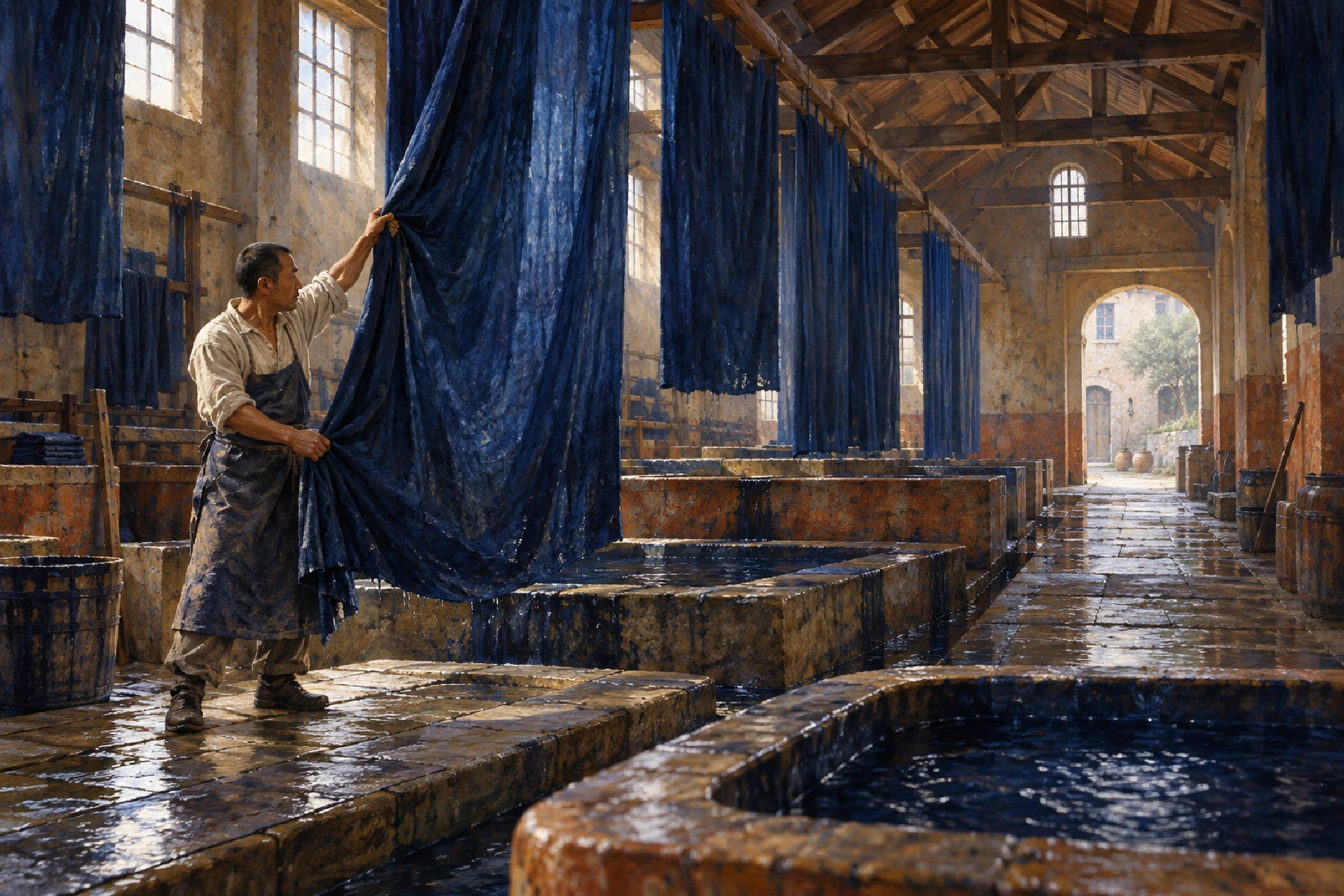
A worker draws back a great wet cloth, revealing stepped dye vats and a rain-wet courtyard. Luminous brushwork and continuous tonal passages give the interior enveloping depth.
Remix this referenceDrawing Back the Dye-House Cloth
- Form language
- Reduce complex structures to broad interlocking masses, allowing secondary details to vary naturally.
- Contour
- Build edges from adjoining paint tones; alternate dissolved boundaries with occasional firm, unoutlined edges.
- Mark-making
- Use broad overlapping brush passes, with irregular smaller strokes interrupting otherwise quiet passages.
- Surface rendering
- Build luminous continuous tones with translucent paint veils and softly joined value transitions, retaining visible paint drag.
Priority
Preserve luminous continuous tonal modeling within visibly painterly surfaces.
What to avoid & what to check
Exact prompt for this example
MODULE OWNERSHIP
subject: Subject count, type, stable proportions and landmarks, resting face geometry, hair shape, physical materials, garment construction and permanent marks. No emotion, movement, color assignment or rendering recipe.
expression: Facial soft-tissue displacement and pupil direction, muscle coordination, regional intensity, asymmetry and onset/peak/release. No head/body pose, stable appearance, skin color or rendering.
gesture: Head/neck/body/limb orientation, joint movement, support, contact and pose-caused occlusion using existing anatomy. No eye/pupil movement, emotion, identity, props inventory or camera.
props: Prop count, type, construction, physical material and scale relative to the subject. Holding/contact belongs to gesture, position to composition, color to palette.
scene: Environment elements, terrain, backdrop/floor presence and structural detail. No canvas positions, camera, lighting, assigned colors or render texture.
camera: Projection, focal-length impression, camera elevation/yaw/roll, viewing distance and crop. No actor pose, world placement, lighting or canvas aspect ratio.
composition: Normalized 0-100% canvas positions, scale in frame, depth/overlap, focal hierarchy and margins. No joint pose, camera projection, rendering, subject/prop inventory or emotion.
palette: Color anchors, hue/saturation/value ranges, colors assigned to parts and approximate color coverage. No illumination direction, shading algorithm, physical material or layout.
lighting: Light-source direction/softness/intensity, ambient illumination, physical shadow direction/length and highlight position. Absence of directional illumination is allowed. No shading technique, palette or material changes.
style: Reusable form abstraction, contour weight/taper/edge quality, medium and mark scale/density/direction, surface rendering and tonal transition technique. No fixed subject proportions, anatomy, identity, expression, pose, palette, light-source direction, camera or layout.
output: Image count, aspect ratio, size, file/alpha requirements and global lettering/logo/watermark restrictions. No background scenery, crop, style, identity or pose.

SUBJECT
inventory: One adult dye-house worker, actor A; no other people.
geometry: An ordinary adult build with a compact torso and sturdy forearms.
resting-face: A broad nose, shallow eye sockets and a straight resting mouth define a simple facial structure.
appearance: Close-cropped hair, a collarless cotton shirt and a heavy wrap apron with a broad waist tie.

PRIORITY


AVOID


CHECK


EXPRESSION — ACTOR A
brows: Brows remain level, without pinching together.
lids: Lids remain comfortably open, without a squint.
cheeks: Cheeks remain relaxed without lifting.
nose: Nostrils remain relaxed without flaring.
mouth: Lips meet lightly with level corners.
jaw: The jaw stays loosely closed without clenching.
gaze: Pupils settle toward the courtyard opening.
coordination: Upper and lower face share an understated neutral state.
timing: Hold the settled apex of neutrality, without an emerging reaction.

PRIORITY


AVOID


CHECK


GESTURE
head: A turns their head toward the opening beside the cloth.
torso: A leans sideways from a planted stance, extending the pull through the shoulder.
limbs: One arm reaches high and outward while the other bends near the waist; the knees remain easy.
contact: The raised hand gathers the cloth edge; the lower hand guides a fold, with both feet on the walkway.

PRIORITY


AVOID


CHECK


PROPS
inventory: One length of wet woven cloth, several times the worker's height.
construction: A broad, unpatterned textile with a weighted hem and a simple overhead suspension.

PRIORITY


AVOID


CHECK


SCENE
inventory: A tall dye house with masonry vats, stone walkways, timber roof trusses and a rain-wet courtyard.
structure: Vats descend in shallow terraces beside a continuous walkway; high windows and a courtyard doorway pierce thick walls.

PRIORITY


AVOID


CHECK


CAMERA
projection: Rectilinear perspective with a moderately wide, approximately 28 mm lens impression.
viewpoint: Look obliquely down the hall from standing eye level, with a level horizon.
crop: A wide interior view includes roof structure and floor, with the nearest vat partly cropped.

PRIORITY


AVOID


CHECK


COMPOSITION
placement: A occupies the left third at modest scale; the cloth extends above them and the doorway sits deep to the right.
depth: A cropped foreground vat overlaps the middle walkway; successive terraces lead through the cloth opening to the courtyard.
spacing: The hand-and-cloth junction leads into the revealed hall; generous space beneath the trusses keeps the room dominant.

PRIORITY


AVOID


CHECK


PALETTE
colors: Deep indigo, muted copper, pale honey and cool gray-green.
assignment: Indigo belongs to cloth and dye baths, copper to masonry, honey to the shirt and gray-green to the courtyard.
balance: Subdued indigo and copper dominate, with sparse pale accents and a less saturated courtyard.

PRIORITY


AVOID


CHECK


LIGHTING
sources: Broad daylight enters from high windows on the left, supported by weaker courtyard light.
shadows: Soft shadows fall rightward across the walkways; recesses beneath the vat rims remain deep.
highlights: Light catches upper cloth folds, the raised hand and broken stretches of wet stone.

PRIORITY


AVOID


CHECK


STYLE GUIDE
form-language: Reduce complex structures to broad interlocking masses, allowing secondary details to vary naturally.
contour: Build edges from adjoining paint tones; alternate dissolved boundaries with occasional firm, unoutlined edges.
mark-making: Use broad overlapping brush passes, with irregular smaller strokes interrupting otherwise quiet passages.
surface-rendering: Build luminous continuous tones with translucent paint veils and softly joined value transitions, retaining visible paint drag.

PRIORITY
Preserve luminous continuous tonal modeling within visibly painterly surfaces.

AVOID


CHECK


OUTPUT
format: One opaque PNG image, landscape 3:2, 1800 × 1200 pixels.
restrictions: No lettering, logos or watermarks.

PRIORITY


AVOID


CHECK


FINAL INTEGRATION
gesture + composition + scene: The action and spatial arrangement cooperate to reveal the architecture as the principal subject.
expression + composition: Keep the facial acting legible at its assigned scale without competing with the spatial focal sequence.
lighting + style: The painted transitions should preserve the illumination's spatial clarity.
Model information comes from image provenance. The same prompt may produce a different result.