Text to imageIllustrationStyle guide
One Empty Bowl · Depth Through Ellipses
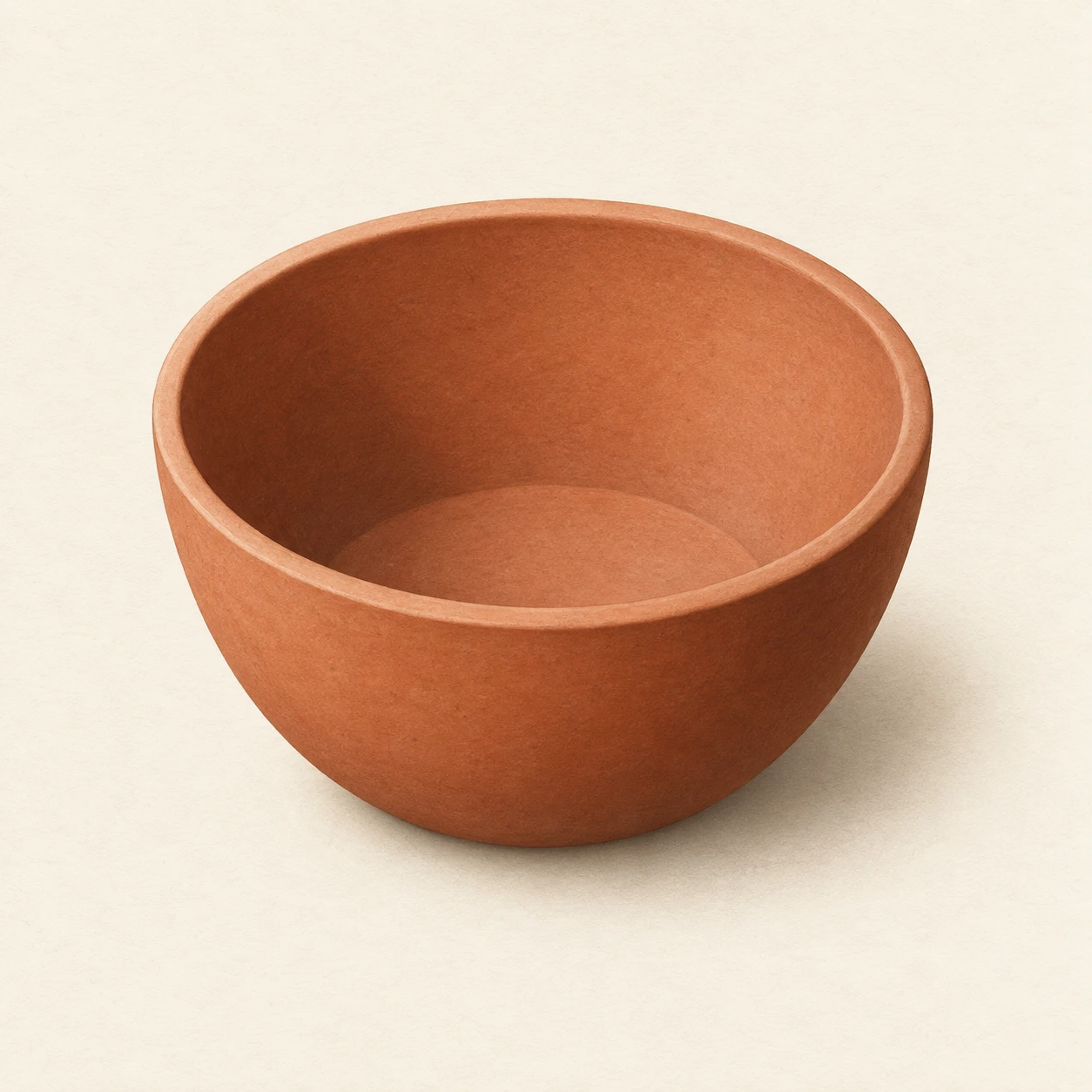
An explanatory illustration using related opening and interior-base ellipses to make an empty bowl’s depth and wall thickness readable.
One Empty Bowl · Depth Through Ellipses
- Shape & line
- Construct the opening as a broad horizontal ellipse and add a closely nested ellipse to show the rim’s thickness. Place a smaller, flatter base ellipse inside the opening, slightly toward image-bottom; connect it to the rim with gently tapering inner walls, and hide its lower arc behind the near wall.
- Color & light
- Use muted terracotta for the bowl and warm ivory for the background. With light entering from image-upper-left, keep the upper-left rim pale, place a broad darker patch on the lower-left interior wall beneath the near rim, and darken the outer wall toward image-right.
- Texture & material
- Render the ceramic with smooth, matte color fills and a faint paper grain that remains even across the image. Keep the rim and interior-base curves crisp enough to distinguish them; use softened boundaries between tonal patches without glossy highlights.
- Composition
- Let the bowl occupy roughly the middle half of the square. Keep the opening ellipse level and the vessel centered beneath it, with the near rim visibly overlapping the interior. Add a soft, compact grounding shadow directly below the bowl, extending slightly toward image-lower-right.
Priority
Prioritize the nested ellipses and near-wall overlap so the bowl reads as a hollow vessel.
What to avoid & what to check
Avoid a circular top view, transparent walls, or a complete base ellipse floating over the near wall.
Check that the rim has visible thickness and the interior base sits behind the near wall.
Exact prompt for this example
SUBJECT
Exactly one empty, round ceramic bowl with a broad opening, a gently tapered body, and a visible interior base. The rim, inner walls, and base belong to one continuous vessel.

COMPOSITION
Show the entire bowl centered in a slightly elevated three-quarter view, with enough downward visibility to reveal its interior. Keep generous blank space around the silhouette.

STYLE GUIDE
1. Shape & line
Construct the opening as a broad horizontal ellipse and add a closely nested ellipse to show the rim’s thickness. Place a smaller, flatter base ellipse inside the opening, slightly toward image-bottom; connect it to the rim with gently tapering inner walls, and hide its lower arc behind the near wall.

2. Color & light
Use muted terracotta for the bowl and warm ivory for the background. With light entering from image-upper-left, keep the upper-left rim pale, place a broad darker patch on the lower-left interior wall beneath the near rim, and darken the outer wall toward image-right.

3. Texture & material
Render the ceramic with smooth, matte color fills and a faint paper grain that remains even across the image. Keep the rim and interior-base curves crisp enough to distinguish them; use softened boundaries between tonal patches without glossy highlights.

4. Composition
Let the bowl occupy roughly the middle half of the square. Keep the opening ellipse level and the vessel centered beneath it, with the near rim visibly overlapping the interior. Add a soft, compact grounding shadow directly below the bowl, extending slightly toward image-lower-right.

PRIORITY
Preserve the requested identity, count, action, composition and output settings. Apply the style rules within those constraints; a style reference must not replace the subject or layout. Within the style: Prioritize the nested ellipses and near-wall overlap so the bowl reads as a hollow vessel.

AVOID
Avoid a circular top view, transparent walls, or a complete base ellipse floating over the near wall.

OUTPUT
One square illustration, with no text, labels, dimensions, signature, or watermark.

SELF-CHECK
Check that the rim has visible thickness and the interior base sits behind the near wall.
Model information comes from image provenance. The same prompt may produce a different result.