Text to imageAnimationStyle guide
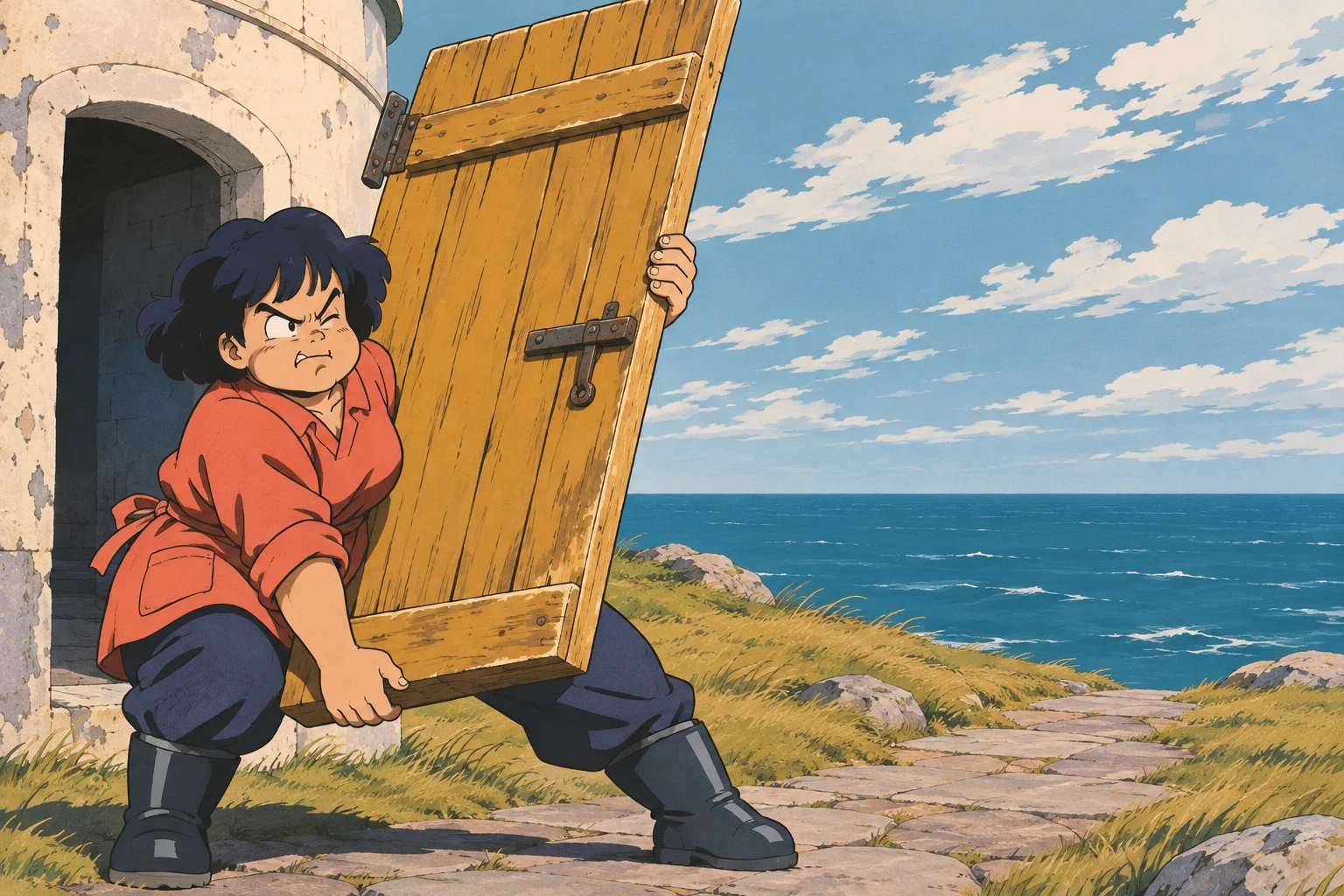
A Keeper Carrying a Door in the Wind
A lighthouse keeper struggles across a coastal path as the wind catches a detached door. Open sea and crisp cel shadow shapes give her small struggle an expansive setting.
Remix this referenceA Keeper Carrying a Door in the Wind
- Form language
- Combine rounded masses with wedge-like facets; simplify small structures into readable, slightly irregular shapes.
- Contour
- Use continuous ink exterior contours, finer interior separators and gently tapered line endings with natural hand variation.
- Mark-making
- Use short tapered crease marks and sparse interior strokes, with occasional loose brush accents and natural variation.
- Surface rendering
- Use hard-edged base fills and one secondary tonal plane per fill, with faint cel-surface grain and restrained brush variation within the planes.
Priority
Rendering medium: 2D Japanese television-anime cel illustration; formal rendering reference: Toei Animation · 1980s · Dragon Ball (1986)
What to avoid & what to check
Exact prompt for this example
MODULE OWNERSHIP
subject: Subject count, type, stable proportions and landmarks, resting face geometry, hair shape, physical materials, garment construction and permanent marks. No emotion, movement, color assignment or rendering recipe.
expression: Facial soft-tissue displacement and pupil direction, muscle coordination, regional intensity, asymmetry and onset/peak/release. No head/body pose, stable appearance, skin color or rendering.
gesture: Head/neck/body/limb orientation, joint movement, support, contact and pose-caused occlusion using existing anatomy. No eye/pupil movement, emotion, identity, props inventory or camera.
props: Prop count, type, construction, physical material and scale relative to the subject. Holding/contact belongs to gesture, position to composition, color to palette.
scene: Environment elements, terrain, backdrop/floor presence and structural detail. No canvas positions, camera, lighting, assigned colors or render texture.
camera: Projection, focal-length impression, camera elevation/yaw/roll, viewing distance and crop. No actor pose, world placement, lighting or canvas aspect ratio.
composition: Normalized 0-100% canvas positions, scale in frame, depth/overlap, focal hierarchy and margins. No joint pose, camera projection, rendering, subject/prop inventory or emotion.
palette: Color anchors, hue/saturation/value ranges, colors assigned to parts and approximate color coverage. No illumination direction, shading algorithm, physical material or layout.
lighting: Light-source direction/softness/intensity, ambient illumination, physical shadow direction/length and highlight position. Absence of directional illumination is allowed. No shading technique, palette or material changes.
style: Reusable form abstraction, contour weight/taper/edge quality, medium and mark scale/density/direction, surface rendering and tonal transition technique. No fixed subject proportions, anatomy, identity, expression, pose, palette, light-source direction, camera or layout.
output: Image count, aspect ratio, size, file/alpha requirements and global lettering/logo/watermark restrictions. No background scenery, crop, style, identity or pose.

SUBJECT
inventory: One original adult woman, a lighthouse keeper; no other figures.
geometry: A sturdy adult build with a compact torso, broad hands and substantial boots; retain recognizable human proportions.
resting-face: Wide-set oval eyes, low straight brows, a blunt nose, a broad mouth and a short rounded chin.
appearance: Short scalloped bob, canvas work tunic over loose trousers, and rubber boots; incidental clothing details may vary coherently.

PRIORITY


AVOID


CHECK


EXPRESSION — ACTOR A
brows: Inner brow ends draw slightly down and together.
lids: Both eyes narrow, with the windward eye squeezed a little tighter.
cheeks: Cheeks gather lightly toward the tightened mouth.
nose: Nostrils widen slightly without wrinkling the nose bridge.
mouth: Lips press together, with one corner pulled sideways in effort.
jaw: Jaw stays closed with a small visible tightening at the chin.
gaze: Pupils aim toward the clear stretch of path.
coordination: Keep the brow tension mild while the mouth carries most of the effort.
timing: Freeze the peak of a sustained effort, with the unequal squint still held.

PRIORITY


AVOID


CHECK


GESTURE
head: A turns her head clear of the door and tucks her chin toward the forward shoulder.
torso: Her torso twists against the door's pull, with one shoulder drawn back and her weight sunk low.
limbs: One knee bends deeply while the other leg stretches sideways to brace; elbows remain bent under the load.
contact: Both boots meet the path; one hand grips the door's side edge and the other supports its lower rail.

PRIORITY


AVOID


CHECK


PROPS
inventory: One detached wooden door, slightly taller than A; no additional carried equipment.
construction: A solid plank door with cross rails, exposed hinge leaves and a simple iron latch; no glass.

PRIORITY


AVOID


CHECK


SCENE
inventory: A coastal lighthouse, its empty doorway, a worn stone path, low headland grass, open sea and a cloud-streaked sky.
structure: The path follows a gentle grassy slope beside the tower; the coast drops toward a distant uninterrupted horizon.

PRIORITY


AVOID


CHECK


CAMERA
projection: Natural perspective with a moderately wide focal-length impression.
viewpoint: View from slightly below standing eye level, obliquely across the path, with a level horizon.
crop: Use an environmental full-figure view that includes the entire door and a cropped portion of the tower.

PRIORITY


AVOID


CHECK


COMPOSITION
placement: Place A in the left third; let the door rise diagonally into the upper middle and leave the right side spacious. The clear path opens toward the lower right.
depth: The door overlaps the tower, while A's face stays unobstructed; the sea opens far behind them.
spacing: Make the face and hands the first read, the door the second; retain breathing room around its upper edge.

PRIORITY


AVOID


CHECK


PALETTE
colors: Anchor the image in petrol blue, chalk ivory, weathered ochre and a small strong coral accent.
assignment: Petrol sea, ivory sky and tower, ochre door and grass, coral tunic, navy hair and trousers, warm beige skin.
balance: Let pale neutrals and muted blues dominate, with the tunic providing the most saturated color.

PRIORITY


AVOID


CHECK


LIGHTING
sources: Broad daylight enters from upper right, softened by thin cloud, with generous ambient fill.
shadows: Short, softly edged ground shadows fall toward lower left; contact shadows remain compact.
highlights: Broad highlights favor the upper-right edges of the face, sleeves and door rails.

PRIORITY


AVOID


CHECK


STYLE GUIDE
form-language: Combine rounded masses with wedge-like facets; simplify small structures into readable, slightly irregular shapes.
contour: Use continuous ink exterior contours, finer interior separators and gently tapered line endings with natural hand variation.
mark-making: Use short tapered crease marks and sparse interior strokes, with occasional loose brush accents and natural variation.
surface-rendering: Use hard-edged base fills and one secondary tonal plane per fill, with faint cel-surface grain and restrained brush variation within the planes.

PRIORITY
Rendering medium: 2D Japanese television-anime cel illustration; formal rendering reference: Toei Animation · 1980s · Dragon Ball (1986)

AVOID


CHECK


OUTPUT
format: One finished image, 3:2 landscape, 1536 × 1024 pixels, opaque PNG.
restrictions: No lettering, logos, captions or watermarks.

PRIORITY


AVOID


CHECK


FINAL INTEGRATION
expression + gesture: Let facial effort and physical resistance describe the same sustained instant.
style + lighting: Translate the physical illumination into the selected tonal-plane language.
Art direction
토에이 애니메이션 / Toei Animation · 1980s · 드래곤볼(1986) / Dragon Ball (1986) ↗- Combine rounded masses and wedge-like facets into readable form abstractions
- Continuous ink exterior contours with finer interior separators
- Short tapered crease marks and sparse marks inside filled areas
- Hard-edged base and single secondary tonal planes with restrained cel-surface texture
Model information comes from image provenance. The same prompt may produce a different result.