Text to imageArt stylesStyle guide
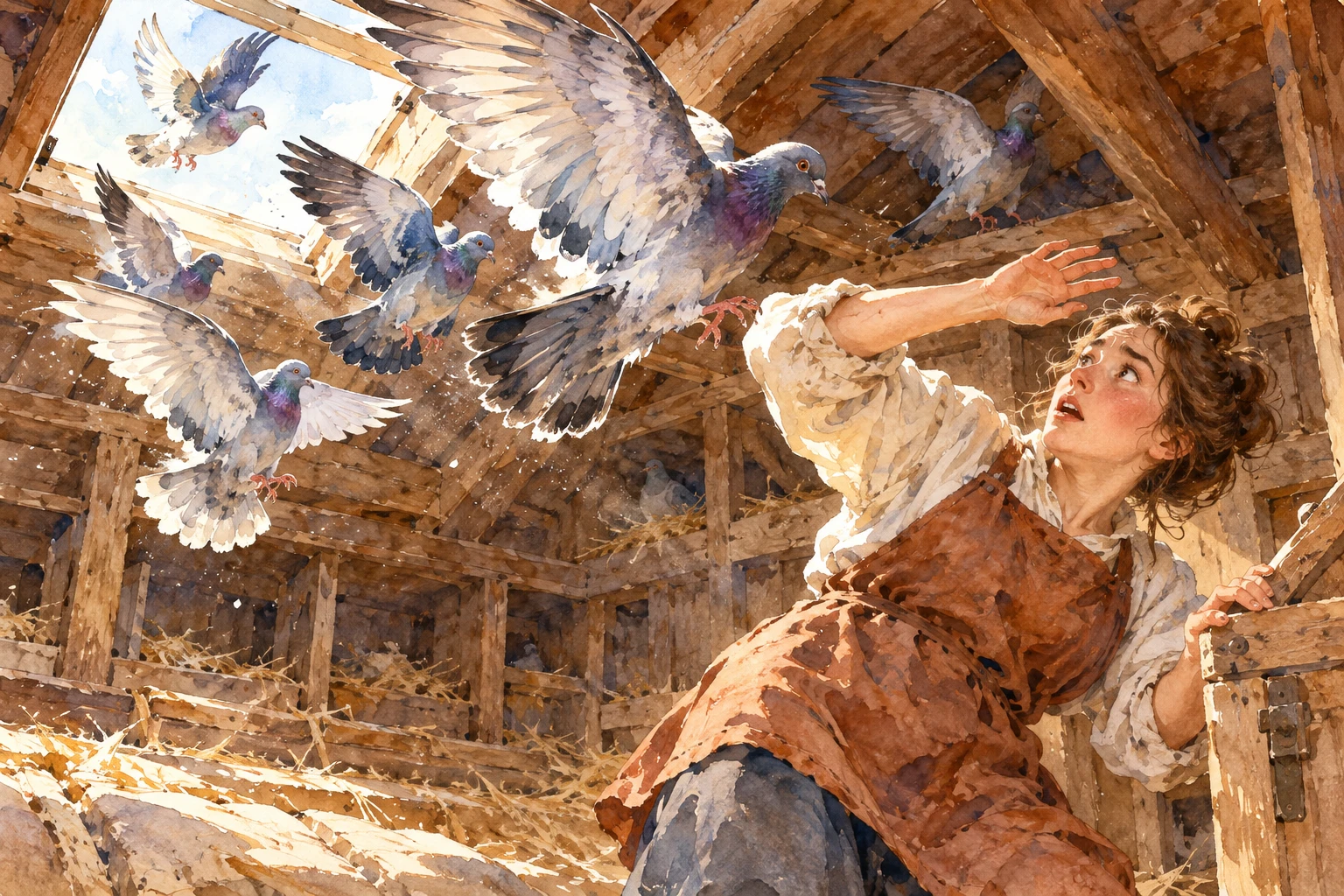
Pigeons Rising Through the Roof Hatch
A dovecote caretaker leans back as pigeons rise through an open roof hatch. Watercolor blooms and broken edges connect the overlapping wings, figure, and rafters.
Remix this referencePigeons Rising Through the Roof Hatch
- Form language
- Reduce complex forms to elastic wash masses and a few descriptive accents; let secondary shapes merge while keeping their construction legible.
- Contour
- Use intermittent brush-drawn contours that taper, feather, and disappear into wet passages; reserve crisp edge fragments for selective clarification.
- Mark-making
- Alternate broad loaded strokes with quick split-brush flicks; allow changing pressure and water load to produce irregular, lively marks.
- Surface rendering
- Build transparent watercolor washes with visible backruns and pigment pooling; add sparse dry glazes over dried blooms and preserve exposed paper.
Priority
Keep watercolor blooms and broken edges visibly active in the finished painting.
What to avoid & what to check
Exact prompt for this example
MODULE OWNERSHIP
subject: Subject count, type, stable proportions and landmarks, resting face geometry, hair shape, physical materials, garment construction and permanent marks. No emotion, movement, color assignment or rendering recipe.
expression: Facial soft-tissue displacement and pupil direction, muscle coordination, regional intensity, asymmetry and onset/peak/release. No head/body pose, stable appearance, skin color or rendering.
gesture: Head/neck/body/limb orientation, joint movement, support, contact and pose-caused occlusion using existing anatomy. No eye/pupil movement, emotion, identity, props inventory or camera.
props: Prop count, type, construction, physical material and scale relative to the subject. Holding/contact belongs to gesture, position to composition, color to palette.
scene: Environment elements, terrain, backdrop/floor presence and structural detail. No canvas positions, camera, lighting, assigned colors or render texture.
camera: Projection, focal-length impression, camera elevation/yaw/roll, viewing distance and crop. No actor pose, world placement, lighting or canvas aspect ratio.
composition: Normalized 0-100% canvas positions, scale in frame, depth/overlap, focal hierarchy and margins. No joint pose, camera projection, rendering, subject/prop inventory or emotion.
palette: Color anchors, hue/saturation/value ranges, colors assigned to parts and approximate color coverage. No illumination direction, shading algorithm, physical material or layout.
lighting: Light-source direction/softness/intensity, ambient illumination, physical shadow direction/length and highlight position. Absence of directional illumination is allowed. No shading technique, palette or material changes.
style: Reusable form abstraction, contour weight/taper/edge quality, medium and mark scale/density/direction, surface rendering and tonal transition technique. No fixed subject proportions, anatomy, identity, expression, pose, palette, light-source direction, camera or layout.
output: Image count, aspect ratio, size, file/alpha requirements and global lettering/logo/watermark restrictions. No background scenery, crop, style, identity or pose.

SUBJECT
inventory: One adult dovecote caretaker, actor A, and five pigeons with individually varied feather patterns.
geometry: A has an ordinary adult build; the pigeons have compact breasts, small heads, tapered tails, and broad feathered wings.
resting-face: A has an oval face, straight brows, a rounded nose tip, and a short upper lip.
appearance: A has hair gathered into a loose coiled updo and a cotton work smock over plain trousers; pigeon plumage includes layered flight feathers.

PRIORITY


AVOID


CHECK


EXPRESSION — ACTOR A
brows: Both brows rise, with the nearer brow slightly higher.
lids: Upper lids lift; lower lids remain softly supported.
cheeks: Cheeks remain loose without a smile-driven lift.
nose: Nostrils remain relaxed and the nose bridge stays unwrinkled.
mouth: Lips part into a small, uneven opening with relaxed corners.
jaw: The jaw drops slightly without stretching the mouth wide.
gaze: Pupils are directed toward the nearest pigeon.
coordination: The lifted upper face carries more surprise than the gently opened mouth.
timing: Catch the apex of a brief startle before the features soften.

PRIORITY


AVOID


CHECK


GESTURE
head: A draws the chin back and turns the head toward the hatch.
torso: A leans backward from the hips while keeping the shoulders uneven.
limbs: One forearm rises beside A's brow; pigeons climb with varied spread and swept wing positions.
contact: A's other hand grips the hatch rim; the raised forearm leaves the eyes and mouth visible.

PRIORITY


AVOID


CHECK


PROPS
inventory: No separate props.
construction: No prop construction applies.

PRIORITY


AVOID


CHECK


SCENE
inventory: A timber dovecote interior with an open roof hatch, rafters, nesting shelves, and a straw-strewn plank floor.
structure: A low pitched roof encloses shallow nesting recesses; the hatch interrupts one roof slope with a broad opening.

PRIORITY


AVOID


CHECK


CAMERA
projection: Moderately wide perspective with a natural 35 mm lens impression.
viewpoint: View obliquely across the loft from the caretaker's eye level, with no camera roll.
crop: Use a medium-wide view, showing A from the knees upward and allowing one nearest wing to leave the frame.

PRIORITY


AVOID


CHECK


COMPOSITION
placement: A occupies the lower right; the flock sweeps toward the upper left, where the hatch provides a spacious opening.
depth: One large foreground wing overlaps the rafters; smaller birds recede toward the hatch behind A.
spacing: Make the face and nearest bird the focal pair; preserve open gaps between wing clusters and breathing room around the face.

PRIORITY


AVOID


CHECK


PALETTE
colors: Anchor the image in ultramarine, burnt sienna, warm paper white, and restrained plum.
assignment: Use sienna for timber and the smock, blue-gray for pigeons, plum at their necks, and warm peach for A's skin.
balance: Warm earth hues form the broad field; cooler birds provide contrast, with generous paper-white passages.

PRIORITY


AVOID


CHECK


LIGHTING
sources: Broad, soft daylight enters from the upper left, with gentle ambient fill inside the loft.
shadows: Soft wing and rafter shadows fall toward the lower right; recesses retain deeper shade.
highlights: Upper-left-facing feather edges, A's brow, and the hatch rim receive the clearest highlights.

PRIORITY


AVOID


CHECK


STYLE GUIDE
form-language: Reduce complex forms to elastic wash masses and a few descriptive accents; let secondary shapes merge while keeping their construction legible.
contour: Use intermittent brush-drawn contours that taper, feather, and disappear into wet passages; reserve crisp edge fragments for selective clarification.
mark-making: Alternate broad loaded strokes with quick split-brush flicks; allow changing pressure and water load to produce irregular, lively marks.
surface-rendering: Build transparent watercolor washes with visible backruns and pigment pooling; add sparse dry glazes over dried blooms and preserve exposed paper.

PRIORITY
Keep watercolor blooms and broken edges visibly active in the finished painting.

AVOID


CHECK


OUTPUT
format: One finished image.
restrictions: Deliver one opaque PNG, landscape 3:2, 1536 × 1024 pixels; no lettering, logos, or watermarks.

PRIORITY


AVOID


CHECK


FINAL INTEGRATION
scene + composition + lighting: Use the hatch established by scene and composition as the opening through which lighting's daylight enters.
Model information comes from image provenance. The same prompt may produce a different result.