Text to imageCafe & brandStyle guide
Hands Weaving a Willow Rim
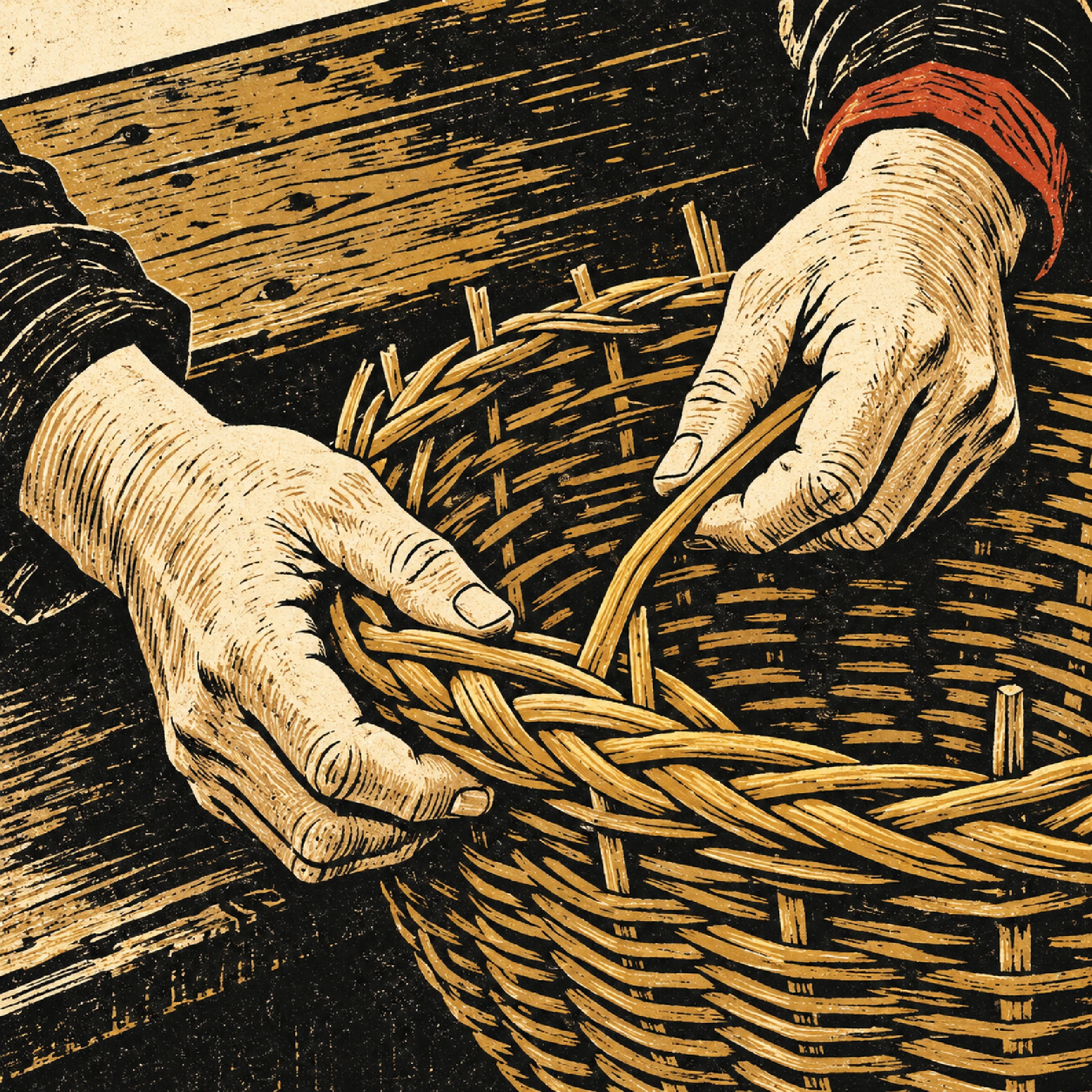
A basketry workshop brand illustration, intimately cropped around hands threading willow through a rim. Bold linocut masses and rhythmic carved marks convey the craft's tactile character.
Remix this referenceHands Weaving a Willow Rim
- Form language
- Reduce forms to bold interlocking masses, preserving small irregularities within a coherent handmade language.
- Contour
- Use decisive cut edges with blunt corners and occasional chipped interruptions; line weight varies with the cut.
- Mark-making
- Carve rhythmic hooked and parallel gouges in loose families, naturally varying their length and spacing.
- Surface rendering
- Build tones through printed solids and carved reserves, allowing slight ink breakup and imperfect overprint at selected edges.
Priority
Bold linocut masses and rhythmic carved marks define the finished treatment.
What to avoid & what to check
Exact prompt for this example
MODULE OWNERSHIP
subject: Subject count, type, stable proportions and landmarks, resting face geometry, hair shape, physical materials, garment construction and permanent marks. No emotion, movement, color assignment or rendering recipe.
expression: Facial soft-tissue displacement and pupil direction, muscle coordination, regional intensity, asymmetry and onset/peak/release. No head/body pose, stable appearance, skin color or rendering.
gesture: Head/neck/body/limb orientation, joint movement, support, contact and pose-caused occlusion using existing anatomy. No eye/pupil movement, emotion, identity, props inventory or camera.
props: Prop count, type, construction, physical material and scale relative to the subject. Holding/contact belongs to gesture, position to composition, color to palette.
scene: Environment elements, terrain, backdrop/floor presence and structural detail. No canvas positions, camera, lighting, assigned colors or render texture.
camera: Projection, focal-length impression, camera elevation/yaw/roll, viewing distance and crop. No actor pose, world placement, lighting or canvas aspect ratio.
composition: Normalized 0-100% canvas positions, scale in frame, depth/overlap, focal hierarchy and margins. No joint pose, camera projection, rendering, subject/prop inventory or emotion.
palette: Color anchors, hue/saturation/value ranges, colors assigned to parts and approximate color coverage. No illumination direction, shading algorithm, physical material or layout.
lighting: Light-source direction/softness/intensity, ambient illumination, physical shadow direction/length and highlight position. Absence of directional illumination is allowed. No shading technique, palette or material changes.
style: Reusable form abstraction, contour weight/taper/edge quality, medium and mark scale/density/direction, surface rendering and tonal transition technique. No fixed subject proportions, anatomy, identity, expression, pose, palette, light-source direction, camera or layout.
output: Image count, aspect ratio, size, file/alpha requirements and global lettering/logo/watermark restrictions. No background scenery, crop, style, identity or pose.

SUBJECT
inventory: A is one adult basket maker.
geometry: Broad palms, substantial thumbs and gently knotted finger joints give the hands a practiced construction.
resting-face: Resting facial geometry is unprescribed.
appearance: Bare hands have ordinary creases; woven sleeves end in folded cuffs. Minor wear may vary naturally.

PRIORITY


AVOID


CHECK


EXPRESSION — ACTOR A
brows: Brow displacement is unprescribed.
lids: Lid displacement is unprescribed.
cheeks: Cheek displacement is unprescribed.
nose: Nasal soft-tissue movement is unprescribed.
mouth: Lip displacement is unprescribed.
jaw: Jaw opening is unprescribed.
gaze: Pupil direction is unprescribed.
coordination: Facial muscle coordination is unprescribed.
timing: The neutral apex label prescribes no facial movement.

PRIORITY


AVOID


CHECK


GESTURE
head: Head and neck orientation is unprescribed.
torso: Torso pose is unprescribed.
limbs: One hand curls around the rim while the other bends the loose strip inward with thumb and fingertips.
contact: Supporting fingers brace the rim; the working thumb presses the strip beneath a woven crossing, partly covering it.

PRIORITY


AVOID


CHECK


PROPS
inventory: One unfinished willow basket and one loose willow strip; the basket mouth is wider than the paired palms.
construction: Flexible woody strips form an open bowl with a thick braided rim and a few unfinished projecting ends.

PRIORITY


AVOID


CHECK


SCENE
inventory: A basketry workbench is the sole environmental element; no floor or room backdrop is present.
structure: The workbench has a broad plank surface and a worn edge.

PRIORITY


AVOID


CHECK


CAMERA
projection: Use natural perspective with a normal-lens impression and little near-edge distortion.
viewpoint: Look obliquely down from just above hand height, with level camera roll.
crop: Crop tightly through the forearms and basket body, retaining both hands and the weaving contact; exclude head, neck and torso.

PRIORITY


AVOID


CHECK


COMPOSITION
placement: The rim sweeps across the lower half; hands enter from left and upper right, meeting right of center.
depth: Hands and rim form the nearest layer; the basket interior recedes above the workbench.
spacing: The weaving contact leads, followed by the broad rim; leave a generous open wedge at upper left.

PRIORITY


AVOID


CHECK


PALETTE
colors: Use warm ivory, soot black, muted ochre and a small vermilion accent.
assignment: Assign ivory to hands and open areas, ochre to willow, black to sleeves and bench, vermilion to one cuff.
balance: Ivory and black dominate; ochre connects the craft elements and vermilion remains a brief accent.

PRIORITY


AVOID


CHECK


LIGHTING
sources: Broad, soft daylight arrives from upper left with gentle ambient illumination.
shadows: Short shadows fall toward lower right, deepening beneath fingers and inside the basket.
highlights: Light catches the upper-left knuckles and exposed top of the rim.

PRIORITY


AVOID


CHECK


STYLE GUIDE
form-language: Reduce forms to bold interlocking masses, preserving small irregularities within a coherent handmade language.
contour: Use decisive cut edges with blunt corners and occasional chipped interruptions; line weight varies with the cut.
mark-making: Carve rhythmic hooked and parallel gouges in loose families, naturally varying their length and spacing.
surface-rendering: Build tones through printed solids and carved reserves, allowing slight ink breakup and imperfect overprint at selected edges.

PRIORITY
Bold linocut masses and rhythmic carved marks define the finished treatment.

AVOID


CHECK


OUTPUT
format: Produce one square image at 2048 × 2048 pixels as an opaque PNG.
restrictions: Include no lettering, logos or watermarks.

PRIORITY


AVOID


CHECK


FINAL INTEGRATION
gesture + props + composition: Let the hand action, basket construction and visual sequence cooperate to make the craft immediately understandable.
lighting + style: Translate the lighting through the print language while maintaining tactile clarity.
Model information comes from image provenance. The same prompt may produce a different result.