Text to imageLandscapeStyle guide
Ice Beneath the Turf
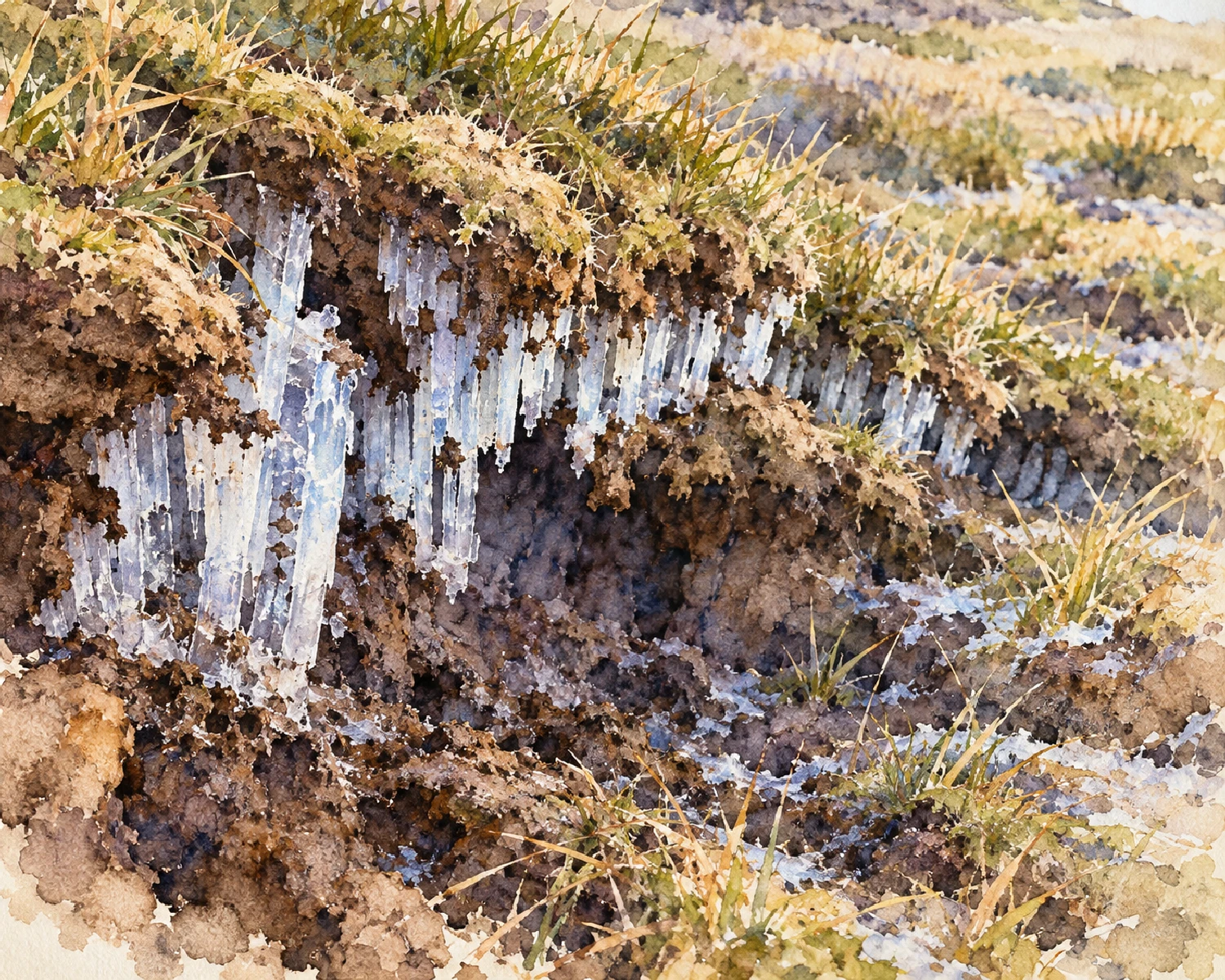
An intimate watercolor of turf lifted by needle ice. Blooming earth washes and interrupted ice edges reveal unexpected depth in a small patch of terrain.
Remix this referenceIce Beneath the Turf
- Form language
- Simplify complex terrain into irregular interlocking masses, retaining a few slender interruptions instead of describing every fragment.
- Contour
- Let contours alternate between wet feathering, lost edges and brief dry-brush catches; avoid a continuous enclosing outline.
- Mark-making
- Use broad tilted washes, occasional backrun blooms and sparse dragged strokes; allow their size and spacing to vary naturally.
- Surface rendering
- Build transparent watercolor layers on absorbent paper, letting pigment pool at drying edges while reserved paper interrupts the washes.
Priority
Make watercolor blooms and broken edges visibly shape the image.
What to avoid & what to check
Exact prompt for this example
MODULE OWNERSHIP
subject: Subject count, type, stable proportions and landmarks, resting face geometry, hair shape, physical materials, garment construction and permanent marks. No emotion, movement, color assignment or rendering recipe.
expression: Facial soft-tissue displacement and pupil direction, muscle coordination, regional intensity, asymmetry and onset/peak/release. No head/body pose, stable appearance, skin color or rendering.
gesture: Head/neck/body/limb orientation, joint movement, support, contact and pose-caused occlusion using existing anatomy. No eye/pupil movement, emotion, identity, props inventory or camera.
props: Prop count, type, construction, physical material and scale relative to the subject. Holding/contact belongs to gesture, position to composition, color to palette.
scene: Environment elements, terrain, backdrop/floor presence and structural detail. No canvas positions, camera, lighting, assigned colors or render texture.
camera: Projection, focal-length impression, camera elevation/yaw/roll, viewing distance and crop. No actor pose, world placement, lighting or canvas aspect ratio.
composition: Normalized 0-100% canvas positions, scale in frame, depth/overlap, focal hierarchy and margins. No joint pose, camera projection, rendering, subject/prop inventory or emotion.
palette: Color anchors, hue/saturation/value ranges, colors assigned to parts and approximate color coverage. No illumination direction, shading algorithm, physical material or layout.
lighting: Light-source direction/softness/intensity, ambient illumination, physical shadow direction/length and highlight position. Absence of directional illumination is allowed. No shading technique, palette or material changes.
style: Reusable form abstraction, contour weight/taper/edge quality, medium and mark scale/density/direction, surface rendering and tonal transition technique. No fixed subject proportions, anatomy, identity, expression, pose, palette, light-source direction, camera or layout.
output: Image count, aspect ratio, size, file/alpha requirements and global lettering/logo/watermark restrictions. No background scenery, crop, style, identity or pose.

SUBJECT
inventory: No separate figures or object subjects.
geometry: No independent body or object proportions apply.
resting-face: No faces are present.
appearance: No independent character appearance or garment construction applies.

PRIORITY


AVOID


CHECK


PROPS
inventory: No separate props.
construction: No prop construction applies.

PRIORITY


AVOID


CHECK


SCENE
inventory: A frost-heaved turf bank, needle ice, damp exposed soil, sparse grass and a shallow moorland hollow.
structure: A broken sod shelf rests on slender ice columns above a soil recess; uneven grassland continues beyond it.

PRIORITY


AVOID


CHECK


CAMERA
projection: Natural perspective with a mild telephoto impression and restrained depth exaggeration.
viewpoint: Observe from near ground level, looking slightly downward and obliquely along the exposed bank.
crop: Use a close detail crop that cuts through the turf shelf and excludes the horizon.

PRIORITY


AVOID


CHECK


COMPOSITION
placement: The turf shelf enters from the upper left; its exposed ice fringe becomes the off-center focal passage.
depth: Overlapping sod, ice and recessed earth establish depth before the quieter grassland recedes behind them.
spacing: Balance the dense broken ledge with an open lower-right hollow; keep the sharpest visual accents together.

PRIORITY


AVOID


CHECK


PALETTE
colors: Peat umber, muted olive, smoky violet and pale glacial blue, with restrained warm paper white.
assignment: Use umber for soil, olive for turf, violet in the recess and pale blue with paper white for the ice.
balance: Earth colors occupy most of the image; the narrow pale ice band supplies the strongest value contrast.

PRIORITY


AVOID


CHECK


LIGHTING
sources: Broad, soft morning light arrives from the upper right under a lightly overcast sky.
shadows: The overhanging sod shades the soil recess; short soft shadows fall toward the lower left.
highlights: Small broken highlights catch the upper-right edges of the exposed ice needles.

PRIORITY


AVOID


CHECK


STYLE GUIDE
form-language: Simplify complex terrain into irregular interlocking masses, retaining a few slender interruptions instead of describing every fragment.
contour: Let contours alternate between wet feathering, lost edges and brief dry-brush catches; avoid a continuous enclosing outline.
mark-making: Use broad tilted washes, occasional backrun blooms and sparse dragged strokes; allow their size and spacing to vary naturally.
surface-rendering: Build transparent watercolor layers on absorbent paper, letting pigment pool at drying edges while reserved paper interrupts the washes.

PRIORITY
Make watercolor blooms and broken edges visibly shape the image.

AVOID


CHECK


OUTPUT
format: Deliver one finished image at 1500 × 1200 pixels, 5:4 aspect ratio, as an opaque PNG.
restrictions: No lettering, logos, signatures or watermarks.

PRIORITY


AVOID


CHECK
Model information comes from image provenance. The same prompt may produce a different result.