Text to imageIllustrationStyle guide
One Pea Pod · Partial Cutaway Reveal
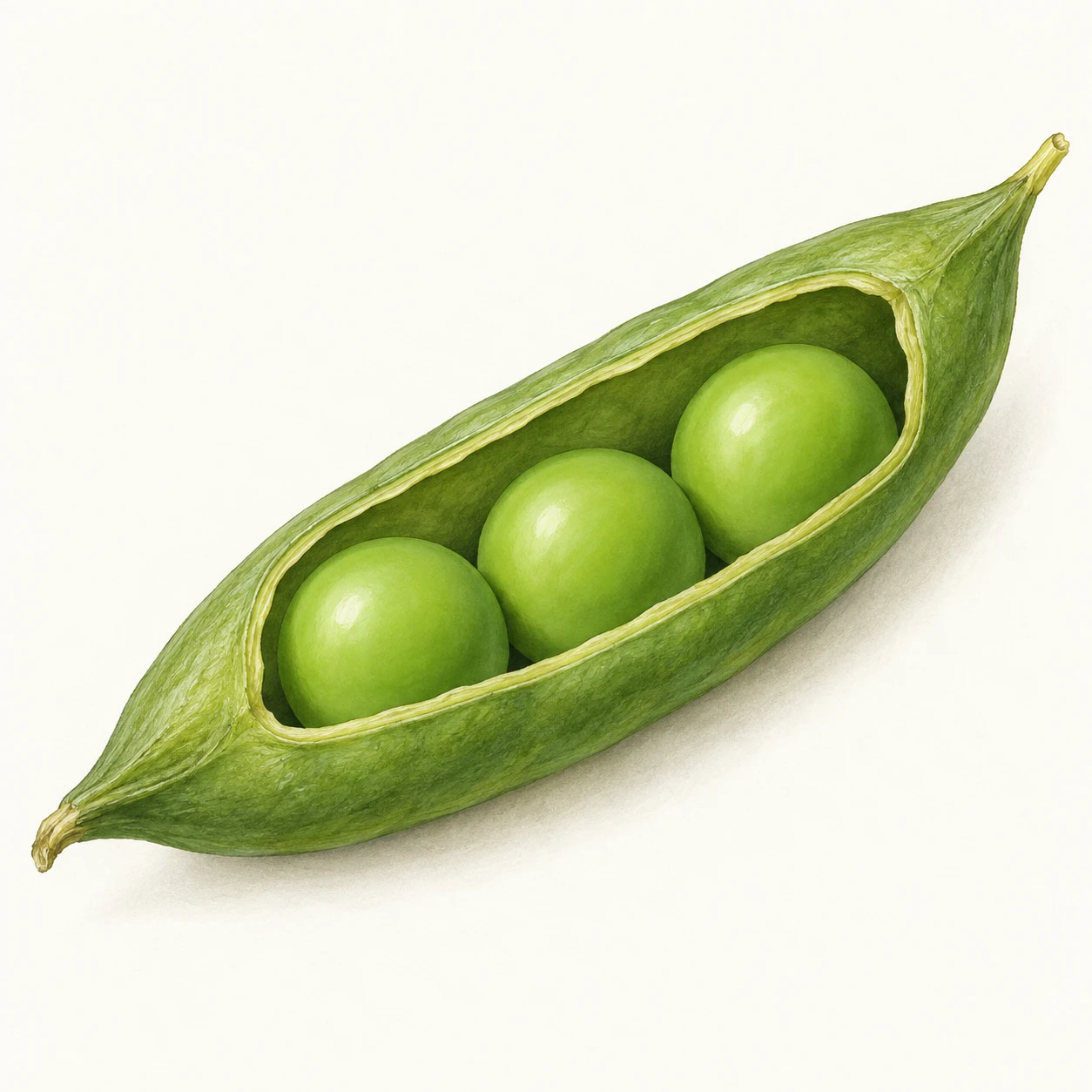
An illustration that removes part of a pod’s front shell, using the remaining shell and cut rim to explain the arrangement of three peas.
One Pea Pod · Partial Cutaway Reveal
- Shape & line
- Draw the pod as one tapered curved enclosure, then interrupt its front surface with an elongated cutaway window. Trace the opening with a narrow double contour that visibly shows shell thickness; keep the outer silhouette continuous around both pointed ends.
- Color & light
- Use muted leaf green for the outer shell, pale yellow-green for the cut rim, and fresher green for the peas. Light from image upper left, placing soft shadows on each pea’s lower-right side and darker contact crescents where the peas meet the inner shell.
- Texture & material
- Render the shell with restrained lengthwise fibers and a matte painted surface, while keeping the peas smooth with broad soft highlights. Give the exposed rim a clean, slightly irregular edge so it reads as cut plant tissue rather than a transparent surface.
- Composition
- Keep the near rim along the image lower-right edge of the opening, overlapping a small portion of each pea’s lower edge. Show the rear shell above and behind the peas toward image upper left, preserving enough visible cavity between them to explain how the contents sit inside.
Priority
Make the removed front shell and the seated arrangement of three peas immediately readable.
What to avoid & what to check
Avoid making the entire shell transparent or placing the peas outside the cavity.
Confirm that exactly three peas sit behind the near rim and in front of the intact rear shell.
Exact prompt for this example
SUBJECT
Show one green pea pod containing exactly three round peas in a single row. Remove a broad window from the shell facing the viewer while keeping both pointed ends, the rear shell, and a continuous rim intact. The peas remain seated inside the pod.

COMPOSITION
Use a close three-quarter view with the pod running diagonally from image lower left to upper right. Face the cutaway window toward the viewer so all three peas and the shell behind them are readable. Center the pod with generous pale background margins.

STYLE GUIDE
1. Shape & line
Draw the pod as one tapered curved enclosure, then interrupt its front surface with an elongated cutaway window. Trace the opening with a narrow double contour that visibly shows shell thickness; keep the outer silhouette continuous around both pointed ends.

2. Color & light
Use muted leaf green for the outer shell, pale yellow-green for the cut rim, and fresher green for the peas. Light from image upper left, placing soft shadows on each pea’s lower-right side and darker contact crescents where the peas meet the inner shell.

3. Texture & material
Render the shell with restrained lengthwise fibers and a matte painted surface, while keeping the peas smooth with broad soft highlights. Give the exposed rim a clean, slightly irregular edge so it reads as cut plant tissue rather than a transparent surface.

4. Composition
Keep the near rim along the image lower-right edge of the opening, overlapping a small portion of each pea’s lower edge. Show the rear shell above and behind the peas toward image upper left, preserving enough visible cavity between them to explain how the contents sit inside.

PRIORITY
Preserve the requested identity, count, action, composition and output settings. Apply the style rules within those constraints; a style reference must not replace the subject or layout. Within the style: Make the removed front shell and the seated arrangement of three peas immediately readable.

AVOID
Avoid making the entire shell transparent or placing the peas outside the cavity.

OUTPUT
Create one square botanical explanatory illustration, with no lettering, labels, arrows, or watermark.

SELF-CHECK
Confirm that exactly three peas sit behind the near rim and in front of the intact rear shell.
Model information comes from image provenance. The same prompt may produce a different result.