Text to imageLandscapeStyle guide
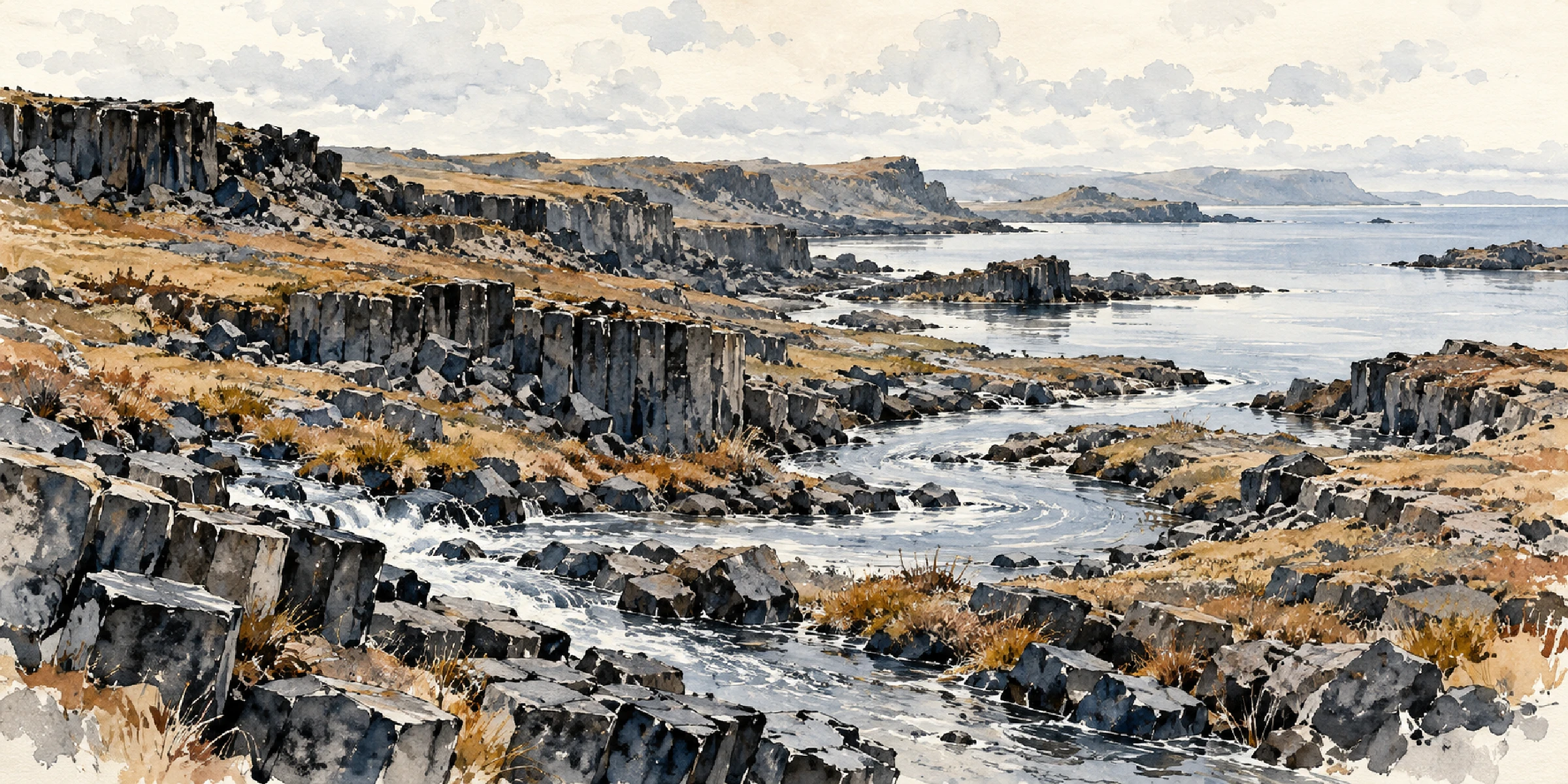
A Stream Through Fallen Basalt Columns
A stream threads through fallen basalt columns toward an open sea inlet. Broken ink strokes and spreading washes give the terrain rhythm within generous negative space.
Remix this referenceA Stream Through Fallen Basalt Columns
- Form language
- Reduce forms to interlocking wedges and interrupted bands; preserve irregular silhouettes rather than repeating identical units.
- Contour
- Use assertive, broken brush contours on selected edges, letting other boundaries dissolve or remain entirely unstated.
- Mark-making
- Alternate dragging dry-brush strokes with quick reed-like flicks; allow mark length and pressure to vary naturally.
- Surface rendering
- Float transparent ink washes into uneven pools and soft blooms; preserve untouched paper between selective layers.
Priority
Make editorial ink wash visible through decisive brushwork, spreading washes and open paper.
What to avoid & what to check
Exact prompt for this example
MODULE OWNERSHIP
subject: Subject count, type, stable proportions and landmarks, resting face geometry, hair shape, physical materials, garment construction and permanent marks. No emotion, movement, color assignment or rendering recipe.
expression: Facial soft-tissue displacement and pupil direction, muscle coordination, regional intensity, asymmetry and onset/peak/release. No head/body pose, stable appearance, skin color or rendering.
gesture: Head/neck/body/limb orientation, joint movement, support, contact and pose-caused occlusion using existing anatomy. No eye/pupil movement, emotion, identity, props inventory or camera.
props: Prop count, type, construction, physical material and scale relative to the subject. Holding/contact belongs to gesture, position to composition, color to palette.
scene: Environment elements, terrain, backdrop/floor presence and structural detail. No canvas positions, camera, lighting, assigned colors or render texture.
camera: Projection, focal-length impression, camera elevation/yaw/roll, viewing distance and crop. No actor pose, world placement, lighting or canvas aspect ratio.
composition: Normalized 0-100% canvas positions, scale in frame, depth/overlap, focal hierarchy and margins. No joint pose, camera projection, rendering, subject/prop inventory or emotion.
palette: Color anchors, hue/saturation/value ranges, colors assigned to parts and approximate color coverage. No illumination direction, shading algorithm, physical material or layout.
lighting: Light-source direction/softness/intensity, ambient illumination, physical shadow direction/length and highlight position. Absence of directional illumination is allowed. No shading technique, palette or material changes.
style: Reusable form abstraction, contour weight/taper/edge quality, medium and mark scale/density/direction, surface rendering and tonal transition technique. No fixed subject proportions, anatomy, identity, expression, pose, palette, light-source direction, camera or layout.
output: Image count, aspect ratio, size, file/alpha requirements and global lettering/logo/watermark restrictions. No background scenery, crop, style, identity or pose.

SUBJECT
inventory: No discrete character or object subject; the environment carries the image.
geometry: No separate subject geometry applies.
resting-face: No faces are present.
appearance: No character appearance or garments apply.

PRIORITY


AVOID


CHECK


PROPS
inventory: No separate props.
construction: No prop construction applies.

PRIORITY


AVOID


CHECK


SCENE
inventory: A coastal basalt field contains a winding stream, low sedges, an eroded escarpment and a sheltered sea inlet.
structure: Fallen polygonal columns form irregular heaps; the stream passes between exposed column ends before widening into the inlet. Basalt upper edges beside the stream are wet.

PRIORITY


AVOID


CHECK


CAMERA
projection: Use natural perspective with a moderately wide lens impression and restrained edge expansion.
viewpoint: Look slightly downward from a low hillside, obliquely along the stream toward the coast; keep the camera level.
crop: Take an expansive environmental view, cropping nearby rubble while retaining the distant inlet and horizon.

PRIORITY


AVOID


CHECK


COMPOSITION
placement: Begin the stream near the lower left, bend it through the middle and release it into the spacious upper-right inlet.
depth: Overlapping column ends establish the foreground; successive bends lead beyond a broken midground ridge.
spacing: Make the stream's passage the focal journey; balance crowded rubble against broad, quiet water and sky.

PRIORITY


AVOID


CHECK


PALETTE
colors: Use blue-black, diluted slate, warm ivory and a small amount of rusty ochre.
assignment: Give basalt blue-black and slate, water pale slate, sky ivory, and scattered sedges rusty ochre.
balance: Keep the overall range pale and restrained, with concentrated dark accents and sparse warm interruptions.

PRIORITY


AVOID


CHECK


LIGHTING
sources: Broad overcast daylight arrives from the upper left with abundant ambient fill.
shadows: Soft, short shadows fall to the right beneath projecting columns; crevices retain deeper shade.
highlights: Keep highlights broad and subdued along streamside upper edges and exposed water surfaces.

PRIORITY


AVOID


CHECK


STYLE GUIDE
form-language: Reduce forms to interlocking wedges and interrupted bands; preserve irregular silhouettes rather than repeating identical units.
contour: Use assertive, broken brush contours on selected edges, letting other boundaries dissolve or remain entirely unstated.
mark-making: Alternate dragging dry-brush strokes with quick reed-like flicks; allow mark length and pressure to vary naturally.
surface-rendering: Float transparent ink washes into uneven pools and soft blooms; preserve untouched paper between selective layers.

PRIORITY
Make editorial ink wash visible through decisive brushwork, spreading washes and open paper.

AVOID


CHECK


OUTPUT
format: One finished image, 2:1 aspect ratio, 2400 × 1200 pixels, opaque PNG.
restrictions: No lettering, logos or watermarks.

PRIORITY


AVOID


CHECK


FINAL INTEGRATION
scene + camera + composition: Coordinate terrain continuity and the view so the visual journey remains legible without regularizing the natural forms.
Model information comes from image provenance. The same prompt may produce a different result.