Text to imageProductStyle guide
Book Press and Folded Sheets
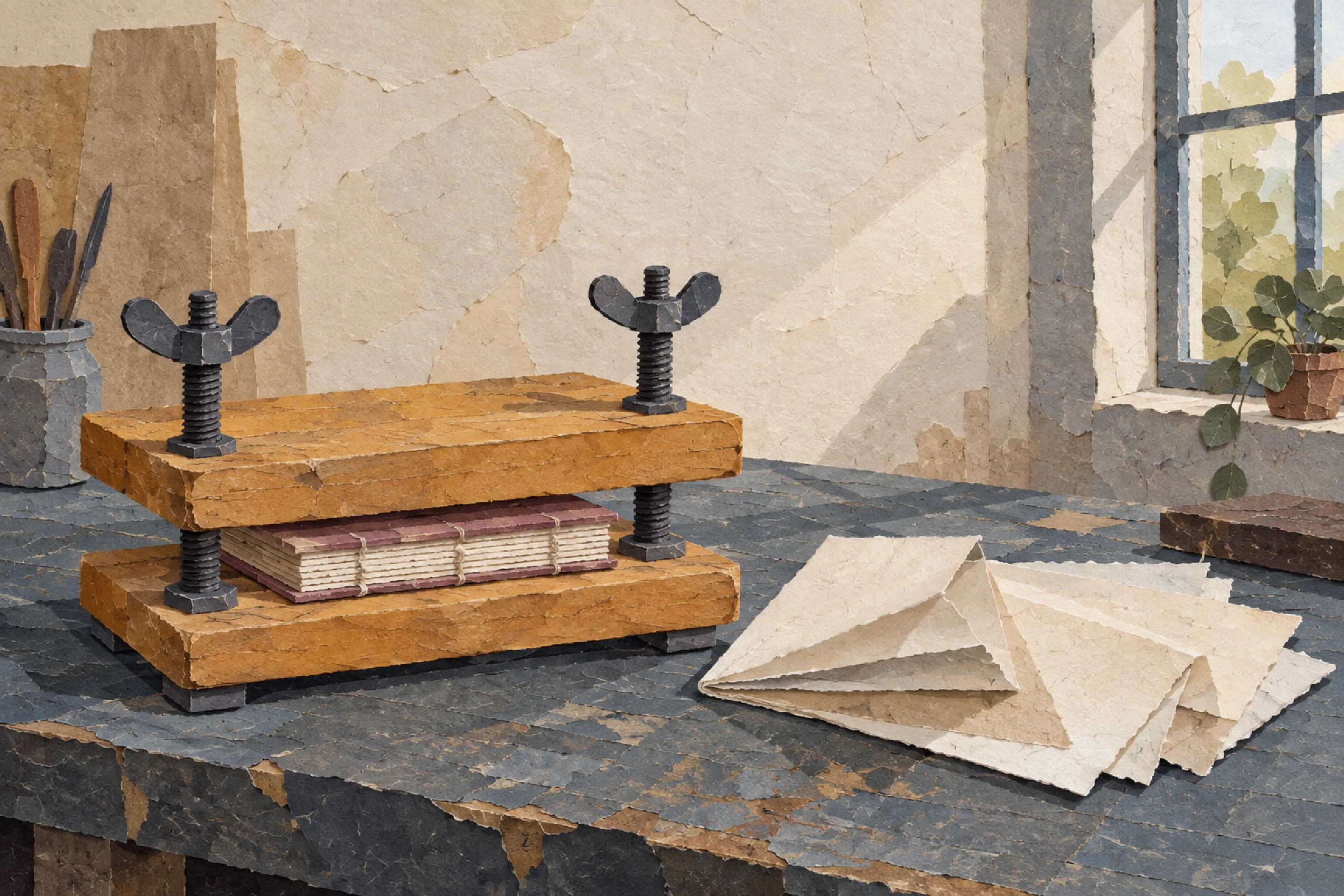
A compact wooden book press and a fan of folded sheets in a bindery. Layered paper collage and generous space reveal the tool's construction and the warmth of handmade work.
Remix this referenceBook Press and Folded Sheets
- Form language
- Reduce forms to interlocking cut silhouettes and folded planes; preserve useful construction cues while allowing handmade irregularity.
- Contour
- Let scissor-cut boundaries define contours, mixing decisive straight cuts with gently wavering curves and occasional torn interruptions.
- Mark-making
- Use layered colored paper with sparse rubbed-pencil accents and visible fibers; vary small surface marks without repeating a texture pattern.
- Surface rendering
- Build tones through overlapping paper shapes and lightly stained sheets; lifted edges reveal the layered assembly, while stains soften tonal transitions.
Priority
Make layered cut-paper construction and tactile overlaps clearly visible.
What to avoid & what to check
Exact prompt for this example
MODULE OWNERSHIP
subject: Subject count, type, stable proportions and landmarks, resting face geometry, hair shape, physical materials, garment construction and permanent marks. No emotion, movement, color assignment or rendering recipe.
expression: Facial soft-tissue displacement and pupil direction, muscle coordination, regional intensity, asymmetry and onset/peak/release. No head/body pose, stable appearance, skin color or rendering.
gesture: Head/neck/body/limb orientation, joint movement, support, contact and pose-caused occlusion using existing anatomy. No eye/pupil movement, emotion, identity, props inventory or camera.
props: Prop count, type, construction, physical material and scale relative to the subject. Holding/contact belongs to gesture, position to composition, color to palette.
scene: Environment elements, terrain, backdrop/floor presence and structural detail. No canvas positions, camera, lighting, assigned colors or render texture.
camera: Projection, focal-length impression, camera elevation/yaw/roll, viewing distance and crop. No actor pose, world placement, lighting or canvas aspect ratio.
composition: Normalized 0-100% canvas positions, scale in frame, depth/overlap, focal hierarchy and margins. No joint pose, camera projection, rendering, subject/prop inventory or emotion.
palette: Color anchors, hue/saturation/value ranges, colors assigned to parts and approximate color coverage. No illumination direction, shading algorithm, physical material or layout.
lighting: Light-source direction/softness/intensity, ambient illumination, physical shadow direction/length and highlight position. Absence of directional illumination is allowed. No shading technique, palette or material changes.
style: Reusable form abstraction, contour weight/taper/edge quality, medium and mark scale/density/direction, surface rendering and tonal transition technique. No fixed subject proportions, anatomy, identity, expression, pose, palette, light-source direction, camera or layout.
output: Image count, aspect ratio, size, file/alpha requirements and global lettering/logo/watermark restrictions. No background scenery, crop, style, identity or pose.

SUBJECT
inventory: One compact, unbranded tabletop book press.
geometry: Two broad rectangular platens are joined by paired upright screw posts with wing-shaped tightening handles.
resting-face: No face or facial landmarks.
appearance: Solid timber platens and steel screw hardware, with softened board corners and modest signs of workshop use.

PRIORITY


AVOID


CHECK


PROPS
inventory: One slim sewn book block with card cover panels and a small group of folded paper sheets, sized for the press.
construction: Front and back cover panels leave the stitched spine exposed; loose sheets have broad folds and subtly irregular deckled edges.

PRIORITY


AVOID


CHECK


SCENE
inventory: A quiet bindery with a long workbench, a plaster wall and a tall recessed window.
structure: The bench meets an unadorned wall; the window recess provides the room's only substantial architectural detail.

PRIORITY


AVOID


CHECK


CAMERA
projection: Gentle perspective with a normal-lens impression; parallel edges converge subtly.
viewpoint: A moderately elevated three-quarter view from the front reveals both the platen tops and screw hardware.
crop: A medium-wide view keeps the whole press and loose sheets visible, with portions of the bench and window.

PRIORITY


AVOID


CHECK


COMPOSITION
placement: Place the press low and left of center; folded sheets fan toward the right beneath a spacious wall area.
depth: The book block sits between the platens; overlapping sheets extend into the foreground, with the window farther back.
spacing: The press leads, the paper fan answers, and the open wall supplies a long pause; preserve clear outer margins.

PRIORITY


AVOID


CHECK


PALETTE
colors: Honey ochre, slate blue, dusty rose and warm cream, with charcoal as a restrained dark anchor.
assignment: Ochre platens, charcoal hardware, cream pages and wall, slate bench, and dusty-rose cover panels.
balance: Cream occupies the broadest area; ochre and slate establish the main contrast, with rose used sparingly.

PRIORITY


AVOID


CHECK


LIGHTING
sources: Broad window light enters from the upper right, moderately bright against soft room ambient light.
shadows: Soft shadows fall leftward across the bench, with small contact shadows beneath overlaps; lifted collage edges cast narrow relief shadows leftward.
highlights: Upper-right platen edges and screw handles catch restrained highlights.

PRIORITY


AVOID


CHECK


STYLE GUIDE
form-language: Reduce forms to interlocking cut silhouettes and folded planes; preserve useful construction cues while allowing handmade irregularity.
contour: Let scissor-cut boundaries define contours, mixing decisive straight cuts with gently wavering curves and occasional torn interruptions.
mark-making: Use layered colored paper with sparse rubbed-pencil accents and visible fibers; vary small surface marks without repeating a texture pattern.
surface-rendering: Build tones through overlapping paper shapes and lightly stained sheets; lifted edges reveal the layered assembly, while stains soften tonal transitions.

PRIORITY
Make layered cut-paper construction and tactile overlaps clearly visible.

AVOID


CHECK


OUTPUT
format: One finished 3:2 image, 2400 × 1600 pixels, opaque PNG.
restrictions: No lettering, logos or watermarks.

PRIORITY


AVOID


CHECK


FINAL INTEGRATION
subject + style: Keep the product's construction readable through the collage's simplified shapes.
composition + style: Use overlapping layers to support the visual rhythm while leaving the open areas restful.
lighting + style: Keep depicted room shadows distinct from the subtle relief shadows of the paper medium.
Model information comes from image provenance. The same prompt may produce a different result.