Text to imageCharacterStyle guide
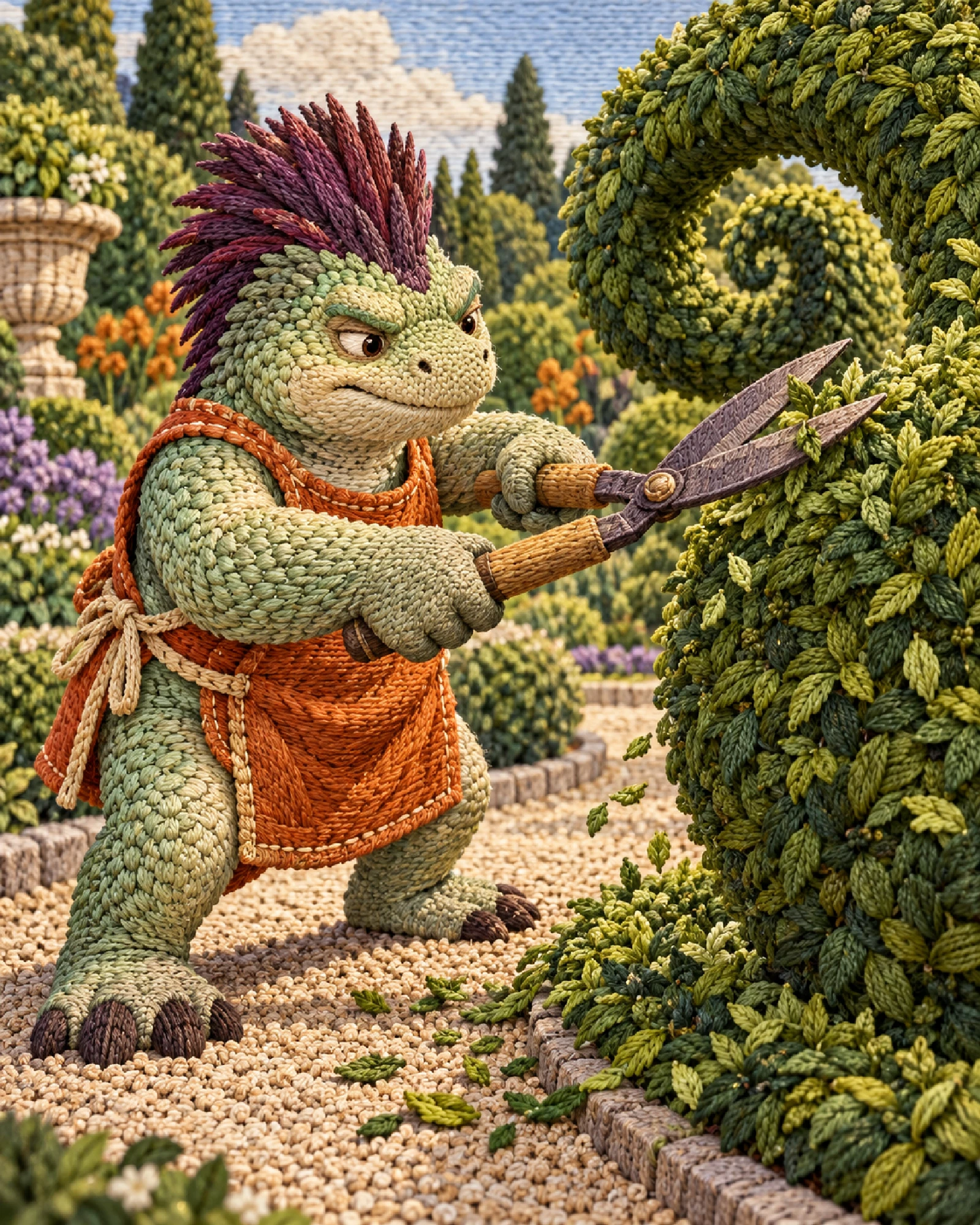
A Gardener Trimming a Spiral Hedge
A little gardener with a bristled crest trims a spiral hedge. Overlapping arms, shears and foliage make a lively moment in raised, richly worked embroidery.
Remix this referenceA Gardener Trimming a Spiral Hedge
- Form language
- Reduce forms to interlocking rounded wedges and generous curves; allow small handmade irregularities within a consistent vocabulary.
- Contour
- Couched cords create substantial, slightly wandering boundaries, thinning into single strands at delicate edges.
- Mark-making
- Directional satin stitches bend with each shape; occasional seed knots interrupt the flow with naturally varied spacing.
- Surface rendering
- Layer padded stitches into tangible relief, with visible strand separation, slight cloth puckering and soft transitions made by interleaving threads.
Priority
The embroidery must read as built thread relief rather than a printed textile pattern.
What to avoid & what to check
Exact prompt for this example
MODULE OWNERSHIP
subject: Subject count, type, stable proportions and landmarks, resting face geometry, hair shape, physical materials, garment construction and permanent marks. No emotion, movement, color assignment or rendering recipe.
expression: Facial soft-tissue displacement and pupil direction, muscle coordination, regional intensity, asymmetry and onset/peak/release. No head/body pose, stable appearance, skin color or rendering.
gesture: Head/neck/body/limb orientation, joint movement, support, contact and pose-caused occlusion using existing anatomy. No eye/pupil movement, emotion, identity, props inventory or camera.
props: Prop count, type, construction, physical material and scale relative to the subject. Holding/contact belongs to gesture, position to composition, color to palette.
scene: Environment elements, terrain, backdrop/floor presence and structural detail. No canvas positions, camera, lighting, assigned colors or render texture.
camera: Projection, focal-length impression, camera elevation/yaw/roll, viewing distance and crop. No actor pose, world placement, lighting or canvas aspect ratio.
composition: Normalized 0-100% canvas positions, scale in frame, depth/overlap, focal hierarchy and margins. No joint pose, camera projection, rendering, subject/prop inventory or emotion.
palette: Color anchors, hue/saturation/value ranges, colors assigned to parts and approximate color coverage. No illumination direction, shading algorithm, physical material or layout.
lighting: Light-source direction/softness/intensity, ambient illumination, physical shadow direction/length and highlight position. Absence of directional illumination is allowed. No shading technique, palette or material changes.
style: Reusable form abstraction, contour weight/taper/edge quality, medium and mark scale/density/direction, surface rendering and tonal transition technique. No fixed subject proportions, anatomy, identity, expression, pose, palette, light-source direction, camera or layout.
output: Image count, aspect ratio, size, file/alpha requirements and global lettering/logo/watermark restrictions. No background scenery, crop, style, identity or pose.

SUBJECT
inventory: One original nonhuman gardener, actor A.
geometry: A broad trapezoid head, short barrel torso and broad feet; a stiff brushlike crest gives a distinctive silhouette.
resting-face: Small oval eyes sit above a broad short muzzle; the resting mouth is a shallow horizontal cleft.
appearance: Pebbled hide, coarse crest bristles and a canvas tabard with side ties; minor surface details may vary coherently.

PRIORITY


AVOID


CHECK


EXPRESSION — ACTOR A
brows: Inner brows draw slightly together, with one sitting a little lower.
lids: Upper lids lower slightly while lower lids remain gently firm.
cheeks: Cheeks stay mostly relaxed, with a small tightening beside the mouth.
nose: Nostrils remain relaxed without a wrinkle across the muzzle.
mouth: Lips press together lightly; one corner tucks inward.
jaw: Jaw stays closed without a hard clench.
gaze: Both pupils track the meeting point of the shear blades.
coordination: The narrowed upper face leads the acting; the mouth adds restrained effort.
timing: Hold the apex of concentration during a precise snip.

PRIORITY


AVOID


CHECK


GESTURE
head: A extends the neck slightly and inclines the head toward the cutting point.
torso: The torso leans forward from a stable, staggered stance.
limbs: Bent elbows spread apart as both arms close the shears; the rear heel lifts slightly.
contact: Each hand grips one handle; the blades enclose a leafy tip, and the forward foot bears the weight.

PRIORITY


AVOID


CHECK


PROPS
inventory: One pair of hedge shears, roughly as long as A's torso.
construction: Two broad steel blades share a pivot and extend into rounded wooden handles.

PRIORITY


AVOID


CHECK


SCENE
inventory: A garden with one spiral topiary, a narrow gravel path and freshly clipped leaves.
structure: The hedge forms a thick ascending curl with an open hollow; irregular garden beds border the path.

PRIORITY


AVOID


CHECK


CAMERA
projection: Gentle natural perspective with a normal-lens impression.
viewpoint: View from A's chest height at a three-quarter angle, with a level horizon.
crop: Show A's whole figure and the shears; let the upper hedge continue beyond the frame.

PRIORITY


AVOID


CHECK


COMPOSITION
placement: A occupies the left half, the hedge sweeps through the right, and their meeting point sits just off center.
depth: The arms and shears overlap the hedge; the face leads, followed by the cutting point and spiral opening.
spacing: Leave breathing room around the crest and a generous open wedge of path below the working arms.

PRIORITY


AVOID


CHECK


PALETTE
colors: Moss green, pale celadon, burnt orange, deep plum and warm flax.
assignment: Celadon hide, plum crest, orange tabard, moss foliage and flax ground; shears use muted plum and flax.
balance: Greens and flax dominate; the orange garment is the concentrated saturated accent.

PRIORITY


AVOID


CHECK


LIGHTING
sources: Broad soft light from the upper left, with gentle ambient fill.
shadows: Short shadows fall toward the lower right; close overlaps retain small contact shadows.
highlights: Fine highlights catch the upper-left edges of raised surfaces.

PRIORITY


AVOID


CHECK


STYLE GUIDE
form-language: Reduce forms to interlocking rounded wedges and generous curves; allow small handmade irregularities within a consistent vocabulary.
contour: Couched cords create substantial, slightly wandering boundaries, thinning into single strands at delicate edges.
mark-making: Directional satin stitches bend with each shape; occasional seed knots interrupt the flow with naturally varied spacing.
surface-rendering: Layer padded stitches into tangible relief, with visible strand separation, slight cloth puckering and soft transitions made by interleaving threads.

PRIORITY
The embroidery must read as built thread relief rather than a printed textile pattern.

AVOID


CHECK


OUTPUT
format: One finished image, 4:5 portrait, 1600 × 2000 pixels, opaque PNG.
restrictions: No lettering, logos or watermarks.

PRIORITY


AVOID


CHECK


FINAL INTEGRATION
expression + gesture + composition: Keep the acting readable through the working overlaps without interrupting the action.
Model information comes from image provenance. The same prompt may produce a different result.