Text to imageCalligraphyStyle guide
Hangul in Broad Ribbon Strokes
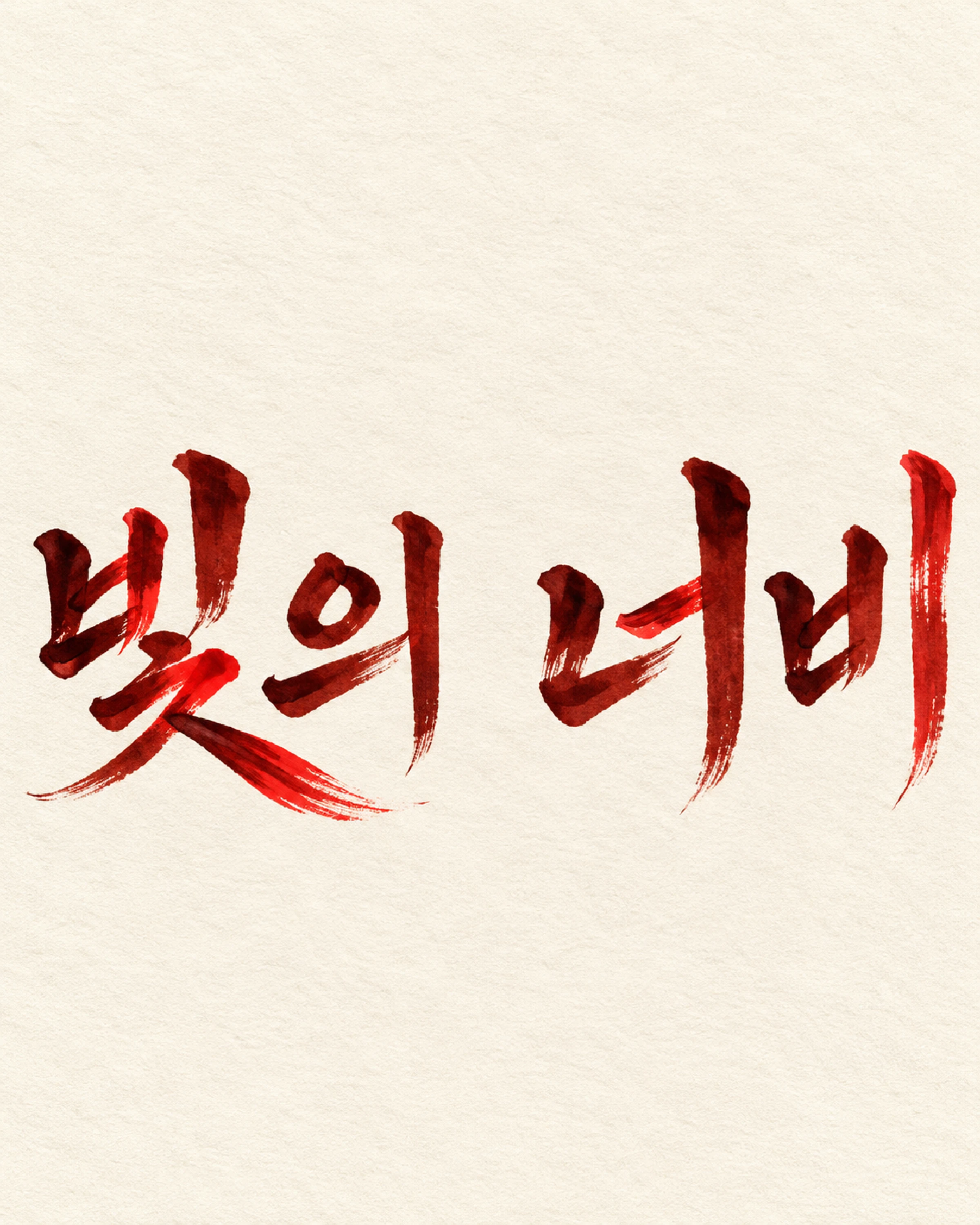
Oxblood ribbon strokes spread into scarlet turns, with open counters and generous empty space revealing the lettering’s rhythm.
Remix this referenceHangul in Broad Ribbon Strokes
- Form language
- Build broad-nib lettering from confident ribbon-like bands and slender blade joins; alternate expansive sweeps with compact turns.
- Contour
- Use chisel-cut entries, supple long edges and tapered exits, allowing occasional slight edge drag instead of mechanically uniform outlines.
- Mark-making
- Let long strokes carry faint parallel nib tracks; concentrate ink at turns and allow natural differences between successive passes.
- Surface rendering
- Use translucent ink with darker overlaps and softly feathered absorption at a few edges; preserve luminous paper through lighter deposits.
Priority
Emphasize the broad nib’s expressive rhythm between wide ribbon strokes and slender joins.
What to avoid & what to check
Exact prompt for this example
MODULE OWNERSHIP
subject: Subject count, type, stable proportions and landmarks, resting face geometry, hair shape, physical materials, garment construction and permanent marks. No emotion, movement, color assignment or rendering recipe.
expression: Facial soft-tissue displacement and pupil direction, muscle coordination, regional intensity, asymmetry and onset/peak/release. No head/body pose, stable appearance, skin color or rendering.
gesture: Head/neck/body/limb orientation, joint movement, support, contact and pose-caused occlusion using existing anatomy. No eye/pupil movement, emotion, identity, props inventory or camera.
props: Prop count, type, construction, physical material and scale relative to the subject. Holding/contact belongs to gesture, position to composition, color to palette.
scene: Environment elements, terrain, backdrop/floor presence and structural detail. No canvas positions, camera, lighting, assigned colors or render texture.
camera: Projection, focal-length impression, camera elevation/yaw/roll, viewing distance and crop. No actor pose, world placement, lighting or canvas aspect ratio.
composition: Normalized 0-100% canvas positions, scale in frame, depth/overlap, focal hierarchy and margins. No joint pose, camera projection, rendering, subject/prop inventory or emotion.
palette: Color anchors, hue/saturation/value ranges, colors assigned to parts and approximate color coverage. No illumination direction, shading algorithm, physical material or layout.
lighting: Light-source direction/softness/intensity, ambient illumination, physical shadow direction/length and highlight position. Absence of directional illumination is allowed. No shading technique, palette or material changes.
style: Reusable form abstraction, contour weight/taper/edge quality, medium and mark scale/density/direction, surface rendering and tonal transition technique. No fixed subject proportions, anatomy, identity, expression, pose, palette, light-source direction, camera or layout.
output: Image count, aspect ratio, size, file/alpha requirements and global lettering/logo/watermark restrictions. No background scenery, crop, style, identity or pose.

SUBJECT
inventory: One original Hangul calligraphic inscription; no figures or pictorial motifs.
geometry: Write exactly "빛의 너비" with recognizable syllable blocks, distinct consonants and vowels, and generous open counters.
resting-face: No faces or facial geometry.
appearance: The inscription consists of ink deposited directly on an uncoated paper sheet.

PRIORITY


AVOID


CHECK


PROPS
inventory: No separate props.
construction: No prop construction applies.

PRIORITY


AVOID


CHECK


SCENE
inventory: An uninterrupted paper field forms the entire setting.
structure: No depicted room, landscape, floor, horizon or border structure.

PRIORITY


AVOID


CHECK


CAMERA
projection: Orthographic graphic reproduction without perspective convergence.
viewpoint: Look squarely at the paper plane with no yaw, tilt or roll.
crop: Show the complete inscription; the physical sheet edges remain outside the crop.

PRIORITY


AVOID


CHECK


COMPOSITION
placement: Set the phrase in one broad horizontal band below mid-height, beginning near the left margin and stopping short of the right.
depth: Keep a single graphic plane; the broad letter masses lead, followed by their internal openings and the word space.
spacing: Leave the upper half largely empty; use unequal inter-block gaps and a generous word break without crowding the margins.

PRIORITY


AVOID


CHECK


PALETTE
colors: Use deep oxblood, vivid scarlet and warm ivory as the three color anchors.
assignment: Assign oxblood to most lettering, scarlet to selected returning strokes, and ivory to the paper.
balance: Ivory dominates the field; oxblood supplies visual weight, while scarlet remains a concentrated accent.

PRIORITY


AVOID


CHECK


LIGHTING
sources: Use even, diffuse ambient illumination without a visible directional source.
shadows: No cast shadows or directional shading across the sheet.
highlights: No localized specular highlights.

PRIORITY


AVOID


CHECK


STYLE GUIDE
form-language: Build broad-nib lettering from confident ribbon-like bands and slender blade joins; alternate expansive sweeps with compact turns.
contour: Use chisel-cut entries, supple long edges and tapered exits, allowing occasional slight edge drag instead of mechanically uniform outlines.
mark-making: Let long strokes carry faint parallel nib tracks; concentrate ink at turns and allow natural differences between successive passes.
surface-rendering: Use translucent ink with darker overlaps and softly feathered absorption at a few edges; preserve luminous paper through lighter deposits.

PRIORITY
Emphasize the broad nib’s expressive rhythm between wide ribbon strokes and slender joins.

AVOID


CHECK


OUTPUT
format: One finished image, portrait 4:5, 2400 × 3000 pixels, opaque PNG.
restrictions: Allow primary lettering; forbid additional text, logos and watermarks.

PRIORITY


AVOID


CHECK


FINAL INTEGRATION
subject + output: The subject inscription "빛의 너비" is the primary lettering authorized by output.
Model information comes from image provenance. The same prompt may produce a different result.