Text to imageAnimationStyle guide
Thawing Her Whistle
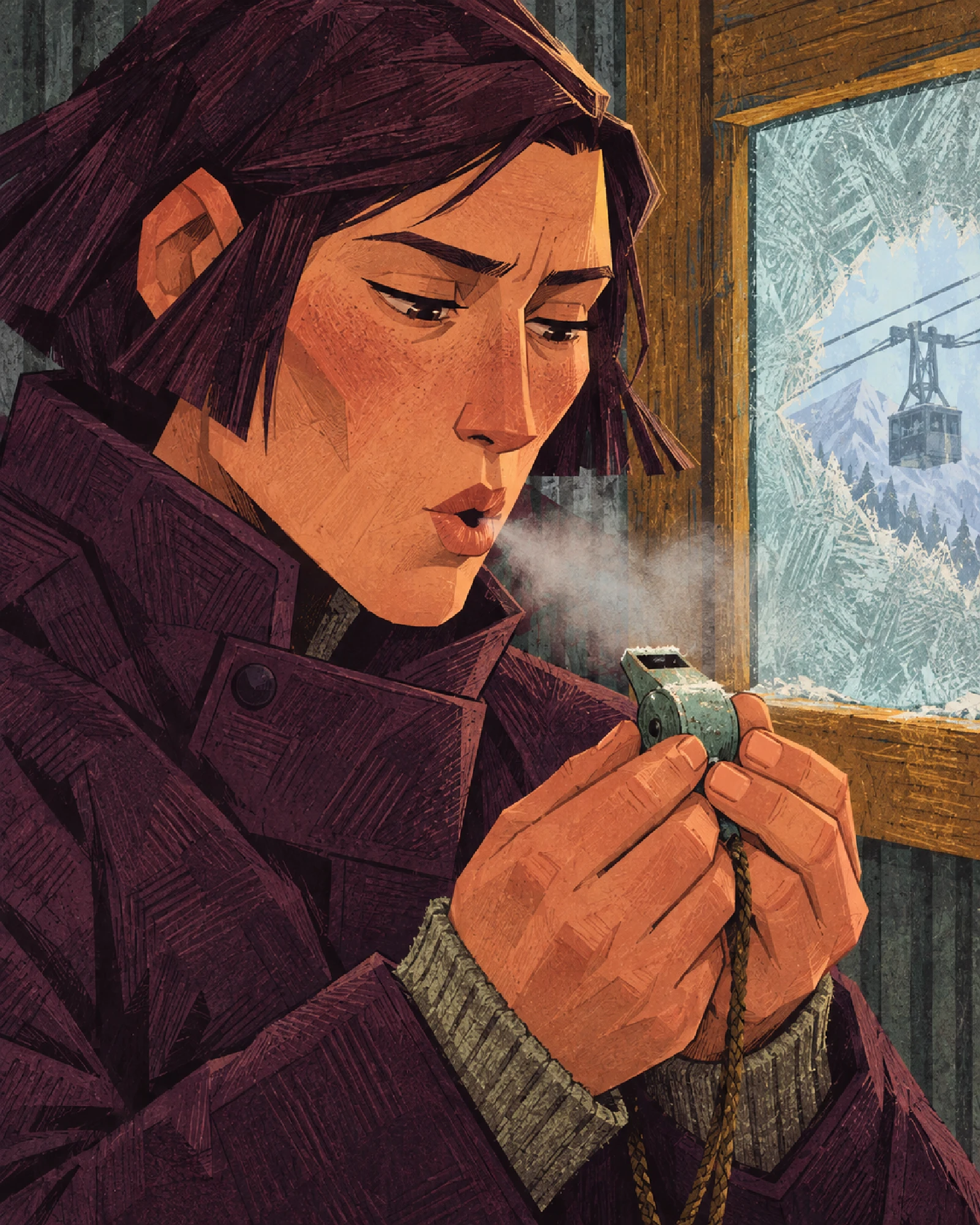
Inside a mountain cable-car shelter, an attendant breathes onto a frost-bound whistle. Angular carved lines and short hatching give this small act of warmth a tactile presence.
Remix this referenceThawing Her Whistle
- Form language
- Translate surfaces into interlocking angular planes with occasional broad curves; simplify minor details freely within this vocabulary.
- Contour
- Use slightly irregular straight and angular contours, with blunt turns, uneven pressure and occasional carved-looking breaks.
- Mark-making
- Gather short parallel hatches into loose directional groups; add a few scratched strokes with naturally varied lengths and gaps.
- Surface rendering
- Build flat printed planes with limited paper grain and hatched tonal regions; use stepped transitions rather than continuous volume modeling.
Priority
Rendering medium: 2D woodcut-print animated-film illustration; formal rendering reference: Cartoon Saloon · 2020s · Wolfwalkers (2020), town sequences
What to avoid & what to check
Exact prompt for this example
MODULE OWNERSHIP
subject: Subject count, type, stable proportions and landmarks, resting face geometry, hair shape, physical materials, garment construction and permanent marks. No emotion, movement, color assignment or rendering recipe.
expression: Facial soft-tissue displacement and pupil direction, muscle coordination, regional intensity, asymmetry and onset/peak/release. No head/body pose, stable appearance, skin color or rendering.
gesture: Head/neck/body/limb orientation, joint movement, support, contact and pose-caused occlusion using existing anatomy. No eye/pupil movement, emotion, identity, props inventory or camera.
props: Prop count, type, construction, physical material and scale relative to the subject. Holding/contact belongs to gesture, position to composition, color to palette.
scene: Environment elements, terrain, backdrop/floor presence and structural detail. No canvas positions, camera, lighting, assigned colors or render texture.
camera: Projection, focal-length impression, camera elevation/yaw/roll, viewing distance and crop. No actor pose, world placement, lighting or canvas aspect ratio.
composition: Normalized 0-100% canvas positions, scale in frame, depth/overlap, focal hierarchy and margins. No joint pose, camera projection, rendering, subject/prop inventory or emotion.
palette: Color anchors, hue/saturation/value ranges, colors assigned to parts and approximate color coverage. No illumination direction, shading algorithm, physical material or layout.
lighting: Light-source direction/softness/intensity, ambient illumination, physical shadow direction/length and highlight position. Absence of directional illumination is allowed. No shading technique, palette or material changes.
style: Reusable form abstraction, contour weight/taper/edge quality, medium and mark scale/density/direction, surface rendering and tonal transition technique. No fixed subject proportions, anatomy, identity, expression, pose, palette, light-source direction, camera or layout.
output: Image count, aspect ratio, size, file/alpha requirements and global lettering/logo/watermark restrictions. No background scenery, crop, style, identity or pose.

SUBJECT
inventory: One adult woman, a mountain cable-car attendant; no other figures.
geometry: A sturdy build, broad hands and a long face with prominent cheekbones; short hair forms a blunt wedge behind each ear.
resting-face: Straight brows, deep-set almond eyes, a broad nasal bridge and a wide mouth above a rounded square chin.
appearance: A heavy wool work coat has a stand collar and overlapping front closure; knitted cuffs extend beneath its sleeves.

PRIORITY


AVOID


CHECK


EXPRESSION — ACTOR A
brows: Inner brows lower slightly, with one brow a little more contracted.
lids: Upper lids lower gently; lower lids tighten without closing the eyes.
cheeks: Cheeks round subtly with the sustained outward breath.
nose: Nostrils remain relaxed, with no wrinkling at the bridge.
mouth: Lips project into a small rounded opening, slightly uneven at the corners.
jaw: The jaw releases just enough to keep the lips softly separated.
gaze: Pupils aim down toward the whistle.
coordination: Mild brow concentration accompanies a controlled exhale; neither region becomes a grimace.
timing: Capture the apex of one steady exhale, before the lips relax.

PRIORITY


AVOID


CHECK


GESTURE
head: She inclines her head toward her hands, allowing the neck to fold naturally.
torso: Her upper back rounds slightly and both shoulders draw inward around the task.
limbs: Bent elbows stay low while both hands form a loose cup beneath her mouth.
contact: Fingertips cradle the whistle, leaving its rim exposed; the hands do not obscure her lips.

PRIORITY


AVOID


CHECK


PROPS
inventory: One thumb-sized whistle with an attached braided neck cord.
construction: The metal whistle is a flattened hollow capsule with a short mouthpiece; uneven frost clings to its rim.

PRIORITY


AVOID


CHECK


SCENE
inventory: A mountain cable-car shelter contains a frosted window, timber sill and corrugated wall; a small breath plume hangs in the air.
structure: A clear crescent interrupts the window frost, revealing a suspension cable beyond; the wall ribs run vertically.

PRIORITY


AVOID


CHECK


CAMERA
projection: Use a mild telephoto perspective with little near-to-far exaggeration.
viewpoint: View from face height at a shallow three-quarter yaw, with no camera roll.
crop: An intimate chest-up crop trims the rear hair edge and forearms while retaining the entire mouth and both hands.

PRIORITY


AVOID


CHECK


COMPOSITION
placement: The face fills the upper-left half; the smaller hands and whistle occupy the lower-right, forming one diagonal focal group.
depth: Hands overlap the coat; the breath bridges the open gap toward the face, with shelter details receding behind.
spacing: Give the mouth-to-whistle gap the clearest space; let the window opening provide a quieter margin beside the head.

PRIORITY


AVOID


CHECK


PALETTE
colors: Anchor the image in deep aubergine, muted ochre, pale celadon and a restrained coral accent.
assignment: Use aubergine for the coat and hair, ochre for timber, celadon for window frost and whistle, and coral for the face and hands.
balance: Keep aubergine broad and subdued; reserve pale values for frost and breath, with coral forming a compact warm accent.

PRIORITY


AVOID


CHECK


LIGHTING
sources: A soft off-frame shelter lamp shines from upper right; weaker diffuse window light fills from the left.
shadows: Short, soft shadows fall toward lower left beneath the nose, collar and fingers.
highlights: Small highlights touch the right brow ridge, upper knuckles and exposed whistle rim.

PRIORITY


AVOID


CHECK


STYLE GUIDE
form-language: Translate surfaces into interlocking angular planes with occasional broad curves; simplify minor details freely within this vocabulary.
contour: Use slightly irregular straight and angular contours, with blunt turns, uneven pressure and occasional carved-looking breaks.
mark-making: Gather short parallel hatches into loose directional groups; add a few scratched strokes with naturally varied lengths and gaps.
surface-rendering: Build flat printed planes with limited paper grain and hatched tonal regions; use stepped transitions rather than continuous volume modeling.

PRIORITY
Rendering medium: 2D woodcut-print animated-film illustration; formal rendering reference: Cartoon Saloon · 2020s · Wolfwalkers (2020), town sequences

AVOID


CHECK


OUTPUT
format: One finished image, portrait 4:5 aspect ratio, 1600 × 2000 pixels, opaque PNG.
restrictions: No lettering, logos or watermarks.

PRIORITY


AVOID


CHECK


FINAL INTEGRATION
expression + gesture + composition: Coordinate the visible exhale and hand action so the small intervening space carries the moment.
Art direction
카툰 살롱 / Cartoon Saloon · 2020s · 울프워커스(2020)의 도시 장면 / Wolfwalkers (2020), town sequences ↗- Transfer the angular planar abstraction of the town sequences to generic form surfaces
- Slightly irregular straight and angular contours resembling carved lines
- Short parallel hatch groups and restrained scratched marks
- Flat planes with limited paper texture and hatched tonal regions, without continuous modeling
Model information comes from image provenance. The same prompt may produce a different result.