Text to imageProductStyle guide
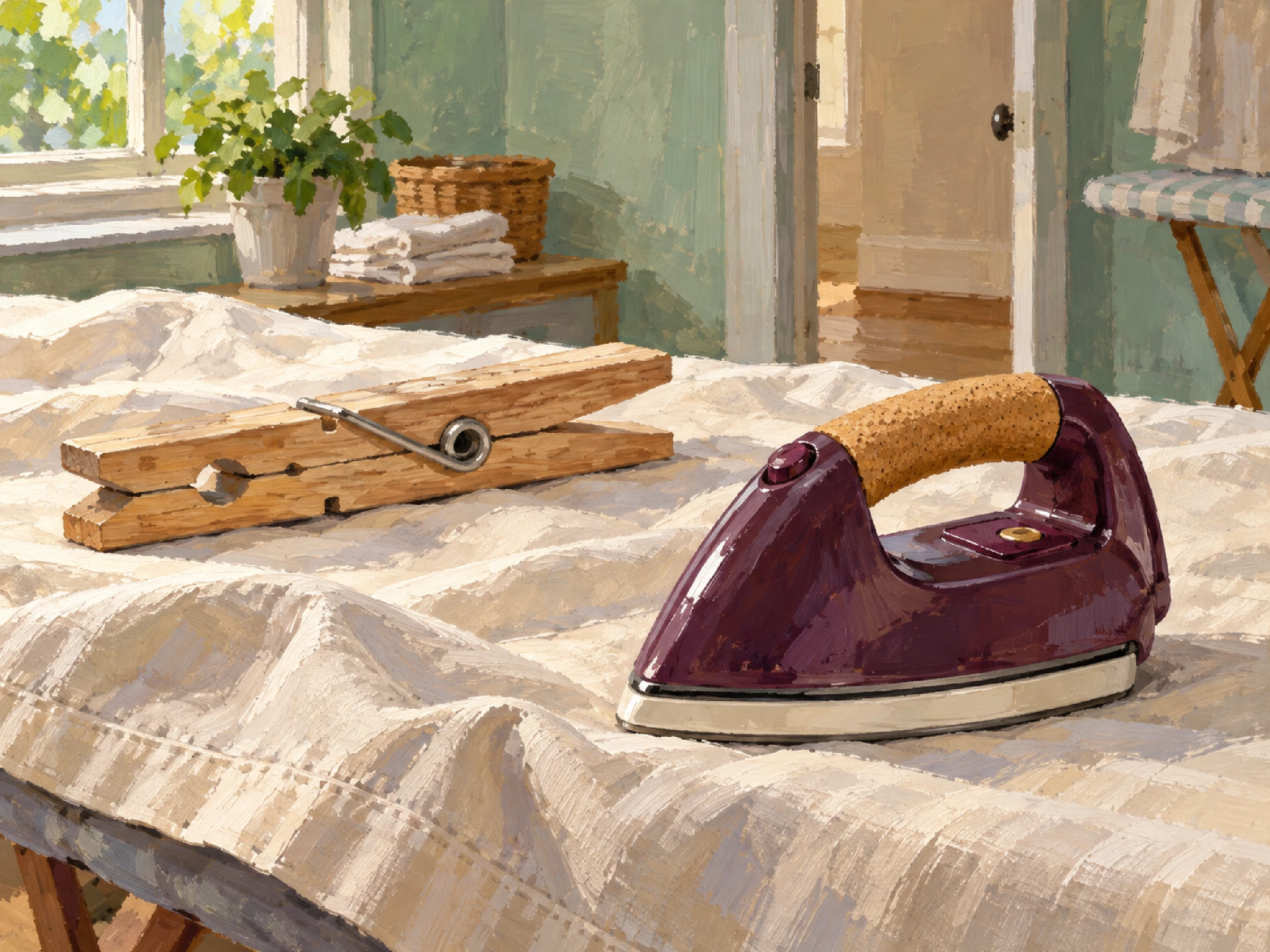
A Tiny Iron Beside a Clothespin
A travel iron smaller than an ordinary clothespin rests among broad linen folds. Loose opaque gouache turns a familiar ironing space into an unexpected encounter with scale.
Remix this referenceA Tiny Iron Beside a Clothespin
- Form language
- Describe objects as softly simplified painted volumes; retain useful structural breaks while allowing small details to vary naturally.
- Contour
- Let overlapping brush shapes establish contours, alternating firm edges with lost edges and occasional bristle-frayed turns.
- Mark-making
- Use loose opaque gouache strokes with visible starts, loaded ends and occasional dry skips; vary stroke size with the form.
- Surface rendering
- Model tone with overlapping opaque patches and lightly scumbled transitions; let earlier paint show through imperfect corrections.
Priority
Visible opaque brushwork must make the loose gouache medium unmistakable.
What to avoid & what to check
Exact prompt for this example
MODULE OWNERSHIP
subject: Subject count, type, stable proportions and landmarks, resting face geometry, hair shape, physical materials, garment construction and permanent marks. No emotion, movement, color assignment or rendering recipe.
expression: Facial soft-tissue displacement and pupil direction, muscle coordination, regional intensity, asymmetry and onset/peak/release. No head/body pose, stable appearance, skin color or rendering.
gesture: Head/neck/body/limb orientation, joint movement, support, contact and pose-caused occlusion using existing anatomy. No eye/pupil movement, emotion, identity, props inventory or camera.
props: Prop count, type, construction, physical material and scale relative to the subject. Holding/contact belongs to gesture, position to composition, color to palette.
scene: Environment elements, terrain, backdrop/floor presence and structural detail. No canvas positions, camera, lighting, assigned colors or render texture.
camera: Projection, focal-length impression, camera elevation/yaw/roll, viewing distance and crop. No actor pose, world placement, lighting or canvas aspect ratio.
composition: Normalized 0-100% canvas positions, scale in frame, depth/overlap, focal hierarchy and margins. No joint pose, camera projection, rendering, subject/prop inventory or emotion.
palette: Color anchors, hue/saturation/value ranges, colors assigned to parts and approximate color coverage. No illumination direction, shading algorithm, physical material or layout.
lighting: Light-source direction/softness/intensity, ambient illumination, physical shadow direction/length and highlight position. Absence of directional illumination is allowed. No shading technique, palette or material changes.
style: Reusable form abstraction, contour weight/taper/edge quality, medium and mark scale/density/direction, surface rendering and tonal transition technique. No fixed subject proportions, anatomy, identity, expression, pose, palette, light-source direction, camera or layout.
output: Image count, aspect ratio, size, file/alpha requirements and global lettering/logo/watermark restrictions. No background scenery, crop, style, identity or pose.

SUBJECT
inventory: One original miniature cordless travel iron; no people or animals.
geometry: A pointed wedge body supports an open arch handle; a distinct soleplate lip follows the rounded heel.
resting-face: No face or anthropomorphic features.
appearance: An enamelled metal shell, a cork handle insert and a ceramic soleplate define the product construction.

PRIORITY


AVOID


CHECK


PROPS
inventory: One ordinary wooden clothespin and one linen sheet; the clothespin is longer than the complete iron.
construction: The clothespin has paired wooden jaws and a metal spring; the linen has a broad turned hem and broad soft folds.

PRIORITY


AVOID


CHECK


SCENE
inventory: A domestic utility room with a padded ironing board, an open doorway and a window.
structure: The doorway reveals a simple wall and skirting board.

PRIORITY


AVOID


CHECK


CAMERA
projection: Natural perspective with a normal-lens impression and gentle depth compression.
viewpoint: Look closely across the board from slightly above its surface, with an oblique view of the iron and no roll.
crop: Keep the whole iron and clothespin visible while cropping the board edges and allowing a glimpse of the room.

PRIORITY


AVOID


CHECK


COMPOSITION
placement: Place the iron in the lower-right third and the clothespin across the left middle, with open space above.
depth: The iron is the clear first read; a fabric ridge leads behind it toward the subordinate doorway.
spacing: Spread linen across the board around the iron; give its silhouette breathing room amid disproportionately expansive folds.

PRIORITY


AVOID


CHECK


PALETTE
colors: Warm linen cream, muted mint, deep plum and small honey-brown accents.
assignment: Plum identifies the iron shell; cream belongs to linen, mint to the room, honey brown to cork and wood.
balance: Pale cream dominates; plum provides a small accent, and secondary colors remain gently desaturated.

PRIORITY


AVOID


CHECK


LIGHTING
sources: Soft window daylight enters broadly from the left, with mild room ambience.
shadows: Short diffuse shadows extend rightward beneath the iron, clothespin and raised folds.
highlights: A broad highlight rests on the upper-left shell and the left-facing crests of the linen.

PRIORITY


AVOID


CHECK


STYLE GUIDE
form-language: Describe objects as softly simplified painted volumes; retain useful structural breaks while allowing small details to vary naturally.
contour: Let overlapping brush shapes establish contours, alternating firm edges with lost edges and occasional bristle-frayed turns.
mark-making: Use loose opaque gouache strokes with visible starts, loaded ends and occasional dry skips; vary stroke size with the form.
surface-rendering: Model tone with overlapping opaque patches and lightly scumbled transitions; let earlier paint show through imperfect corrections.

PRIORITY
Visible opaque brushwork must make the loose gouache medium unmistakable.

AVOID


CHECK


OUTPUT
format: One finished image, landscape 4:3 aspect ratio, 2400 × 1800 pixels, opaque PNG.
restrictions: No lettering, logos, signatures or watermarks.

PRIORITY


AVOID


CHECK


FINAL INTEGRATION
subject + props + composition: Make the scale reversal immediately understandable while keeping the product construction readable.
lighting + style: Let the broad illumination remain clear through painterly tonal patches and varied edges.
Model information comes from image provenance. The same prompt may produce a different result.