Text to imageCafe & brandStyle guide
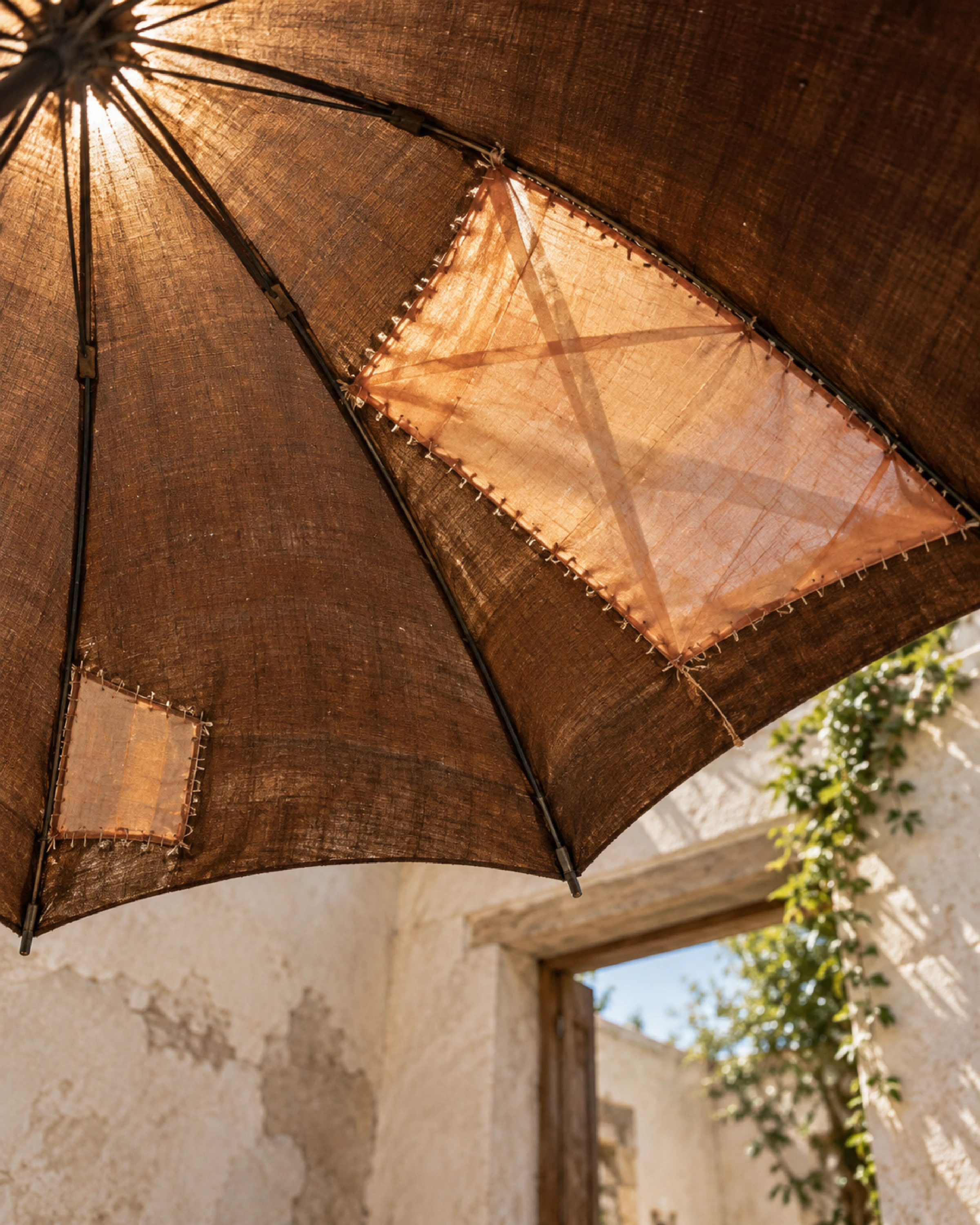
Sun Through a Patched Umbrella
An intimate brand photograph beneath a repaired umbrella, where translucent patches reveal a courtyard and give worn fabric a renewed sense of possibility.
Remix this referenceSun Through a Patched Umbrella
- Form language
- Retain observed irregularities and material distinctions; let large fabric planes simplify naturally through photographic depth.
- Contour
- Use optically formed edges: crisp thread silhouettes near focus, softer doubled fabric edges and gently dissolving distant boundaries.
- Mark-making
- Fine irregular film grain and occasional faint emulsion specks give the photograph an analog presence without a uniform texture overlay.
- Surface rendering
- Use color-negative print tonality with open shadow detail, softly compressed highlights and slight halation at luminous fabric edges.
Priority
Make optical depth and color-negative print character visibly define the analog photographic treatment.
What to avoid & what to check
Exact prompt for this example
MODULE OWNERSHIP
subject: Subject count, type, stable proportions and landmarks, resting face geometry, hair shape, physical materials, garment construction and permanent marks. No emotion, movement, color assignment or rendering recipe.
expression: Facial soft-tissue displacement and pupil direction, muscle coordination, regional intensity, asymmetry and onset/peak/release. No head/body pose, stable appearance, skin color or rendering.
gesture: Head/neck/body/limb orientation, joint movement, support, contact and pose-caused occlusion using existing anatomy. No eye/pupil movement, emotion, identity, props inventory or camera.
props: Prop count, type, construction, physical material and scale relative to the subject. Holding/contact belongs to gesture, position to composition, color to palette.
scene: Environment elements, terrain, backdrop/floor presence and structural detail. No canvas positions, camera, lighting, assigned colors or render texture.
camera: Projection, focal-length impression, camera elevation/yaw/roll, viewing distance and crop. No actor pose, world placement, lighting or canvas aspect ratio.
composition: Normalized 0-100% canvas positions, scale in frame, depth/overlap, focal hierarchy and margins. No joint pose, camera projection, rendering, subject/prop inventory or emotion.
palette: Color anchors, hue/saturation/value ranges, colors assigned to parts and approximate color coverage. No illumination direction, shading algorithm, physical material or layout.
lighting: Light-source direction/softness/intensity, ambient illumination, physical shadow direction/length and highlight position. Absence of directional illumination is allowed. No shading technique, palette or material changes.
style: Reusable form abstraction, contour weight/taper/edge quality, medium and mark scale/density/direction, surface rendering and tonal transition technique. No fixed subject proportions, anatomy, identity, expression, pose, palette, light-source direction, camera or layout.
output: Image count, aspect ratio, size, file/alpha requirements and global lettering/logo/watermark restrictions. No background scenery, crop, style, identity or pose.

SUBJECT
inventory: One repaired umbrella, conceived as the hero of an original umbrella repair brand image.
geometry: A broad domed canopy has slender radial ribs and two unequal repair panels inset into the canopy; small construction details may vary.
resting-face: No face or facial geometry applies.
appearance: Worn woven canopy fabric, translucent organza repairs, metal ribs and visible hand stitching retain signs of use.

PRIORITY


AVOID


CHECK


PROPS
inventory: No separate props.
construction: No prop construction applies.

PRIORITY


AVOID


CHECK


SCENE
inventory: A roofless courtyard with a plaster wall, an open doorway and a short trailing vine; no floor is visible.
structure: The doorway sits within a thick wall; irregular plaster repairs suggest a working domestic courtyard.

PRIORITY


AVOID


CHECK


CAMERA
projection: Natural photographic perspective with a close-focus normal-to-short-telephoto lens impression.
viewpoint: View closely from beneath the canopy, looking steeply upward with a slight oblique yaw and no roll.
crop: Crop through the canopy perimeter and rib ends; exclude the handle and keep the nearest repair stitching readable.

PRIORITY


AVOID


CHECK


COMPOSITION
placement: The canopy sweeps across the frame; the larger patch sits near 65% width and 40% height, above a narrow courtyard opening.
depth: Nearest stitching leads into the translucent panel, with the courtyard receding behind it in distinct depth layers.
spacing: The larger patch is the first read; unequal fabric masses and the smaller patch create an irregular surrounding rhythm.

PRIORITY


AVOID


CHECK


PALETTE
colors: Anchor the image in tobacco brown, misty apricot, chalk cream and a restrained leaf green.
assignment: Use dark tobacco brown for the canopy, apricot for the repairs, cream for plaster and green for the vine.
balance: Brown occupies most of the image; the pale patches provide a generous warm interruption, with green only a small accent.

PRIORITY


AVOID


CHECK


LIGHTING
sources: Soft sunlight enters from upper left through the canopy, supported by gentle courtyard bounce.
shadows: Ribs cast soft narrow shadows toward lower right across the underside; folds retain broad, quiet shadow pockets.
highlights: The upper-left patch edges glow gently; tiny metal highlights remain subdued.

PRIORITY


AVOID


CHECK


STYLE GUIDE
form-language: Retain observed irregularities and material distinctions; let large fabric planes simplify naturally through photographic depth.
contour: Use optically formed edges: crisp thread silhouettes near focus, softer doubled fabric edges and gently dissolving distant boundaries.
mark-making: Fine irregular film grain and occasional faint emulsion specks give the photograph an analog presence without a uniform texture overlay.
surface-rendering: Use color-negative print tonality with open shadow detail, softly compressed highlights and slight halation at luminous fabric edges.

PRIORITY
Make optical depth and color-negative print character visibly define the analog photographic treatment.

AVOID


CHECK


OUTPUT
format: One finished image, portrait 4:5, 2400 × 3000 pixels, JPEG with no alpha.
restrictions: No lettering, logos, slogans or watermarks.

PRIORITY


AVOID


CHECK


FINAL INTEGRATION
subject + camera + style: Let the repair construction remain legible where optical focus gives way to analog softness.
Model information comes from image provenance. The same prompt may produce a different result.