Text to imageSpace & architectureStyle guide
Small Dressing Corner · Mirror-Extended Space
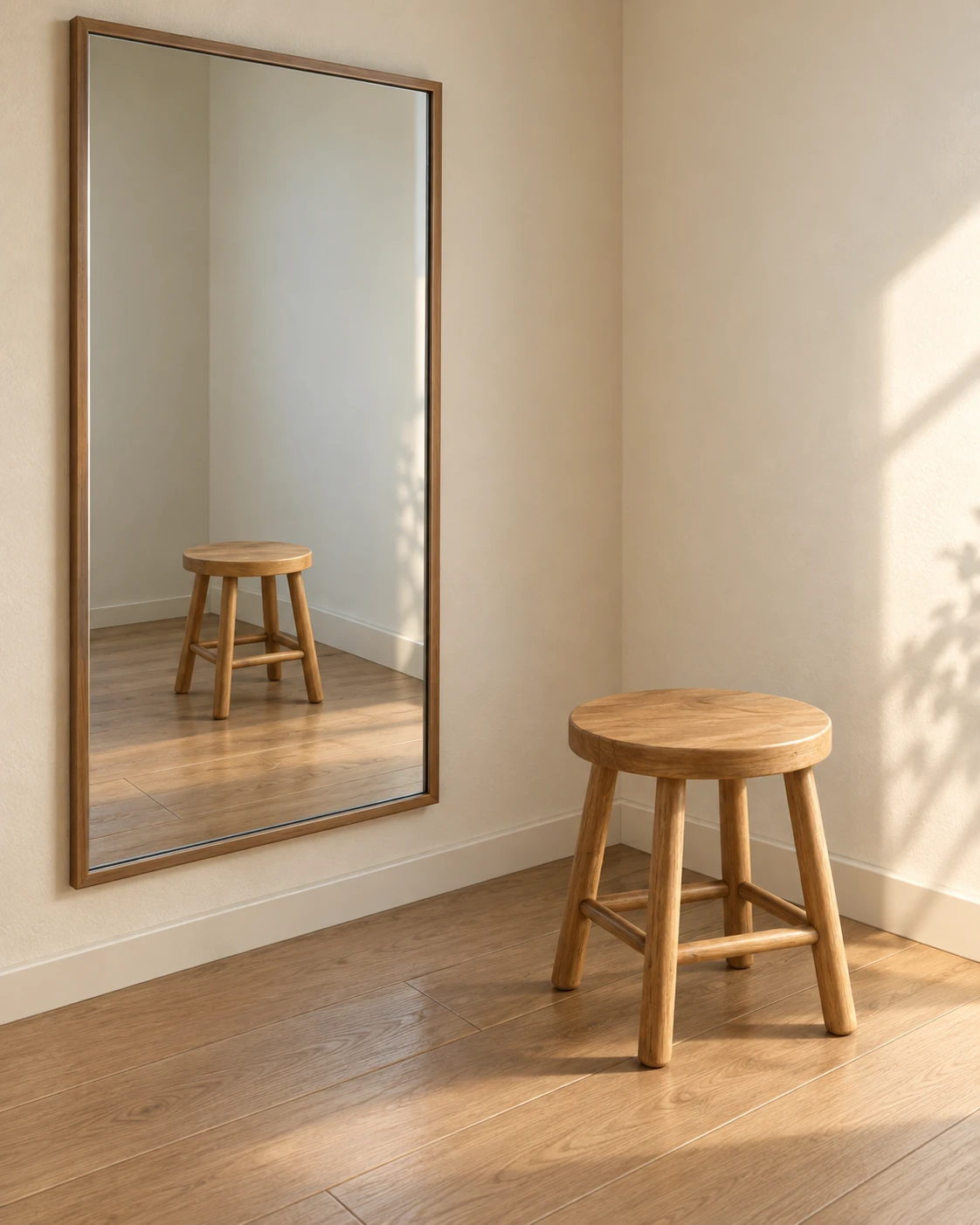
Use a stool’s reflection and continuous floor geometry to make a small corner appear to extend behind a wall mirror.
Small Dressing Corner · Mirror-Extended Space
- Shape & line
- Build the room from clean straight wall and floor edges, and give the mirror a slim rectangular frame. Construct the actual stool with a simple round seat and four legs; draw its reflected seat and legs from the corresponding reversed viewpoint so the reflection reads as the same stool.
- Color & light
- Let soft daylight enter from beyond the image-right edge, brightening the actual stool’s right-facing surfaces and leaving its opposite surfaces gently shaded. Carry that same illumination into the reflected view without adding a separate light source; use warm cream walls and muted honey-colored wood.
- Texture & material
- Keep the painted walls matte and add sparse broad wood-grain marks to the stool. Render the mirror as a crisp reflection with a faint cool tint and a restrained highlight along one frame edge; preserve visible reflected forms instead of covering the glass with glare.
- Composition
- Place the actual stool to the image-right of the mirror without overlapping its frame. Inside the mirror, show its reflection smaller and farther back, with reflected floor seams receding beneath it; terminate every reflected edge at the mirror boundary to make the apparent extension belong to the glass.
Priority
Prioritize a coherent reflected viewpoint and clear separation between the actual stool and its reflection.
What to avoid & what to check
Avoid treating the mirror as an open doorway or placing a second physical stool in the room.
Check that the reflected stool and floor remain inside the frame and visibly correspond to the actual room.
Exact prompt for this example
SUBJECT
A small dressing corner with one rectangular wall mirror and one low wooden stool. The mirror occupies the image-left wall; the actual stool stands on the image-right floor in front of it, and its single reflection appears inside the mirror.

COMPOSITION
Show the corner from standing eye level in a slightly oblique three-quarter view, including the whole mirror, the whole actual stool, and enough floor to connect them. Keep the reflected stool clearly inside the mirror boundary.

STYLE GUIDE
1. Shape & line
Build the room from clean straight wall and floor edges, and give the mirror a slim rectangular frame. Construct the actual stool with a simple round seat and four legs; draw its reflected seat and legs from the corresponding reversed viewpoint so the reflection reads as the same stool.

2. Color & light
Let soft daylight enter from beyond the image-right edge, brightening the actual stool’s right-facing surfaces and leaving its opposite surfaces gently shaded. Carry that same illumination into the reflected view without adding a separate light source; use warm cream walls and muted honey-colored wood.

3. Texture & material
Keep the painted walls matte and add sparse broad wood-grain marks to the stool. Render the mirror as a crisp reflection with a faint cool tint and a restrained highlight along one frame edge; preserve visible reflected forms instead of covering the glass with glare.

4. Composition
Place the actual stool to the image-right of the mirror without overlapping its frame. Inside the mirror, show its reflection smaller and farther back, with reflected floor seams receding beneath it; terminate every reflected edge at the mirror boundary to make the apparent extension belong to the glass.

PRIORITY
Preserve the requested identity, count, action, composition and output settings. Apply the style rules within those constraints; a style reference must not replace the subject or layout. Within the style: Prioritize a coherent reflected viewpoint and clear separation between the actual stool and its reflection.

AVOID
Avoid treating the mirror as an open doorway or placing a second physical stool in the room.

OUTPUT
Create one architectural interior illustration in a 4:5 portrait aspect ratio, with no lettering, labels, logos, or watermark.

SELF-CHECK
Check that the reflected stool and floor remain inside the frame and visibly correspond to the actual room.
Model information comes from image provenance. The same prompt may produce a different result.