Text to imageAnimationStyle guide
Giant Fern in the Lecture Hall
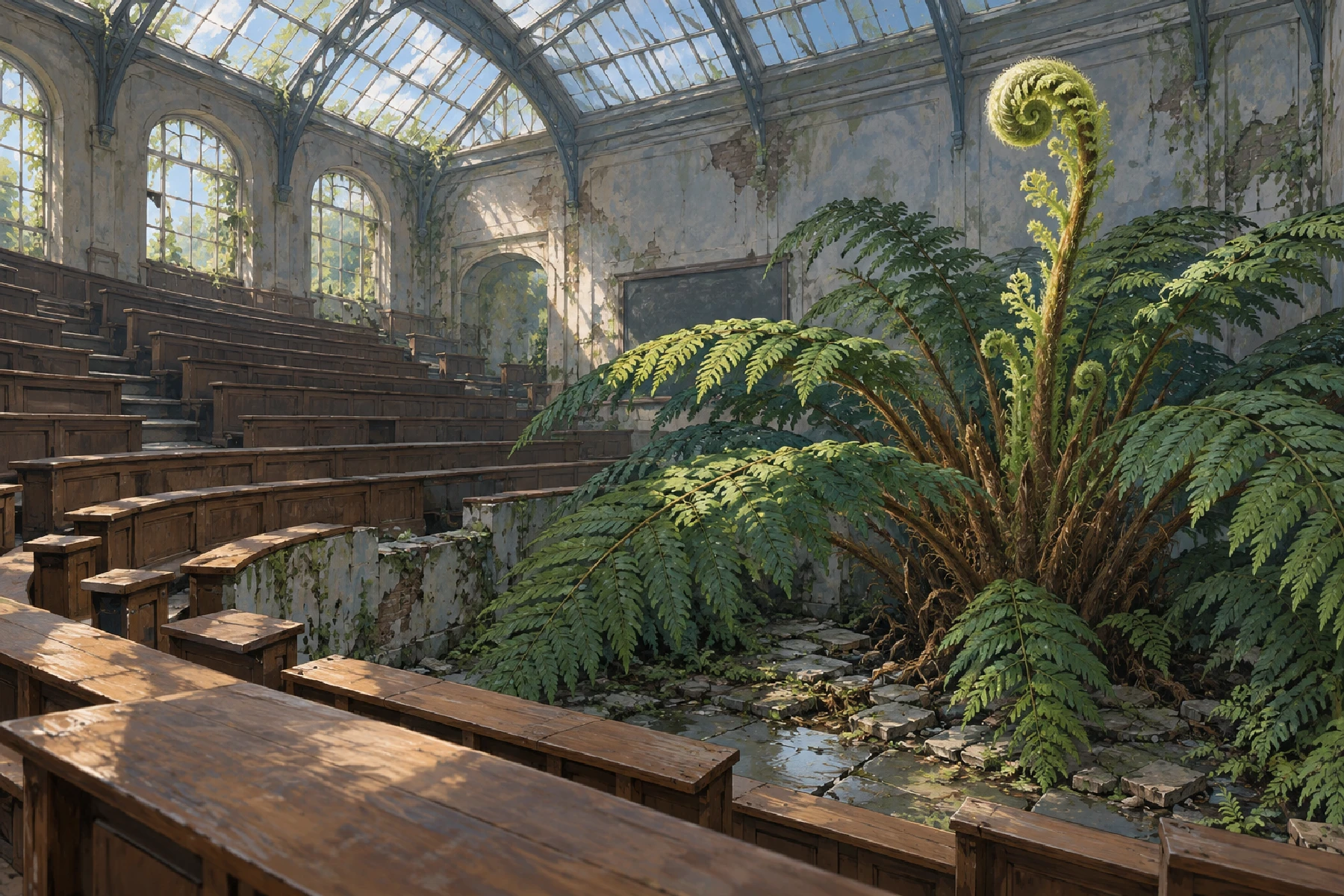
A giant fern grows between the stepped desks of an old botany lecture hall. Its curled frond beneath the glazed roof and the empty writing ledges reveal an unexpected scale in a hand-painted animation background.
Remix this referenceGiant Fern in the Lecture Hall
- Form language
- Establish broad interlocking form planes first; resolve smaller surface changes with selective painted patches and gently irregular shapes.
- Contour
- Build contours from alternating firm and softened paint boundaries; let occasional edges dissolve instead of enclosing every form in a line.
- Mark-making
- Overlap brush traces along each plane, varying their breadth naturally; use sparse dry-brush catches to interrupt otherwise continuous passages.
- Surface rendering
- Retain shallow paper-and-pigment texture, uneven opaque paint and softly blended tonal transitions, with detail selectively lost within larger masses.
Priority
Rendering medium: 2D hand-painted animated-film background illustration; formal rendering reference: Studio Ghibli · 2020s · The Boy and the Heron (2023), background art
What to avoid & what to check
Exact prompt for this example
MODULE OWNERSHIP
subject: Subject count, type, stable proportions and landmarks, resting face geometry, hair shape, physical materials, garment construction and permanent marks. No emotion, movement, color assignment or rendering recipe.
expression: Facial soft-tissue displacement and pupil direction, muscle coordination, regional intensity, asymmetry and onset/peak/release. No head/body pose, stable appearance, skin color or rendering.
gesture: Head/neck/body/limb orientation, joint movement, support, contact and pose-caused occlusion using existing anatomy. No eye/pupil movement, emotion, identity, props inventory or camera.
props: Prop count, type, construction, physical material and scale relative to the subject. Holding/contact belongs to gesture, position to composition, color to palette.
scene: Environment elements, terrain, backdrop/floor presence and structural detail. No canvas positions, camera, lighting, assigned colors or render texture.
camera: Projection, focal-length impression, camera elevation/yaw/roll, viewing distance and crop. No actor pose, world placement, lighting or canvas aspect ratio.
composition: Normalized 0-100% canvas positions, scale in frame, depth/overlap, focal hierarchy and margins. No joint pose, camera projection, rendering, subject/prop inventory or emotion.
palette: Color anchors, hue/saturation/value ranges, colors assigned to parts and approximate color coverage. No illumination direction, shading algorithm, physical material or layout.
lighting: Light-source direction/softness/intensity, ambient illumination, physical shadow direction/length and highlight position. Absence of directional illumination is allowed. No shading technique, palette or material changes.
style: Reusable form abstraction, contour weight/taper/edge quality, medium and mark scale/density/direction, surface rendering and tonal transition technique. No fixed subject proportions, anatomy, identity, expression, pose, palette, light-source direction, camera or layout.
output: Image count, aspect ratio, size, file/alpha requirements and global lettering/logo/watermark restrictions. No background scenery, crop, style, identity or pose.

SUBJECT
inventory: One original, monumental terrestrial fern; no people or animals.
geometry: A thick root crown carries arching divided fronds and one tall crosier with a tightly rolled tip.
resting-face: No face or facial landmarks.
appearance: Fibrous stalk sheaths, leathery leaflets and fine hairs on the crosier; minor botanical irregularities may vary naturally.

PRIORITY


AVOID


CHECK


PROPS
inventory: No separate props.
construction: No prop construction applies.

PRIORITY


AVOID


CHECK


SCENE
inventory: An old botany lecture hall with tiered built-in desks, a glazed roof, plaster walls and a damp, cracked slate floor.
structure: Desk tiers form a shallow horseshoe around a ruptured teaching well; roof ribs remain intact above damp masonry and fallen plaster.

PRIORITY


AVOID


CHECK


CAMERA
projection: Natural perspective with a moderately wide lens impression and restrained edge stretching.
viewpoint: View from the upper seating aisle, looking diagonally downward across the room with a level horizon.
crop: A wide interior view includes the glazed roof and teaching well; the nearest desk is partially cropped.

PRIORITY


AVOID


CHECK


COMPOSITION
placement: The fern occupies the right half, its curled tip near the upper third; the empty desk tiers open broadly across the left.
depth: A foreground desk overlaps the lower fronds; repeated desks recede toward the root crown and the rear wall beyond.
spacing: The crosier is the first focal point, the ordinary desks establish scale, and open space around the curl preserves its silhouette.

PRIORITY


AVOID


CHECK


PALETTE
colors: Deep viridian, muted tobacco brown, chalky blue-gray and a small pale chartreuse accent.
assignment: Viridian belongs to mature fronds, chartreuse to the crosier, tobacco brown to desks, and blue-gray to walls and roof glazing.
balance: Muted architectural colors dominate; deeper greens gather visual weight while the pale new growth provides a restrained accent.

PRIORITY


AVOID


CHECK


LIGHTING
sources: Broad afternoon daylight enters through the upper-left roof glazing, supported by soft ambient light throughout the hall.
shadows: Fronds and desk edges cast softened shadows toward the lower right; the deepest shade remains beneath the seating tiers.
highlights: Broad highlights touch upper-left leaflet surfaces and desk ledges, with a few small glints on floor edges.

PRIORITY


AVOID


CHECK


STYLE GUIDE
form-language: Establish broad interlocking form planes first; resolve smaller surface changes with selective painted patches and gently irregular shapes.
contour: Build contours from alternating firm and softened paint boundaries; let occasional edges dissolve instead of enclosing every form in a line.
mark-making: Overlap brush traces along each plane, varying their breadth naturally; use sparse dry-brush catches to interrupt otherwise continuous passages.
surface-rendering: Retain shallow paper-and-pigment texture, uneven opaque paint and softly blended tonal transitions, with detail selectively lost within larger masses.

PRIORITY
Rendering medium: 2D hand-painted animated-film background illustration; formal rendering reference: Studio Ghibli · 2020s · The Boy and the Heron (2023), background art

AVOID


CHECK


OUTPUT
format: One finished image, 3:2 landscape, 1800 × 1200 pixels, opaque PNG.
restrictions: No lettering, logos, signatures or watermarks.

PRIORITY


AVOID


CHECK


FINAL INTEGRATION
subject + scene + composition: Botanical construction and architectural repetition cooperate to make the scale change immediately legible.
Art direction
스튜디오 지브리 / Studio Ghibli · 2020s · 그대들은 어떻게 살 것인가(2023)의 배경 미술 / The Boy and the Heron (2023), background art ↗- Establish broad form planes before describing smaller surface variations with painted patches
- Use hard and soft painted boundaries rather than strong continuous outlines
- Overlapping brush traces following the plane direction with sparse dry-brush marks
- Shallow paper-and-pigment texture, uneven painted planes and blended tonal transitions
Model information comes from image provenance. The same prompt may produce a different result.