Text to imageLandscapeStyle guide
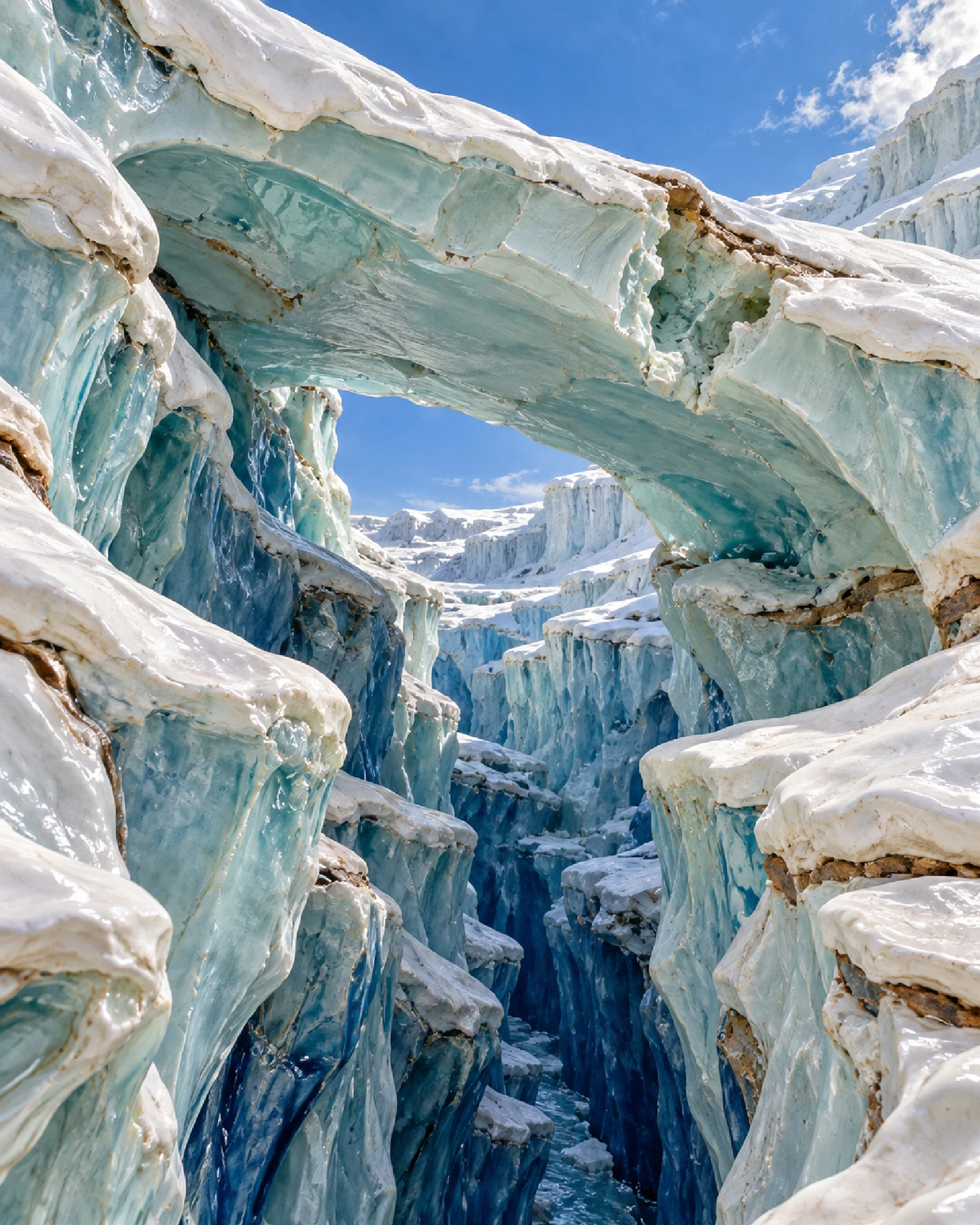
Beneath a Broken Snow Bridge
A sweeping snow bridge above a glacial chasm, expressed through raised ceramic forms and pooled glaze.
Remix this referenceBeneath a Broken Snow Bridge
- Form language
- Translate natural masses into hand-built ceramic relief: broad rounded slabs, scooped hollows, and irregular raised lips.
- Contour
- Let modeled edges define contours; alternate softly rolled rims with occasional crisp breaks rather than outlining every form.
- Mark-making
- Use sparse, uneven spatula sweeps and shallow dragged grooves that follow broad surfaces; let small tool traces vary naturally.
- Surface rendering
- Model glossy glaze pooling in hollows, thinner translucent glaze on raised edges, and occasional exposed matte ceramic.
Priority
The image must visibly read as modeled ceramic relief with glazed depth.
What to avoid & what to check
Exact prompt for this example
MODULE OWNERSHIP
subject: Subject count, type, stable proportions and landmarks, resting face geometry, hair shape, physical materials, garment construction and permanent marks. No emotion, movement, color assignment or rendering recipe.
expression: Facial soft-tissue displacement and pupil direction, muscle coordination, regional intensity, asymmetry and onset/peak/release. No head/body pose, stable appearance, skin color or rendering.
gesture: Head/neck/body/limb orientation, joint movement, support, contact and pose-caused occlusion using existing anatomy. No eye/pupil movement, emotion, identity, props inventory or camera.
props: Prop count, type, construction, physical material and scale relative to the subject. Holding/contact belongs to gesture, position to composition, color to palette.
scene: Environment elements, terrain, backdrop/floor presence and structural detail. No canvas positions, camera, lighting, assigned colors or render texture.
camera: Projection, focal-length impression, camera elevation/yaw/roll, viewing distance and crop. No actor pose, world placement, lighting or canvas aspect ratio.
composition: Normalized 0-100% canvas positions, scale in frame, depth/overlap, focal hierarchy and margins. No joint pose, camera projection, rendering, subject/prop inventory or emotion.
palette: Color anchors, hue/saturation/value ranges, colors assigned to parts and approximate color coverage. No illumination direction, shading algorithm, physical material or layout.
lighting: Light-source direction/softness/intensity, ambient illumination, physical shadow direction/length and highlight position. Absence of directional illumination is allowed. No shading technique, palette or material changes.
style: Reusable form abstraction, contour weight/taper/edge quality, medium and mark scale/density/direction, surface rendering and tonal transition technique. No fixed subject proportions, anatomy, identity, expression, pose, palette, light-source direction, camera or layout.
output: Image count, aspect ratio, size, file/alpha requirements and global lettering/logo/watermark restrictions. No background scenery, crop, style, identity or pose.

SUBJECT
inventory: No characters or separate focal objects.
geometry: No independent subject geometry applies.
resting-face: No faces are present.
appearance: No character appearance or clothing applies.

PRIORITY


AVOID


CHECK


PROPS
inventory: No separate props.
construction: No prop construction applies.

PRIORITY


AVOID


CHECK


SCENE
inventory: A natural snow bridge spans a deep glacial crevasse amid ice shelves, sparse sediment seams, and a narrow sky opening.
structure: One bridge edge has sheared away, exposing its thick underside; nested ice ledges descend toward a concealed meltwater channel.

PRIORITY


AVOID


CHECK


CAMERA
projection: Use moderately wide perspective with a convincing sense of near-to-far expansion.
viewpoint: Look obliquely upward from within the crevasse, with a level roll and a clear view beneath the bridge.
crop: Crop nearby ice walls at the edges while retaining the bridge opening and enough distant shelves to establish depth.

PRIORITY


AVOID


CHECK


COMPOSITION
placement: Sweep the bridge across the upper half; place its torn opening near 60% width and 45% height as the main focus.
depth: Overlapping foreground ledges frame the exposed underside, followed by progressively smaller shelves in the chasm.
spacing: Keep a generous uninterrupted opening below the bridge so its sweeping mass contrasts with the depth beneath it.

PRIORITY


AVOID


CHECK


PALETTE
colors: Use chalk white, pale celadon, deep cobalt, and a restrained warm stone accent.
assignment: Assign white to snow caps, celadon to exposed ice, cobalt to deep recesses, and warm stone to sediment seams.
balance: Let pale colors dominate, with concentrated dark blue depth and only small warm interruptions.

PRIORITY


AVOID


CHECK


LIGHTING
sources: Broad daylight enters from the upper right, with weak ambient fill reaching into the crevasse.
shadows: The bridge casts a broad shadow down and left; shelf shadows deepen gradually into the chasm.
highlights: Keep highlights strongest along upper-right-facing ridges, with softer reflected light beneath the arch.

PRIORITY


AVOID


CHECK


STYLE GUIDE
form-language: Translate natural masses into hand-built ceramic relief: broad rounded slabs, scooped hollows, and irregular raised lips.
contour: Let modeled edges define contours; alternate softly rolled rims with occasional crisp breaks rather than outlining every form.
mark-making: Use sparse, uneven spatula sweeps and shallow dragged grooves that follow broad surfaces; let small tool traces vary naturally.
surface-rendering: Model glossy glaze pooling in hollows, thinner translucent glaze on raised edges, and occasional exposed matte ceramic.

PRIORITY
The image must visibly read as modeled ceramic relief with glazed depth.

AVOID


CHECK


OUTPUT
format: One image, portrait 4:5, 1600 × 2000 pixels, opaque PNG.
restrictions: No lettering, logos, signatures, or watermarks.

PRIORITY


AVOID


CHECK
Model information comes from image provenance. The same prompt may produce a different result.