Text to imageCafe & brandStyle guide
Quinces Across the Weighing Scale
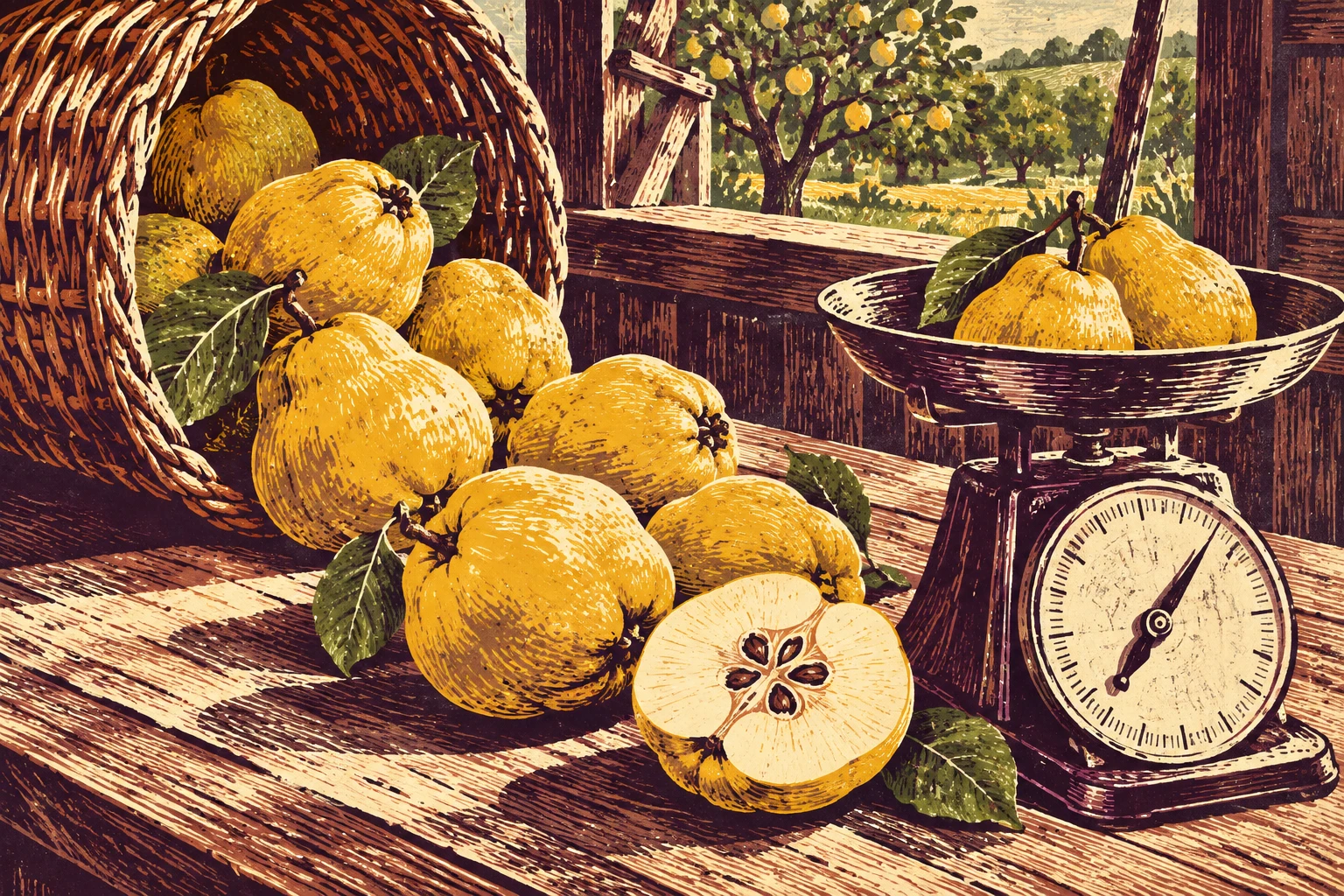
A bold linocut brand image for an original fruit-preserve maker, with quinces spilling from a hamper toward a weighing scale.
Remix this referenceQuinces Across the Weighing Scale
- Form language
- Reduce forms to assertive relief-print masses with angular notches and swelling curves; let small irregularities vary freely.
- Contour
- Use blunt cut edges that tighten into short hooked tips; alternate heavy silhouettes with broken internal boundaries.
- Mark-making
- Carve rhythmic gouge strokes that curve around rounded planes and lengthen across straight ones, with uneven spacing.
- Surface rendering
- Print dense ink beside dry, pressure-broken passages; build tone with open cuts and allow slight color-block misregistration.
Priority
Make the bold linocut character visible through carved rhythm and varied ink pressure.
What to avoid & what to check
Exact prompt for this example
MODULE OWNERSHIP
subject: Subject count, type, stable proportions and landmarks, resting face geometry, hair shape, physical materials, garment construction and permanent marks. No emotion, movement, color assignment or rendering recipe.
expression: Facial soft-tissue displacement and pupil direction, muscle coordination, regional intensity, asymmetry and onset/peak/release. No head/body pose, stable appearance, skin color or rendering.
gesture: Head/neck/body/limb orientation, joint movement, support, contact and pose-caused occlusion using existing anatomy. No eye/pupil movement, emotion, identity, props inventory or camera.
props: Prop count, type, construction, physical material and scale relative to the subject. Holding/contact belongs to gesture, position to composition, color to palette.
scene: Environment elements, terrain, backdrop/floor presence and structural detail. No canvas positions, camera, lighting, assigned colors or render texture.
camera: Projection, focal-length impression, camera elevation/yaw/roll, viewing distance and crop. No actor pose, world placement, lighting or canvas aspect ratio.
composition: Normalized 0-100% canvas positions, scale in frame, depth/overlap, focal hierarchy and margins. No joint pose, camera projection, rendering, subject/prop inventory or emotion.
palette: Color anchors, hue/saturation/value ranges, colors assigned to parts and approximate color coverage. No illumination direction, shading algorithm, physical material or layout.
lighting: Light-source direction/softness/intensity, ambient illumination, physical shadow direction/length and highlight position. Absence of directional illumination is allowed. No shading technique, palette or material changes.
style: Reusable form abstraction, contour weight/taper/edge quality, medium and mark scale/density/direction, surface rendering and tonal transition technique. No fixed subject proportions, anatomy, identity, expression, pose, palette, light-source direction, camera or layout.
output: Image count, aspect ratio, size, file/alpha requirements and global lettering/logo/watermark restrictions. No background scenery, crop, style, identity or pose.

SUBJECT
inventory: One harvest group of whole quinces with a single cut half; no people or animals.
geometry: The fruit has uneven pear-like bodies, broad shoulders and shallow lobes; the cut half exposes a compact seed star.
resting-face: No faces or facial landmarks apply.
appearance: Fine down covers firm skins; short woody stems and occasional attached leaves distinguish the harvest.

PRIORITY


AVOID


CHECK


GESTURE
head: Head and neck channels have no control targets.
torso: The hamper tilts with its opening angled downward; whole quinces tumble toward the upright scale's dish.
limbs: Limb-joint channels have no control targets.
contact: The hatch sill supports the hamper; the table supports the scale and cut half, and the lowest whole quinces touch the dish.

PRIORITY


AVOID


CHECK


PROPS
inventory: One harvest hamper and one mechanical tabletop scale, each large enough to accommodate several quinces.
construction: The hamper uses open wickerwork; the scale has a shallow metal dish, cast pedestal and broad circular dial.

PRIORITY


AVOID


CHECK


SCENE
inventory: An orchard packing shed contains a trestle table and a broad loading hatch, with fruit trees beyond.
structure: The hatch has a deep timber sill; plain boards and forked orchard branches establish a simple working enclosure.

PRIORITY


AVOID


CHECK


CAMERA
projection: Use compressed illustrative perspective with a modest telephoto impression and readable shallow depth.
viewpoint: Look slightly downward across the tabletop from an oblique front view, keeping the frame level.
crop: Use a moderately wide frame; crop the hamper edge while retaining the complete scale and fruit.

PRIORITY


AVOID


CHECK


COMPOSITION
placement: The hamper enters from the upper left; fruit fill the intervening diagonal toward the scale in the lower-right third.
depth: Overlapping quinces bridge the hamper and scale; the cut half sits forward, with hatch and orchard behind.
spacing: Lead with the fruit cascade, then the scale; preserve open gaps between clusters and breathing room above the table.

PRIORITY


AVOID


CHECK


PALETTE
colors: Use quince gold, aubergine, warm ivory and a restrained leaf green.
assignment: Assign gold to fruit, aubergine to structural masses and scale, ivory to exposed flesh and open fields, green to leaves.
balance: Alternate generous ivory areas with strong aubergine masses; gold forms the continuous accent and green stays occasional.

PRIORITY


AVOID


CHECK


LIGHTING
sources: Soft daylight enters from the left through the loading hatch, with gentle ambient fill.
shadows: Broad shadows extend rightward beneath the fruit and scale without obscuring their separation.
highlights: Keep broad highlights on left-facing fruit surfaces and a small highlight along the dish rim.

PRIORITY


AVOID


CHECK


STYLE GUIDE
form-language: Reduce forms to assertive relief-print masses with angular notches and swelling curves; let small irregularities vary freely.
contour: Use blunt cut edges that tighten into short hooked tips; alternate heavy silhouettes with broken internal boundaries.
mark-making: Carve rhythmic gouge strokes that curve around rounded planes and lengthen across straight ones, with uneven spacing.
surface-rendering: Print dense ink beside dry, pressure-broken passages; build tone with open cuts and allow slight color-block misregistration.

PRIORITY
Make the bold linocut character visible through carved rhythm and varied ink pressure.

AVOID


CHECK


OUTPUT
format: Not applicable.
restrictions: Deliver one finished 3:2 image, 2700 × 1800 pixels, as an opaque PNG; include no lettering, logos or watermarks.

PRIORITY


AVOID


CHECK


FINAL INTEGRATION
composition + style: Use the interaction of overlapping masses and carved intervals to sustain the harvest narrative without losing object separation.
Model information comes from image provenance. The same prompt may produce a different result.