Text to imageAnimationStyle guide
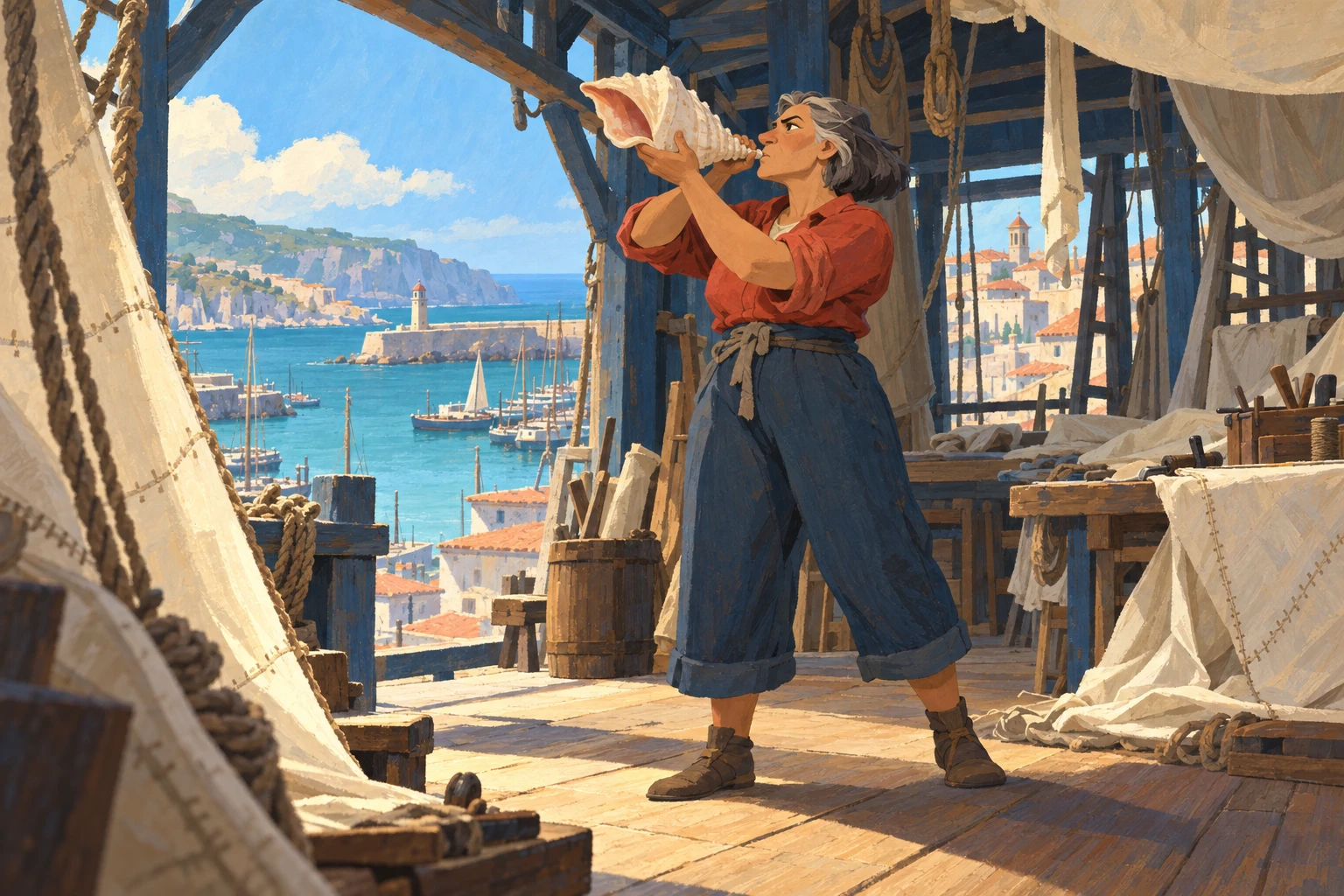
Woman Sounding a Conch Above the Harbor
A woman sounds a conch from a sail loft above the harbor. Hanging sailcloth frames overlapping roofs and breakwaters in an opaque gouache animation concept illustration.
Remix this referenceWoman Sounding a Conch Above the Harbor
- Form language
- Abstract forms into broad planar masses, alternating simple curves with angular facets; allow small shapes to vary naturally.
- Contour
- Separate forms through opaque painted boundaries; alternate firm edges with occasional broken edges instead of continuous outlines.
- Mark-making
- Leave broad brush traces within planes and small dry-brush interruptions at edges, with irregular pressure and spacing.
- Surface rendering
- Build matte opaque gouache surfaces over shallow paper tooth, using a few decisive tonal steps and occasional rubbed transitions.
Priority
Rendering medium: 2D opaque-gouache animated-film concept illustration; formal rendering reference: Walt Disney Studios · 1950s · Peter Pan concept art (1953)
What to avoid & what to check
Exact prompt for this example
MODULE OWNERSHIP
subject: Subject count, type, stable proportions and landmarks, resting face geometry, hair shape, physical materials, garment construction and permanent marks. No emotion, movement, color assignment or rendering recipe.
expression: Facial soft-tissue displacement and pupil direction, muscle coordination, regional intensity, asymmetry and onset/peak/release. No head/body pose, stable appearance, skin color or rendering.
gesture: Head/neck/body/limb orientation, joint movement, support, contact and pose-caused occlusion using existing anatomy. No eye/pupil movement, emotion, identity, props inventory or camera.
props: Prop count, type, construction, physical material and scale relative to the subject. Holding/contact belongs to gesture, position to composition, color to palette.
scene: Environment elements, terrain, backdrop/floor presence and structural detail. No canvas positions, camera, lighting, assigned colors or render texture.
camera: Projection, focal-length impression, camera elevation/yaw/roll, viewing distance and crop. No actor pose, world placement, lighting or canvas aspect ratio.
composition: Normalized 0-100% canvas positions, scale in frame, depth/overlap, focal hierarchy and margins. No joint pose, camera projection, rendering, subject/prop inventory or emotion.
palette: Color anchors, hue/saturation/value ranges, colors assigned to parts and approximate color coverage. No illumination direction, shading algorithm, physical material or layout.
lighting: Light-source direction/softness/intensity, ambient illumination, physical shadow direction/length and highlight position. Absence of directional illumination is allowed. No shading technique, palette or material changes.
style: Reusable form abstraction, contour weight/taper/edge quality, medium and mark scale/density/direction, surface rendering and tonal transition technique. No fixed subject proportions, anatomy, identity, expression, pose, palette, light-source direction, camera or layout.
output: Image count, aspect ratio, size, file/alpha requirements and global lettering/logo/watermark restrictions. No background scenery, crop, style, identity or pose.

SUBJECT
inventory: One original human character, A: an older woman who repairs sails.
geometry: A has a sturdy torso, substantial hands and compact legs; her long nose and square chin are clear landmarks.
resting-face: Her resting face has almond-shaped eyes, straight brows, broad cheek planes and a thin upper lip.
appearance: A thick bob ends in irregular blunt locks; she wears a woven work shirt with rolled sleeves and high-waisted wide trousers.

PRIORITY


AVOID


CHECK


EXPRESSION — ACTOR A
brows: Brows draw slightly inward and down, with a small unevenness between them.
lids: Upper lids lower slightly; lower lids tighten without squeezing shut.
cheeks: Cheeks expand subtly with sustained breath, retaining a firm outer contour.
nose: Nostrils widen faintly; the bridge remains unwrinkled.
mouth: The visible lip corners draw inward into a small, firm blowing shape.
jaw: The jaw stays nearly closed with gentle tension below the lower lip.
gaze: Pupils look toward the distant harbor entrance rather than toward the shell.
coordination: Focused eyes and restrained mouth tension support one steady, purposeful call.
timing: Capture the sustained apex of the call, after the initial breath has settled.

PRIORITY


AVOID


CHECK


GESTURE
head: A turns her head toward the sea, extending her neck slightly with her chin gently raised.
torso: Her chest lifts for the sustained breath while her torso turns away from the loft interior.
limbs: A stands with both elbows spread loosely; one foot advances and both knees stay soft beneath her supported weight.
contact: Her right hand steadies the horn at her lips, her left palm supports its underside, and both soles meet the floor.

PRIORITY


AVOID


CHECK


PROPS
inventory: One conch horn, approximately the length of A's forearm.
construction: A natural shell has spiral ridges, a cut-tip mouthpiece and a broad flared outer lip.

PRIORITY


AVOID


CHECK


SCENE
inventory: An open sail-repair loft overlooks a working harbor with moored boats, tiled roofs and a curved breakwater.
structure: Timber posts, a plank floor and suspended lengths of sailcloth form an airy workshop with an open seaward side.

PRIORITY


AVOID


CHECK


CAMERA
projection: Use natural perspective with a moderate-wide, roughly 40 mm focal-length impression.
viewpoint: Look obliquely through the loft from slightly below eye level, with a level horizon.
crop: A medium-wide view includes A's full figure and enough surrounding architecture to establish the loft.

PRIORITY


AVOID


CHECK


COMPOSITION
placement: A's figure is centered near 68% canvas width and spans about three-fifths of frame height; the horn occupies the open left half.
depth: Cropped sailcloth overlaps the foreground, A anchors the middle distance, and harbor roofs recede beyond her.
spacing: Give the face and horn a clear breathing space; the call is the first read and the harbor entrance the second.

PRIORITY


AVOID


CHECK


PALETTE
colors: Use deep petrol blue, muted turquoise, vermilion, warm ivory and earthy ochre as the main anchors.
assignment: Assign blue to loft structure, turquoise to water, vermilion to the shirt, ivory to sails and shell, ochre to skin and boards.
balance: Cool colors occupy the broadest areas; ivory interrupts them generously and vermilion remains a concentrated accent.

PRIORITY


AVOID


CHECK


LIGHTING
sources: Broad, soft daylight enters from the seaward left opening, with weaker ambient light inside the loft.
shadows: Gentle cast shadows extend toward the right interior, with broad shade beneath the hanging cloth.
highlights: Restrained highlights touch the sea-facing cheek, upper shell ridges and exposed cloth folds.

PRIORITY


AVOID


CHECK


STYLE GUIDE
form-language: Abstract forms into broad planar masses, alternating simple curves with angular facets; allow small shapes to vary naturally.
contour: Separate forms through opaque painted boundaries; alternate firm edges with occasional broken edges instead of continuous outlines.
mark-making: Leave broad brush traces within planes and small dry-brush interruptions at edges, with irregular pressure and spacing.
surface-rendering: Build matte opaque gouache surfaces over shallow paper tooth, using a few decisive tonal steps and occasional rubbed transitions.

PRIORITY
Rendering medium: 2D opaque-gouache animated-film concept illustration; formal rendering reference: Walt Disney Studios · 1950s · Peter Pan concept art (1953)

AVOID


CHECK


OUTPUT
format: Deliver one 1536 × 1024 image, landscape 3:2, as an opaque PNG.
restrictions: No lettering, logos, signatures or watermarks.

PRIORITY


AVOID


CHECK
Art direction
디즈니 / Walt Disney Studios · 1950s · 피터 팬 콘셉트 아트(1953) / Peter Pan concept art (1953) ↗- Render forms as broad planar masses with simplified curved and angular facets
- Separate forms primarily through opaque painted boundaries rather than continuous outlines
- Broad brush traces within planes and small dry-brush interruptions at their edges
- Matte opaque gouache planes, shallow paper texture and a small set of tonal levels
Model information comes from image provenance. The same prompt may produce a different result.