Text to imagePortraitStyle guide
Wavy-Haired Adult · Form-Wrapping Ink Hatching
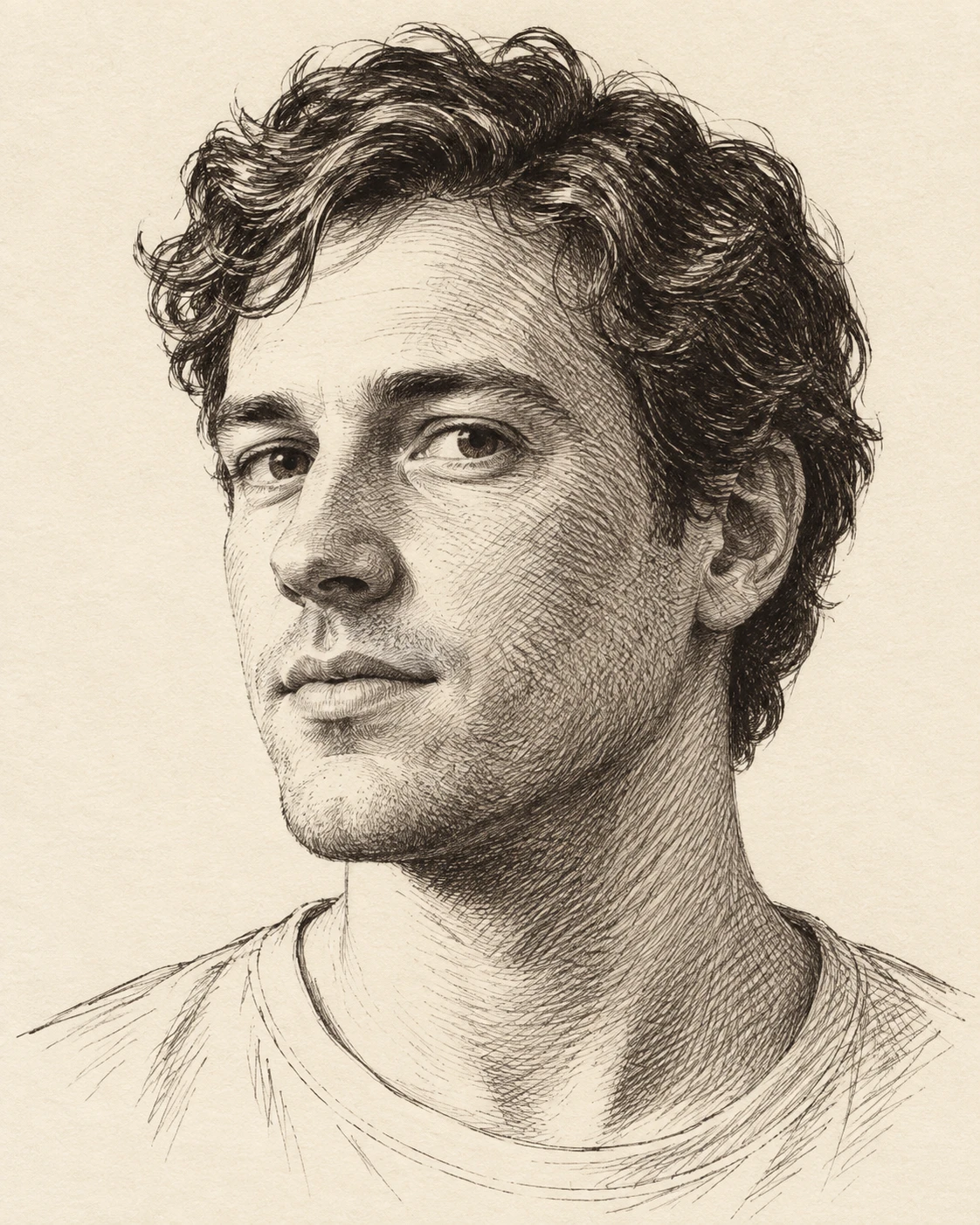
A pen portrait that models the cheeks, nose, and jaw with curved hatching and changes in spacing between strokes.
Wavy-Haired Adult · Form-Wrapping Ink Hatching
- Shape & line
- Build the face with restrained broken contours, then curve the hatch strokes around each visible form: bow them across the cheeks, wrap them along the nose, and turn them beneath the jaw. Change stroke direction at plane transitions instead of laying one diagonal pattern across the entire face.
- Color & light
- Use black ink on warm ivory paper, with broad light arriving from image-left. Leave the image-left forehead and upper cheek mostly as exposed paper; tighten hatch spacing on the image-right cheek and beneath the chin, adding a second crossing layer only in the deepest shadows.
- Texture & material
- Keep individual pen strokes visible with gently varied thickness and slightly tapered ends. Describe the hair with loose grouped curves and denser ink between locks, while giving the skin cleaner, more widely separated strokes; preserve paper gaps rather than blending the marks into smooth gray.
- Composition
- Concentrate the clearest line changes around the eyes, nose, and cheek turn. Simplify the shirt into a few neckline and shoulder strokes, and leave the background unhatched so the curved facial marks carry the portrait's depth without competing patterns.
Priority
Prioritize hatching that visibly follows facial curvature and builds shadow through spacing.
What to avoid & what to check
Avoid uniform diagonal shading, airbrushed gradients, and heavy outlines around every facial feature.
Check that stroke direction changes across the cheek, nose, and jaw, and that open paper remains visible in the lit areas.
Exact prompt for this example
SUBJECT
One adult with short wavy hair, a plain round-neck shirt, and a relaxed closed mouth. Turn the head slightly toward image-left while keeping both eyes visible; the nose overlaps a small portion of the image-left cheek.

COMPOSITION
Frame the head and upper shoulders in a vertical portrait at eye level. Place the face near the center with comfortable space above the hair, and use a plain paper background so the facial hatching remains easy to read.

STYLE GUIDE
1. Shape & line
Build the face with restrained broken contours, then curve the hatch strokes around each visible form: bow them across the cheeks, wrap them along the nose, and turn them beneath the jaw. Change stroke direction at plane transitions instead of laying one diagonal pattern across the entire face.

2. Color & light
Use black ink on warm ivory paper, with broad light arriving from image-left. Leave the image-left forehead and upper cheek mostly as exposed paper; tighten hatch spacing on the image-right cheek and beneath the chin, adding a second crossing layer only in the deepest shadows.

3. Texture & material
Keep individual pen strokes visible with gently varied thickness and slightly tapered ends. Describe the hair with loose grouped curves and denser ink between locks, while giving the skin cleaner, more widely separated strokes; preserve paper gaps rather than blending the marks into smooth gray.

4. Composition
Concentrate the clearest line changes around the eyes, nose, and cheek turn. Simplify the shirt into a few neckline and shoulder strokes, and leave the background unhatched so the curved facial marks carry the portrait's depth without competing patterns.

PRIORITY
Preserve the requested identity, count, action, composition and output settings. Apply the style rules within those constraints; a style reference must not replace the subject or layout. Within the style: Prioritize hatching that visibly follows facial curvature and builds shadow through spacing.

AVOID
Avoid uniform diagonal shading, airbrushed gradients, and heavy outlines around every facial feature.

OUTPUT
Produce one finished pen-and-ink portrait in a 4:5 vertical aspect ratio, with no lettering, captions, signatures, or watermarks.

SELF-CHECK
Check that stroke direction changes across the cheek, nose, and jaw, and that open paper remains visible in the lit areas.
Model information comes from image provenance. The same prompt may produce a different result.