Text to imageCharacterStyle guide
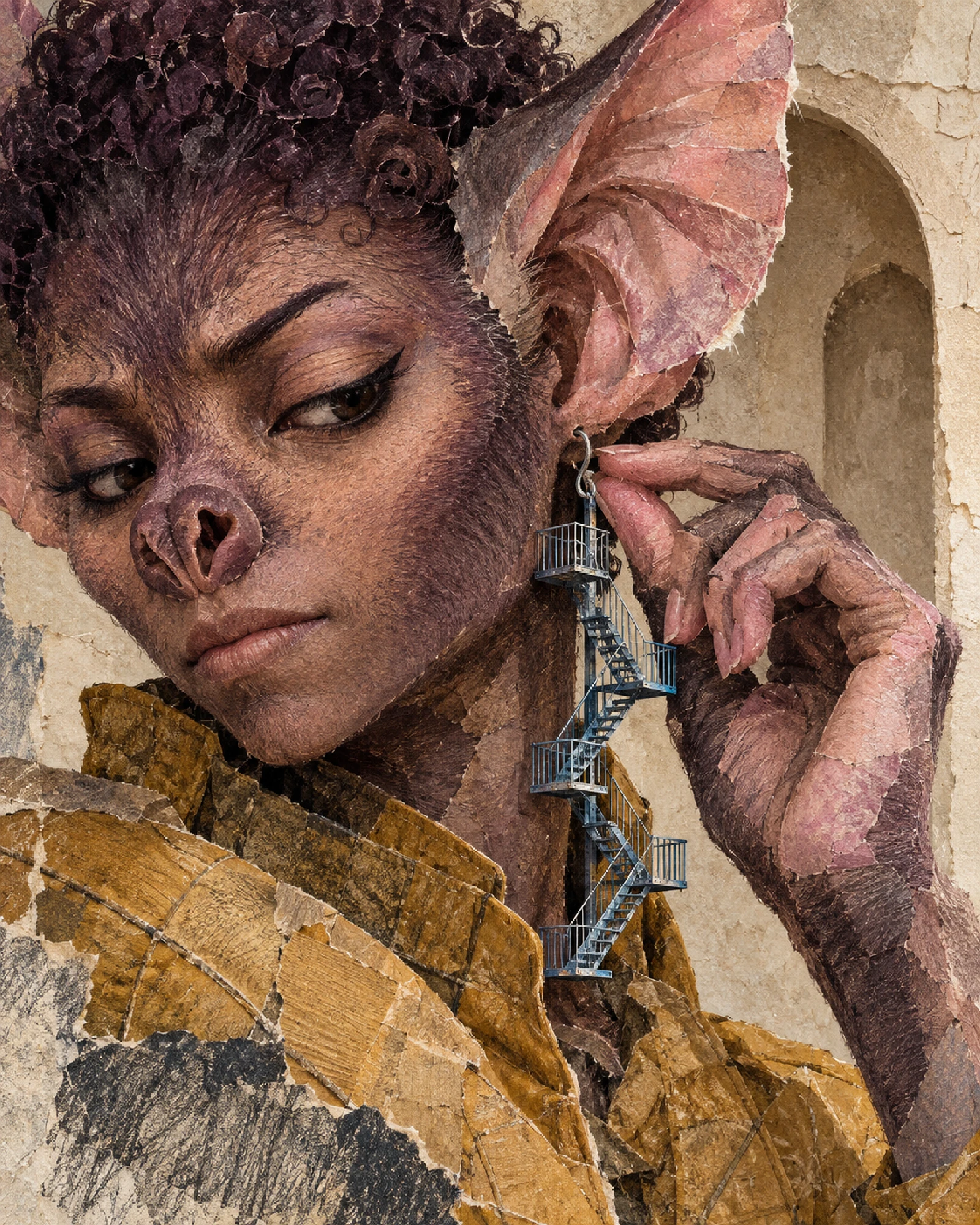
Bat Woman Fastening a Fire-Escape Earring
A giant bat woman hooks a palm-sized fire escape into her ear. Torn paper, graphite and photographic fragments turn an intimate dressing ritual into strange architecture.
Remix this referenceBat Woman Fastening a Fire-Escape Earring
- Form language
- Build broad simplified cut-paper masses interrupted by precise photographic fragments; let changes of representational scale remain conspicuous.
- Contour
- Alternate fibrous torn silhouettes with sharp knife-cut inset edges; use occasional broken pencil contours instead of a continuous outline.
- Mark-making
- Combine broad graphite rubbings with sparse dry-brush crosscuts and inherited photographic grain; vary pressure and spacing naturally.
- Surface rendering
- Overlap translucent tissue with opaque scraps so tonal steps, rubbed smudges and exposed joins coexist; allow coherent local irregularities.
Priority
Preserve the visible collision of torn paper, graphite and photographic fragments as a surreal mixed-media collage.
What to avoid & what to check
Exact prompt for this example
MODULE OWNERSHIP
subject: Subject count, type, stable proportions and landmarks, resting face geometry, hair shape, physical materials, garment construction and permanent marks. No emotion, movement, color assignment or rendering recipe.
expression: Facial soft-tissue displacement and pupil direction, muscle coordination, regional intensity, asymmetry and onset/peak/release. No head/body pose, stable appearance, skin color or rendering.
gesture: Head/neck/body/limb orientation, joint movement, support, contact and pose-caused occlusion using existing anatomy. No eye/pupil movement, emotion, identity, props inventory or camera.
props: Prop count, type, construction, physical material and scale relative to the subject. Holding/contact belongs to gesture, position to composition, color to palette.
scene: Environment elements, terrain, backdrop/floor presence and structural detail. No canvas positions, camera, lighting, assigned colors or render texture.
camera: Projection, focal-length impression, camera elevation/yaw/roll, viewing distance and crop. No actor pose, world placement, lighting or canvas aspect ratio.
composition: Normalized 0-100% canvas positions, scale in frame, depth/overlap, focal hierarchy and margins. No joint pose, camera projection, rendering, subject/prop inventory or emotion.
palette: Color anchors, hue/saturation/value ranges, colors assigned to parts and approximate color coverage. No illumination direction, shading algorithm, physical material or layout.
lighting: Light-source direction/softness/intensity, ambient illumination, physical shadow direction/length and highlight position. Absence of directional illumination is allowed. No shading technique, palette or material changes.
style: Reusable form abstraction, contour weight/taper/edge quality, medium and mark scale/density/direction, surface rendering and tonal transition technique. No fixed subject proportions, anatomy, identity, expression, pose, palette, light-source direction, camera or layout.
output: Image count, aspect ratio, size, file/alpha requirements and global lettering/logo/watermark restrictions. No background scenery, crop, style, identity or pose.

SUBJECT
inventory: One adult giant bat woman, with a humanlike upper body and distinctive bat facial anatomy.
geometry: Broad fan-shaped ears extend from forehead to jaw height; a short muzzle and broad fingertips give her substantial construction.
resting-face: Deep-set almond eyes, a broad divided nose pad and a short upper lip establish the resting face.
appearance: Fine facial fur meets bare folded ear membranes; tight curls, a pierced near earlobe and a quilted stand-collar jacket complete her.

PRIORITY


AVOID


CHECK


EXPRESSION — ACTOR A
brows: Inner brows draw slightly together; the nearer brow sits a little higher.
lids: Upper lids lower modestly while the lower lids tighten just enough for precise attention.
cheeks: Cheeks remain mostly relaxed, with a small lift beside the compressed mouth corner.
nose: Nostrils remain relaxed, without a wrinkle across the nose.
mouth: Lips press lightly together, with one corner tucked inward.
jaw: Jaw stays loosely closed rather than clenched.
gaze: Pupils track downward and sideways toward the fingertips.
coordination: The stronger brow and lid activity combines with restrained mouth tension into quiet concentration.
timing: Hold the apex of concentration just before the facial tension releases.

PRIORITY


AVOID


CHECK


GESTURE
head: Tip her head away from the raised shoulder, lengthening the near side of her neck to expose the earlobe.
torso: Keep the upper torso settled, with one shoulder lifted beneath the working arm.
limbs: Raise the near forearm with fingertips beside her cheek and wrist folded inward; thumb and forefinger pinch while other fingers curl loosely.
contact: Guide the top hook through the earlobe piercing; fingertips partly cover the bracket while the hanging stairs remain free.

PRIORITY


AVOID


CHECK


PROPS
inventory: One miniature fire-escape earring, approximately the length of her palm.
construction: A metal zigzag stair assembly has open landings, slender railings and an integral curved hanging hook.

PRIORITY


AVOID


CHECK


SCENE
inventory: A small dressing alcove with a plaster wall and a shallow arched niche; no floor is visible.
structure: A worn plaster joint and the niche's simple recessed rim provide the only architectural detail.

PRIORITY


AVOID


CHECK


CAMERA
projection: Use restrained perspective with the gently compressed impression of a short portrait lens.
viewpoint: View at cheek height from a three-quarter angle favoring the near ear, with no camera roll.
crop: An intimate head-and-shoulder detail cuts through the crown, far shoulder and forearm.

PRIORITY


AVOID


CHECK


COMPOSITION
placement: The face fills the left half; the near ear occupies the upper right, with the staircase descending below it.
depth: The hand overlaps the cheek edge; the staircase crosses the neck silhouette, clearly separated from the recessed wall.
spacing: Make the ear-hook contact the focal point, followed by the face; leave a narrow breathing space beside the suspended stairs.

PRIORITY


AVOID


CHECK


PALETTE
colors: Use smoky aubergine, faded shell pink, mustard ochre, blue-gray and warm parchment.
assignment: Aubergine belongs to fur and curls, pink to ear membranes and fingers, ochre to the jacket, blue-gray to stairs, parchment to walls.
balance: Muted dark and pale fields dominate; pink provides a restrained living accent and ochre a stronger note.

PRIORITY


AVOID


CHECK


LIGHTING
sources: A broad soft source from upper right meets gentle ambient illumination throughout the alcove.
shadows: Short soft shadows fall down-left beneath the fingers and earlobe; the niche remains gently shaded.
highlights: Small highlights catch the upper-right rail edges and the outer fold of the near ear.

PRIORITY


AVOID


CHECK


STYLE GUIDE
form-language: Build broad simplified cut-paper masses interrupted by precise photographic fragments; let changes of representational scale remain conspicuous.
contour: Alternate fibrous torn silhouettes with sharp knife-cut inset edges; use occasional broken pencil contours instead of a continuous outline.
mark-making: Combine broad graphite rubbings with sparse dry-brush crosscuts and inherited photographic grain; vary pressure and spacing naturally.
surface-rendering: Overlap translucent tissue with opaque scraps so tonal steps, rubbed smudges and exposed joins coexist; allow coherent local irregularities.

PRIORITY
Preserve the visible collision of torn paper, graphite and photographic fragments as a surreal mixed-media collage.

AVOID


CHECK


OUTPUT
format: One finished image, portrait 4:5 aspect ratio, 1600 × 2000 pixels, opaque PNG.
restrictions: No lettering, logos, signatures or watermarks.

PRIORITY


AVOID


CHECK


FINAL INTEGRATION
gesture + props + composition: Coordinate the fastening contact with the miniature construction so the scale surprise reads through the action.
expression + gesture: Synchronize the facial apex with the delicate fastening contact.
Model information comes from image provenance. The same prompt may produce a different result.