Text to imageCharacterStyle guide
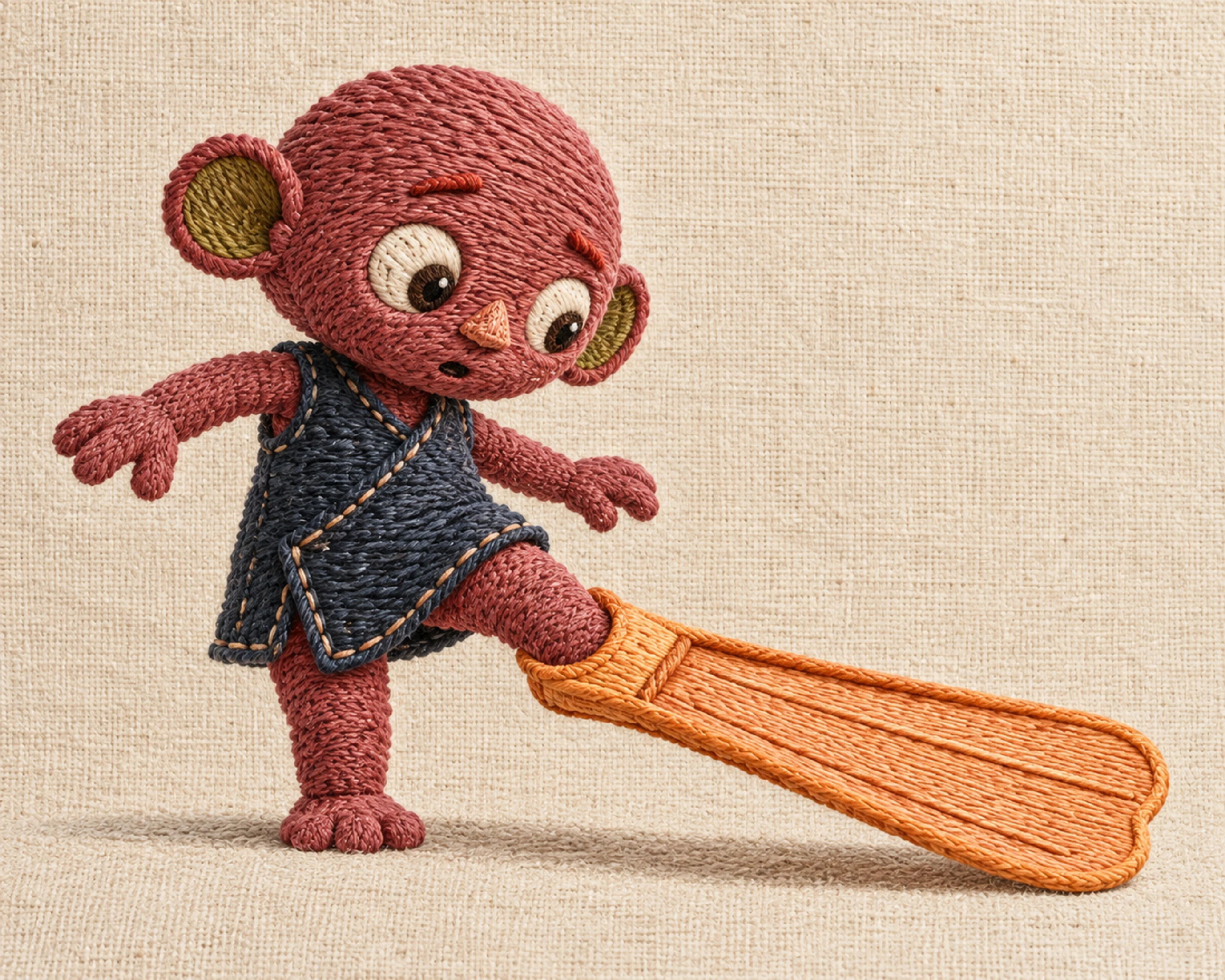
A Disk-Eared Creature Testing a Swim Fin
A small disk-eared creature lifts one enormous swim fin to inspect it. Raised thread and curving stitches give its tentative balancing act a playful silhouette within generous negative space.
Remix this referenceA Disk-Eared Creature Testing a Swim Fin
- Form language
- Translate forms into softly scalloped textile shapes with gently uneven boundaries; allow small local variations within the same rounded vocabulary.
- Contour
- Use slightly wandering couched cords for selected boundaries, letting some edges end directly in exposed stitch tips.
- Mark-making
- Curve satin stitches around local forms, interrupt them with a few loose running stitches, and vary thread spacing naturally.
- Surface rendering
- Build shallow padded thread relief over visible woven ground; blend tones through interleaved strands rather than smooth painted transitions.
Priority
The finished illustration must visibly consist of embroidery with raised thread and an exposed textile ground.
What to avoid & what to check
Exact prompt for this example
MODULE OWNERSHIP
subject: Subject count, type, stable proportions and landmarks, resting face geometry, hair shape, physical materials, garment construction and permanent marks. No emotion, movement, color assignment or rendering recipe.
expression: Facial soft-tissue displacement and pupil direction, muscle coordination, regional intensity, asymmetry and onset/peak/release. No head/body pose, stable appearance, skin color or rendering.
gesture: Head/neck/body/limb orientation, joint movement, support, contact and pose-caused occlusion using existing anatomy. No eye/pupil movement, emotion, identity, props inventory or camera.
props: Prop count, type, construction, physical material and scale relative to the subject. Holding/contact belongs to gesture, position to composition, color to palette.
scene: Environment elements, terrain, backdrop/floor presence and structural detail. No canvas positions, camera, lighting, assigned colors or render texture.
camera: Projection, focal-length impression, camera elevation/yaw/roll, viewing distance and crop. No actor pose, world placement, lighting or canvas aspect ratio.
composition: Normalized 0-100% canvas positions, scale in frame, depth/overlap, focal hierarchy and margins. No joint pose, camera projection, rendering, subject/prop inventory or emotion.
palette: Color anchors, hue/saturation/value ranges, colors assigned to parts and approximate color coverage. No illumination direction, shading algorithm, physical material or layout.
lighting: Light-source direction/softness/intensity, ambient illumination, physical shadow direction/length and highlight position. Absence of directional illumination is allowed. No shading technique, palette or material changes.
style: Reusable form abstraction, contour weight/taper/edge quality, medium and mark scale/density/direction, surface rendering and tonal transition technique. No fixed subject proportions, anatomy, identity, expression, pose, palette, light-source direction, camera or layout.
output: Image count, aspect ratio, size, file/alpha requirements and global lettering/logo/watermark restrictions. No background scenery, crop, style, identity or pose.

SUBJECT
inventory: One original small humanoid creature, actor A.
geometry: A bean-shaped trunk, a broad round head, thin disk ears, short sturdy legs, and broad mitten-like hands.
resting-face: Widely spaced round eyes, small separate brow ridges, a blunt triangular nose, and a short horizontal mouth.
appearance: Hairless suede-like hide, one bare foot, and a sleeveless woven-cloth wrap tunic with an overlapping front flap.

PRIORITY


AVOID


CHECK


EXPRESSION — ACTOR A
brows: The inner brow ends rise a little, unevenly.
lids: One upper lid opens slightly wider while both lower lids stay relaxed.
cheeks: The cheeks remain close to their resting shape.
nose: The nose stays relaxed without wrinkling or flaring.
mouth: The lips form a small, slightly off-center opening.
jaw: The jaw releases only enough for the narrow mouth opening.
gaze: Both pupils look down toward the far end of the lifted fin.
coordination: The eyes lead the discovery; the lower face responds only faintly.
timing: Show curiosity just beginning as the creature notices the fin's unexpected length.

PRIORITY


AVOID


CHECK


GESTURE
head: The head tips downward, with a small sideways cant.
torso: The trunk leans slightly backward to counterbalance the lifted foot.
limbs: One foot lifts forward while the other leg stays planted; both arms spread loosely for balance.
contact: The planted sole supports the body; the lifted foot sits inside the fin's heel pocket, and the hands touch nothing.

PRIORITY


AVOID


CHECK


PROPS
inventory: One swim fin with a blade substantially longer than the creature's foot.
construction: A flexible rubber blade with a broad rounded tip, raised side rails, and an enclosed heel pocket.

PRIORITY


AVOID


CHECK


SCENE
inventory: A continuous studio backdrop and floor, with no scenic objects.
structure: A shallow curved transition joins the floor to the backdrop without architectural detail.

PRIORITY


AVOID


CHECK


CAMERA
projection: An orthographic-like editorial view with minimal depth exaggeration.
viewpoint: A three-quarter view at the creature's eye height, with a level camera.
crop: A full-body view including the complete fin.

PRIORITY


AVOID


CHECK


COMPOSITION
placement: Weight the figure toward the lower left, with the fin extending into the open right side.
depth: Keep the face and lifted fin readable as separate shapes; allow only modest overlap within the silhouette.
spacing: The face leads and the fin answers; preserve generous empty space above, clear space around the extremities, and a clear gap beneath the lifted blade.

PRIORITY


AVOID


CHECK


PALETTE
colors: Oat cream, dusty raspberry, ink navy, pale apricot, and a small moss-green accent.
assignment: Cream surroundings, raspberry hide, navy tunic, apricot fin, and moss-green inner ears.
balance: Cream occupies the broadest area; raspberry and navy form a compact accent against the paler fin.

PRIORITY


AVOID


CHECK


LIGHTING
sources: A broad, low-intensity light from upper left grazes the image surface, supported by gentle ambient fill.
shadows: Raised details cast small soft shadows down-right; a faint floor shadow sits beneath the supporting foot.
highlights: Fine highlights catch the upper-left edges of raised details without sharp glare.

PRIORITY


AVOID


CHECK


STYLE GUIDE
form-language: Translate forms into softly scalloped textile shapes with gently uneven boundaries; allow small local variations within the same rounded vocabulary.
contour: Use slightly wandering couched cords for selected boundaries, letting some edges end directly in exposed stitch tips.
mark-making: Curve satin stitches around local forms, interrupt them with a few loose running stitches, and vary thread spacing naturally.
surface-rendering: Build shallow padded thread relief over visible woven ground; blend tones through interleaved strands rather than smooth painted transitions.

PRIORITY
The finished illustration must visibly consist of embroidery with raised thread and an exposed textile ground.

AVOID


CHECK


OUTPUT
format: One finished image, landscape 5:4, 2500 × 2000 pixels, opaque PNG.
restrictions: No lettering, logos, signatures, or watermarks.

PRIORITY


AVOID


CHECK


FINAL INTEGRATION
expression + gesture + props: Connect the act of inspection with the balancing action so the prop feels newly discovered.
lighting + style: Let illumination reveal the thread relief while preserving the graphic clarity of the stitched shapes.
Model information comes from image provenance. The same prompt may produce a different result.