Text to imageCafe & brandStyle guide
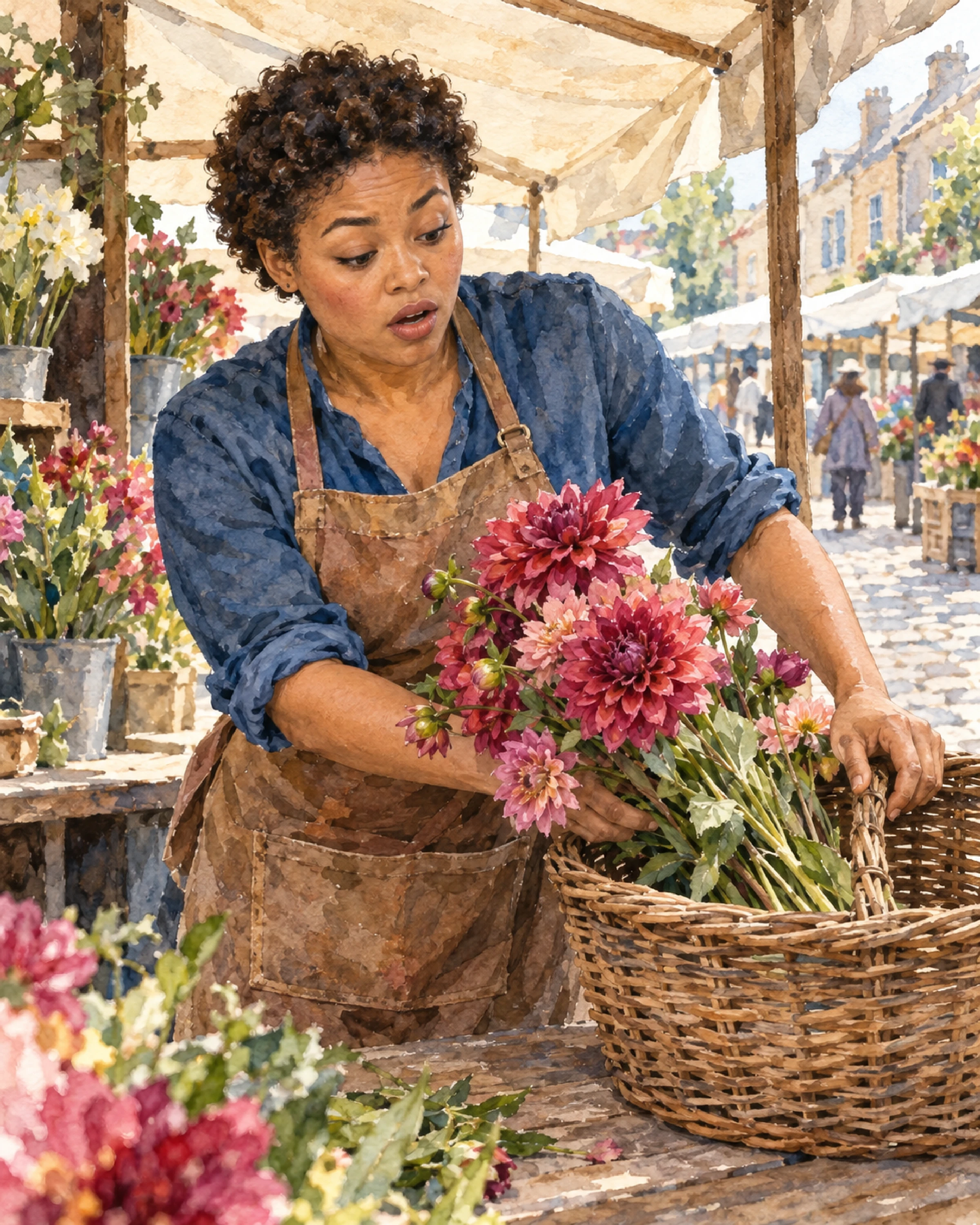
Florist Steadying a Dahlia Basket
A floral brand illustration capturing a florist steadying a tipping basket of dahlias. Overlapping blossoms and expressive watercolor blooms bring a small market moment to life.
Remix this referenceFlorist Steadying a Dahlia Basket
- Form language
- Group forms into buoyant rounded masses and a few firm structural planes; let secondary shapes remain loosely suggested.
- Contour
- Alternate brief tapered brush contours with broken and dissolved edges; retain decisive boundaries only where separation matters.
- Mark-making
- Use sweeping wet strokes, irregular pigment blooms and occasional dry-brush skips; vary marks naturally within each passage.
- Surface rendering
- Build transparent watercolor washes with pooled rims and soft backruns; reserve paper openings and selectively deepen overlapping glazes.
Priority
Make wet watercolor behavior visibly expressive.
What to avoid & what to check
Avoid uniformly sealed outlines and smooth digital fills.
Blooms and broken edges belong to the painting itself.
Exact prompt for this example
MODULE OWNERSHIP
subject: Subject count, type, stable proportions and landmarks, resting face geometry, hair shape, physical materials, garment construction and permanent marks. No emotion, movement, color assignment or rendering recipe.
expression: Facial soft-tissue displacement and pupil direction, muscle coordination, regional intensity, asymmetry and onset/peak/release. No head/body pose, stable appearance, skin color or rendering.
gesture: Head/neck/body/limb orientation, joint movement, support, contact and pose-caused occlusion using existing anatomy. No eye/pupil movement, emotion, identity, props inventory or camera.
props: Prop count, type, construction, physical material and scale relative to the subject. Holding/contact belongs to gesture, position to composition, color to palette.
scene: Environment elements, terrain, backdrop/floor presence and structural detail. No canvas positions, camera, lighting, assigned colors or render texture.
camera: Projection, focal-length impression, camera elevation/yaw/roll, viewing distance and crop. No actor pose, world placement, lighting or canvas aspect ratio.
composition: Normalized 0-100% canvas positions, scale in frame, depth/overlap, focal hierarchy and margins. No joint pose, camera projection, rendering, subject/prop inventory or emotion.
palette: Color anchors, hue/saturation/value ranges, colors assigned to parts and approximate color coverage. No illumination direction, shading algorithm, physical material or layout.
lighting: Light-source direction/softness/intensity, ambient illumination, physical shadow direction/length and highlight position. Absence of directional illumination is allowed. No shading technique, palette or material changes.
style: Reusable form abstraction, contour weight/taper/edge quality, medium and mark scale/density/direction, surface rendering and tonal transition technique. No fixed subject proportions, anatomy, identity, expression, pose, palette, light-source direction, camera or layout.
output: Image count, aspect ratio, size, file/alpha requirements and global lettering/logo/watermark restrictions. No background scenery, crop, style, identity or pose.

SUBJECT
inventory: A is one original adult florist with an ordinary working build.
geometry: Use a compact oval face, broad nose bridge, rounded chin and a short cap of tightly curled hair.
resting-face: At rest, brows are gently arched, eyes almond-shaped and lips softly defined with a fuller lower lip.
appearance: Wear a cotton collarless shirt and a canvas bib apron with a broad pocket; minor fabric details may vary.

PRIORITY
Keep the florist recognizably everyday.

AVOID
Avoid fashion-model proportions.

CHECK
Hair and apron give A a clear, consistent identity.

EXPRESSION — ACTOR A
brows: Both brows rise gently, with one slightly higher.
lids: Upper lids lift; lower lids stay relaxed.
cheeks: Cheeks remain loose without a strong upward bunch.
nose: Nostrils remain unflared and the nose bridge unwrinkled.
mouth: Lips part into a small rounded opening with relaxed corners.
jaw: The jaw releases only slightly.
gaze: Pupils turn toward the basket rim.
coordination: Brow and lid lift lead the quieter mouth response.
timing: Capture the first flicker of surprise before full mouth opening.

PRIORITY
Make the surprise small and immediate.

AVOID
Avoid a theatrical gasp.

CHECK
The upper face reacts more strongly than the mouth.

GESTURE
head: A's neck inclines forward and the head tips slightly toward the working hands.
torso: The torso leans sideways over the counter while the hips remain supported behind it.
limbs: One elbow opens outward for the reach; the other arm bends close to the apron.
contact: One hand catches the basket rim while the other braces the flower stems; fingers partly disappear behind the rim.

PRIORITY
Let both hands explain the quick recovery.

AVOID
Avoid a posed presentation gesture.

CHECK
The reach and supporting contact read together.

PROPS
inventory: One low wicker basket and one loose bunch of cut dahlias with several open flower heads.
construction: The basket has an open woven body and stout rim; layered petals top long stems, and the basket is torso-width.

PRIORITY
Give the flowers generous, recognizable heads.

AVOID
Avoid a rigidly arranged bouquet.

CHECK
The basket and loose stems remain distinguishable.

SCENE
inventory: An open market flower stall with a timber counter, canvas canopy and a cobbled lane.
structure: Simple posts support the canopy; an open stall frontage connects directly to the lane.

PRIORITY
Suggest a working neighborhood stall.

AVOID
Avoid dense market clutter.

CHECK
The counter and canopy establish the setting.

CAMERA
projection: Use natural perspective with a normal-lens impression.
viewpoint: View from chest height at a gentle three-quarter yaw, with no roll.
crop: Use a medium-wide view ending around A's hips, retaining the head, hands, complete flower heads and a glimpse of the cobbled lane.

PRIORITY
Keep the hand action easy to read.

AVOID
Avoid wide-angle enlargement of the basket.

CHECK
The face and both contacts remain visible.

COMPOSITION
placement: Place A's face near 38% across and 30% down, with the basket low right and flowers sweeping between them.
depth: Flowers overlap the apron, hands overlap the rim, and the counter leads into the quieter stall depth.
spacing: Make the flowers the first focal mass and the face the second; leave breathing room beside the figure.

PRIORITY
Build a lively chain of connected overlaps.

AVOID
Avoid petals obscuring the face or surrounding mockup borders.

CHECK
Flowers, hands and face form one readable event.

PALETTE
colors: Use raspberry, petrol blue, burnt sienna and warm paper ivory, with restrained natural skin tones.
assignment: Raspberry belongs to petals, petrol blue to the shirt, sienna to the apron and basket, and ivory to the canopy.
balance: Let pale warm areas dominate, with concentrated flower saturation and a smaller cool garment counterweight.

PRIORITY
Let the blossoms carry the strongest color.

AVOID
Avoid equally saturated surroundings.

CHECK
The floral accent remains unmistakable.

LIGHTING
sources: Broad overcast daylight enters from the upper left, with gentle ambient fill beneath the canopy.
shadows: Short, soft shadows fall rightward beneath the hands, basket rim and canopy.
highlights: Quiet highlights touch the upper-left cheek and exposed petal tips.

PRIORITY
Keep the daylight broad and forgiving.

AVOID
Avoid theatrical spot illumination.

CHECK
The canopy shade stays softly readable.

STYLE GUIDE
form-language: Group forms into buoyant rounded masses and a few firm structural planes; let secondary shapes remain loosely suggested.
contour: Alternate brief tapered brush contours with broken and dissolved edges; retain decisive boundaries only where separation matters.
mark-making: Use sweeping wet strokes, irregular pigment blooms and occasional dry-brush skips; vary marks naturally within each passage.
surface-rendering: Build transparent watercolor washes with pooled rims and soft backruns; reserve paper openings and selectively deepen overlapping glazes.

PRIORITY
Make wet watercolor behavior visibly expressive.

AVOID
Avoid uniformly sealed outlines and smooth digital fills.

CHECK
Blooms and broken edges belong to the painting itself.

OUTPUT
format: Deliver one portrait image at 4:5, 2400 × 3000 pixels, as an opaque PNG.
restrictions: No lettering, logos or watermarks.

PRIORITY
Deliver one complete opaque PNG export.

AVOID
Avoid presentation labels.

CHECK
The single export meets the requested format.

FINAL INTEGRATION
expression + gesture + composition: Facial response and hand contact should make the overlapping arrangement read as one spontaneous moment.
style + palette + lighting: Keep expressive wash variation compatible with the color hierarchy and readable daylight.
Model information comes from image provenance. The same prompt may produce a different result.