Text to imageLandscapeStyle guide
Small Waterfall · Long-Exposure Flow
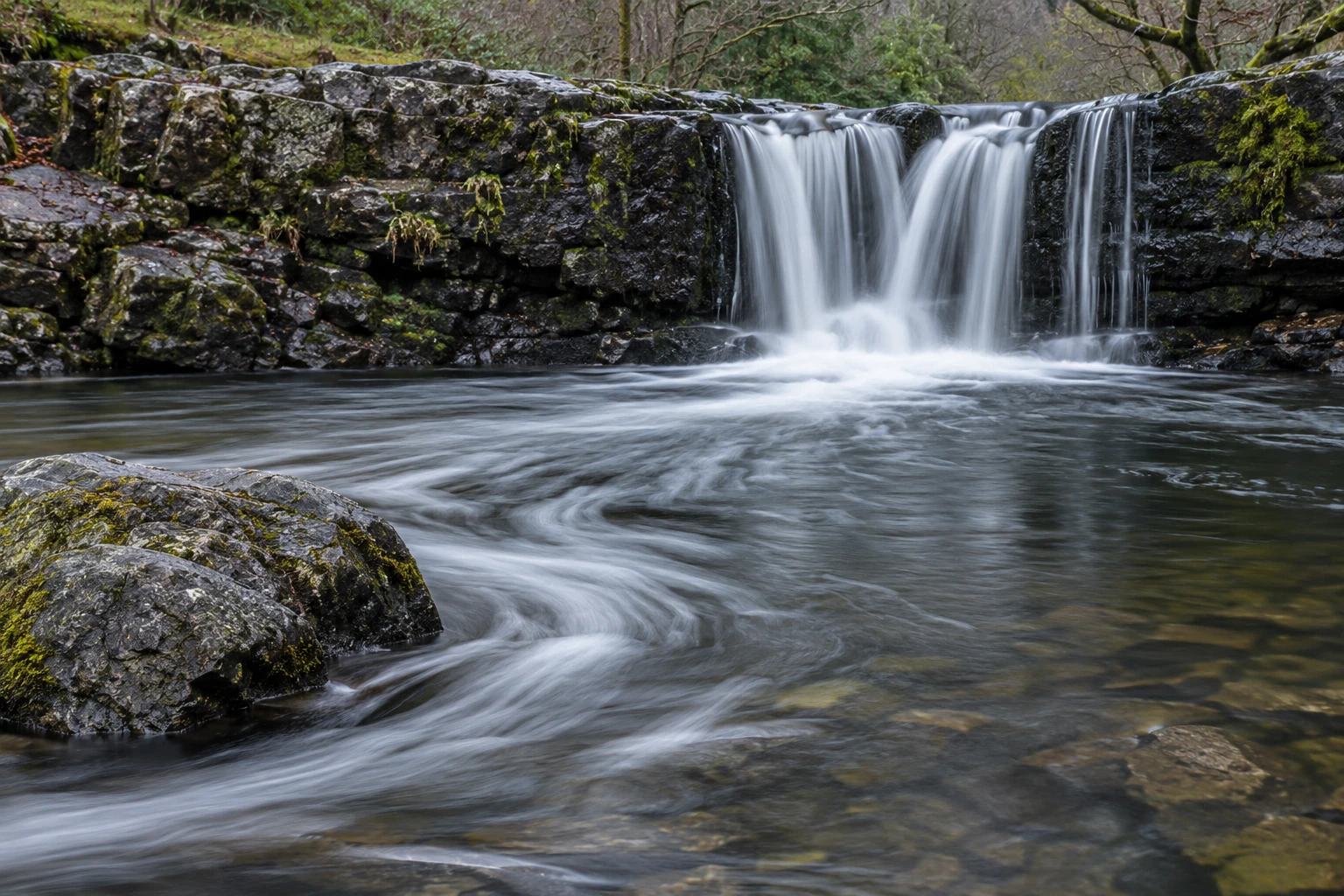
A landscape reference that contrasts a small waterfall’s continuous flowing trails with sharply resolved stationary rocks.
Small Waterfall · Long-Exposure Flow
- Shape & line
- Draw the falling water as continuous downward ribbons that bend over the ledge and broaden at impact; preserve distinct gaps between several ribbons so the waterfall retains structure instead of becoming a solid white curtain.
- Color & light
- Use soft overcast light, cool gray water, and charcoal rocks with muted olive moss; keep the brightest water trails below pure white so pale internal streaks remain visible against the darker ledge.
- Texture & material
- Apply long-exposure softness only to moving water: stretch falling droplets into silky trails and pool foam into gently curved traces, while keeping rock fractures and moss patches sharply resolved.
- Composition
- Lead the pool’s blurred foam traces from the impact area at image-right center toward the image-left foreground, curving them around the sharp foreground rock; leave quiet dark water between traces so the flow direction reads clearly.
Priority
Make the contrast between flowing water trails and stationary sharp rocks immediately visible.
What to avoid & what to check
Avoid frozen droplets, uniformly blurred scenery, and featureless white water.
Confirm that the water trails connect across the ledge, fall, and pool while the foreground rock stays crisp.
Exact prompt for this example
SUBJECT
One small waterfall spilling over a low dark rock ledge into one shallow pool; the falling water connects visibly to spreading surface currents below.

COMPOSITION
Use a landscape frame viewed from the downstream bank, with the ledge across the upper third, the waterfall just right of center, and the receiving pool filling the lower half. Include a stationary rock on the image-left foreground as a clear sharpness reference.

STYLE GUIDE
1. Shape & line
Draw the falling water as continuous downward ribbons that bend over the ledge and broaden at impact; preserve distinct gaps between several ribbons so the waterfall retains structure instead of becoming a solid white curtain.

2. Color & light
Use soft overcast light, cool gray water, and charcoal rocks with muted olive moss; keep the brightest water trails below pure white so pale internal streaks remain visible against the darker ledge.

3. Texture & material
Apply long-exposure softness only to moving water: stretch falling droplets into silky trails and pool foam into gently curved traces, while keeping rock fractures and moss patches sharply resolved.

4. Composition
Lead the pool’s blurred foam traces from the impact area at image-right center toward the image-left foreground, curving them around the sharp foreground rock; leave quiet dark water between traces so the flow direction reads clearly.

PRIORITY
Preserve the requested identity, count, action, composition and output settings. Apply the style rules within those constraints; a style reference must not replace the subject or layout. Within the style: Make the contrast between flowing water trails and stationary sharp rocks immediately visible.

AVOID
Avoid frozen droplets, uniformly blurred scenery, and featureless white water.

OUTPUT
Create one photographic landscape image in a 3:2 aspect ratio, without captions, lettering, logos, or watermarks.

SELF-CHECK
Confirm that the water trails connect across the ledge, fall, and pool while the foreground rock stays crisp.
Model information comes from image provenance. The same prompt may produce a different result.