Text to imageProductStyle guide
Opening a Harvest Carrier
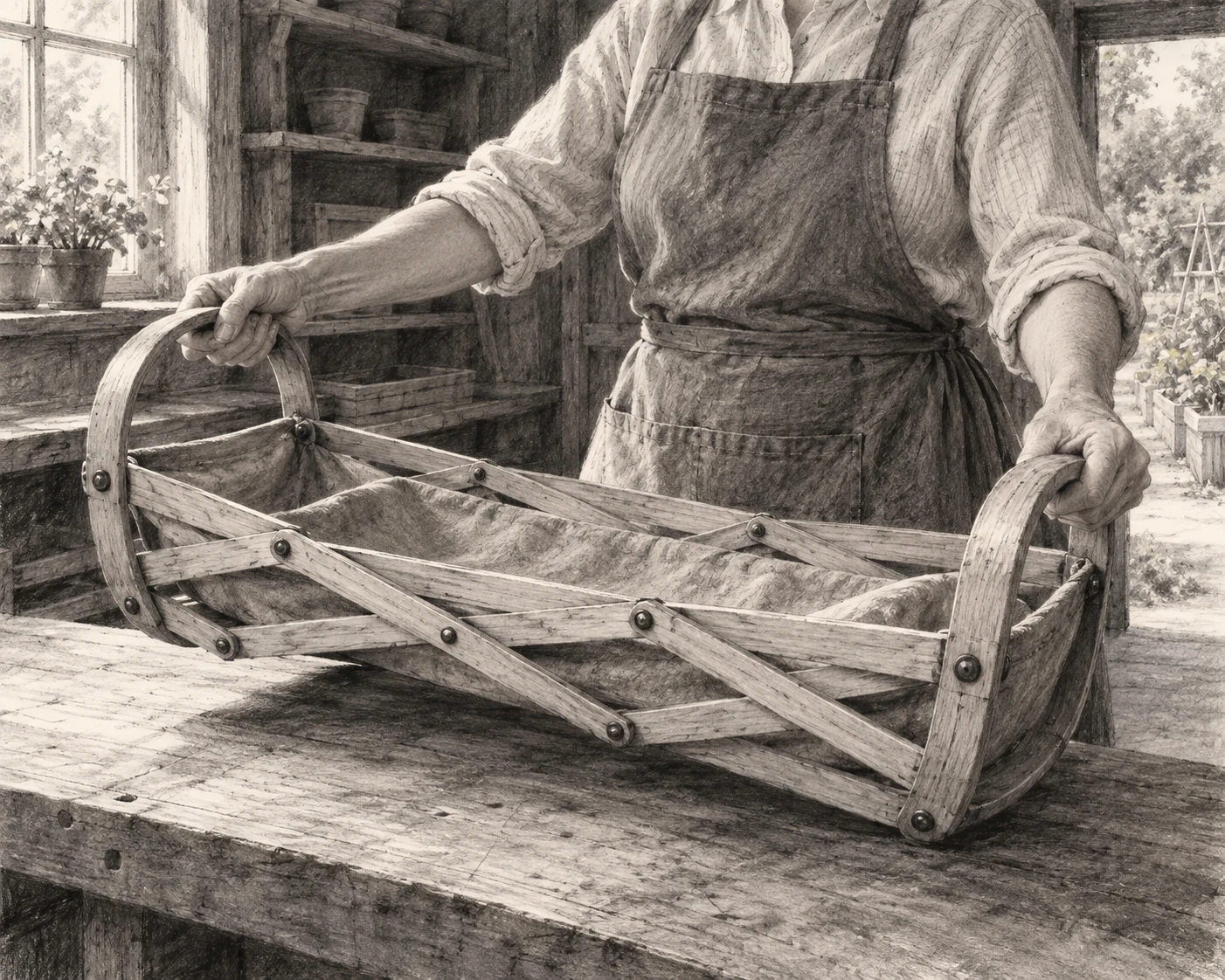
An operator pulls open a concertina harvest carrier in a layered workshop. Rubbed charcoal and erased light reveal the wooden slats and tensioning canvas base.
Remix this referenceOpening a Harvest Carrier
- Form language
- Simplify volumes into observed planes and weight-bearing curves, retaining useful irregularities rather than idealizing every component.
- Contour
- Use broken searching contours, darkening briefly at overlaps and allowing softly lost edges between similar values.
- Mark-making
- Combine broad side-of-stick rubbings with quick angular strokes; preserve pressure changes and occasional abandoned searching lines.
- Surface rendering
- Work charcoal into smudged tonal masses, then lift lights with an eraser so paper emerges through rubbed and softened transitions.
Priority
Preserve the visible push and lift of observational charcoal, including smudges and erased light.
What to avoid & what to check
Exact prompt for this example
MODULE OWNERSHIP
subject: Subject count, type, stable proportions and landmarks, resting face geometry, hair shape, physical materials, garment construction and permanent marks. No emotion, movement, color assignment or rendering recipe.
expression: Facial soft-tissue displacement and pupil direction, muscle coordination, regional intensity, asymmetry and onset/peak/release. No head/body pose, stable appearance, skin color or rendering.
gesture: Head/neck/body/limb orientation, joint movement, support, contact and pose-caused occlusion using existing anatomy. No eye/pupil movement, emotion, identity, props inventory or camera.
props: Prop count, type, construction, physical material and scale relative to the subject. Holding/contact belongs to gesture, position to composition, color to palette.
scene: Environment elements, terrain, backdrop/floor presence and structural detail. No canvas positions, camera, lighting, assigned colors or render texture.
camera: Projection, focal-length impression, camera elevation/yaw/roll, viewing distance and crop. No actor pose, world placement, lighting or canvas aspect ratio.
composition: Normalized 0-100% canvas positions, scale in frame, depth/overlap, focal hierarchy and margins. No joint pose, camera projection, rendering, subject/prop inventory or emotion.
palette: Color anchors, hue/saturation/value ranges, colors assigned to parts and approximate color coverage. No illumination direction, shading algorithm, physical material or layout.
lighting: Light-source direction/softness/intensity, ambient illumination, physical shadow direction/length and highlight position. Absence of directional illumination is allowed. No shading technique, palette or material changes.
style: Reusable form abstraction, contour weight/taper/edge quality, medium and mark scale/density/direction, surface rendering and tonal transition technique. No fixed subject proportions, anatomy, identity, expression, pose, palette, light-source direction, camera or layout.
output: Image count, aspect ratio, size, file/alpha requirements and global lettering/logo/watermark restrictions. No background scenery, crop, style, identity or pose.

SUBJECT
inventory: One expandable harvest carrier and one adult operator, A.
geometry: The carrier has rigid end hoops and crossed side slats around a shallow rectangular bed; A has ordinary adult proportions.
resting-face: No readable facial geometry applies.
appearance: Use ash slats, metal pivots, and a canvas base; A wears a loose woven shirt and a plain bib apron.

PRIORITY


AVOID


CHECK


EXPRESSION — ACTOR A
brows: Brow displacement remains unprescribed.
lids: Lid tension and opening remain unprescribed.
cheeks: Cheek lift and compression remain unprescribed.
nose: Nostril flare and nose wrinkling remain unprescribed.
mouth: Lip displacement and mouth opening remain unprescribed.
jaw: Jaw tension and opening remain unprescribed.
gaze: Pupil direction remains unprescribed.
coordination: Facial muscle coordination remains unprescribed.
timing: Facial timing within the neutral release remains unprescribed.

PRIORITY


AVOID


CHECK


GESTURE
head: No visible head or neck gesture is prescribed.
torso: A leans slightly back from the bench, opening the shoulders against the carrier's resistance.
limbs: Both elbows separate as the hands pull in opposing directions; fingers curl firmly around the grips.
contact: Each hand grips an end hoop, suspending the opening carrier just clear of the bench.

PRIORITY


AVOID


CHECK


PROPS
inventory: No separate props.
construction: No prop construction applies.

PRIORITY


AVOID


CHECK


SCENE
inventory: A garden workshop contains a substantial workbench, empty shallow shelves, a window, and an open garden doorway.
structure: Recessed shelving and a thick doorway reveal the workshop's depth; planted beds continue beyond the threshold.

PRIORITY


AVOID


CHECK


CAMERA
projection: Use a natural normal-lens perspective.
viewpoint: Observe closely from waist height, slightly above the carrier, in an oblique three-quarter view.
crop: Frame the carrier, both hands, and the apron-covered torso; crop the bench lip and exclude the head and legs.

PRIORITY


AVOID


CHECK


COMPOSITION
placement: The carrier spans the lower left to middle right; A's torso occupies the upper right behind it.
depth: The bench lip fronts the carrier; shelving and the garden threshold create successive deeper layers.
spacing: Prioritize the carrier through its nearer hand and crossed slats; leave quiet space above its lower end.

PRIORITY


AVOID


CHECK


PALETTE
colors: Use a near-monochrome range from warm ivory through soft gray to charcoal black.
assignment: Keep slats light gray, canvas and apron middle gray, shirt near ivory, and pivots and deep recesses black.
balance: Let ivory and middle grays dominate, reserving concentrated blacks for small structural accents.

PRIORITY


AVOID


CHECK


LIGHTING
sources: A broad window at the upper left supplies soft strong light, with subdued room fill.
shadows: The carrier casts a soft shadow down and right across the bench; slat overlaps retain deeper contact shadows.
highlights: Light catches upper hoop edges, knuckles, and the exposed crests of the canvas folds.

PRIORITY


AVOID


CHECK


STYLE GUIDE
form-language: Simplify volumes into observed planes and weight-bearing curves, retaining useful irregularities rather than idealizing every component.
contour: Use broken searching contours, darkening briefly at overlaps and allowing softly lost edges between similar values.
mark-making: Combine broad side-of-stick rubbings with quick angular strokes; preserve pressure changes and occasional abandoned searching lines.
surface-rendering: Work charcoal into smudged tonal masses, then lift lights with an eraser so paper emerges through rubbed and softened transitions.

PRIORITY
Preserve the visible push and lift of observational charcoal, including smudges and erased light.

AVOID


CHECK


OUTPUT
format: Deliver one finished image in a 5:4 aspect ratio, 2500 pixels wide, as an opaque PNG.
restrictions: One finished image; 5:4 aspect ratio, 2500 pixels wide, opaque PNG; no lettering, logos, or watermarks.

PRIORITY


AVOID


CHECK


FINAL INTEGRATION
gesture + composition: Keep the interaction legible through the relationship between the hands and the expanding structure.
lighting + style: Use the observed light as the basis for selective erasure within the charcoal drawing.
Model information comes from image provenance. The same prompt may produce a different result.