Text to imageAnimationStyle guide
A Giant Map Spilling from a Tram
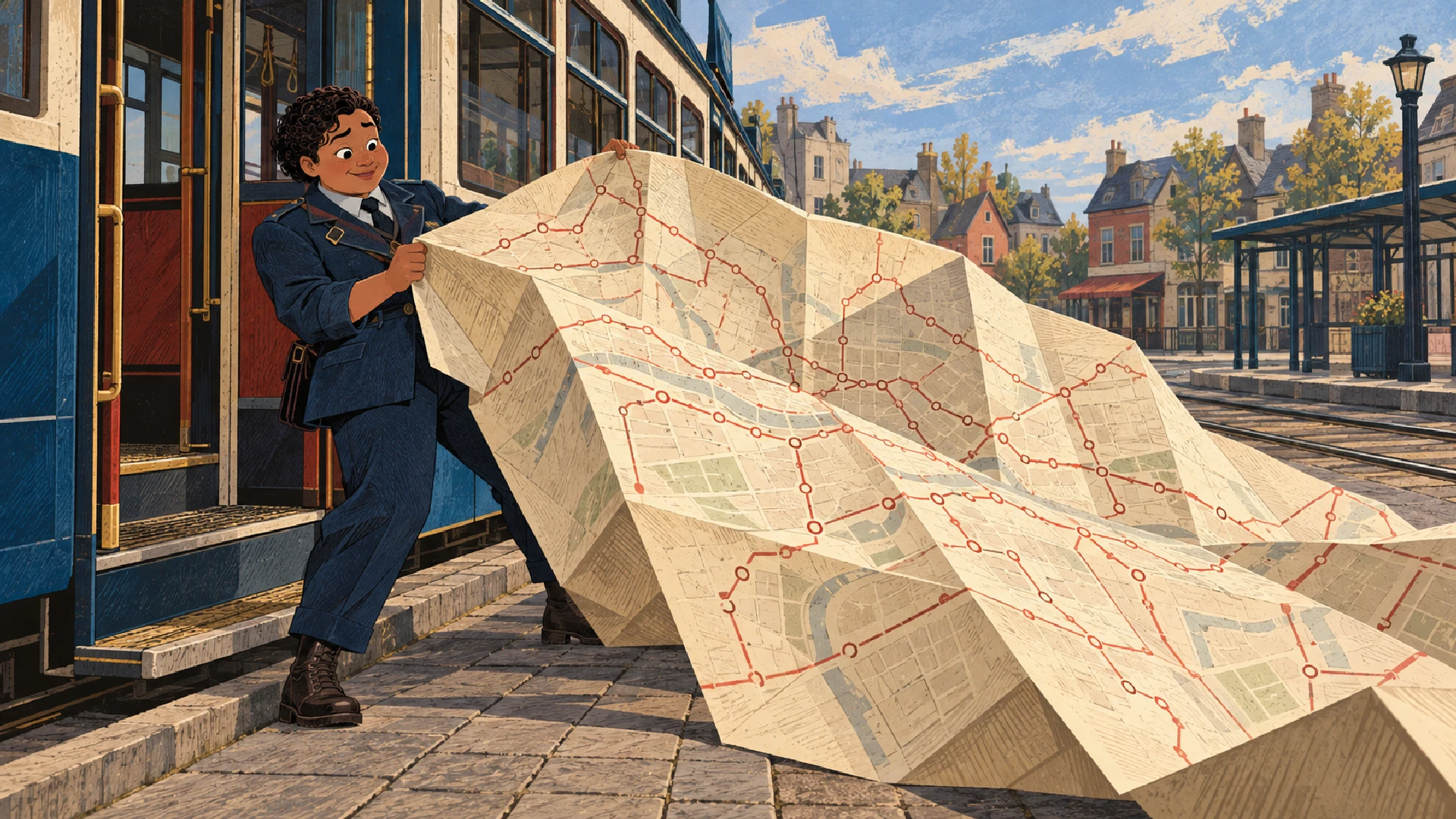
A tram conductor catches a route map grown as large as a building. Its folds spill across the stop as bewilderment gives way to a crooked smile.
Remix this referenceA Giant Map Spilling from a Tram
- Form language
- Translate volumes into angular interlocking planes, using selective simplification and slightly unequal shapes.
- Contour
- Use carved-looking straight and angular contours, with small breaks and natural shifts between firm and slender strokes.
- Mark-making
- Group short parallel hatches along individual planes; add restrained scratches with naturally varied spacing and length.
- Surface rendering
- Build flat printed tonal regions with faint paper tooth and occasional uneven ink edges; use hatch steps instead of continuous modeling.
Priority
Rendering medium: 2D woodcut-print animated-film illustration; formal rendering reference: Cartoon Saloon · 2020s · Wolfwalkers (2020), town sequences
What to avoid & what to check
Exact prompt for this example
MODULE OWNERSHIP
subject: Subject count, type, stable proportions and landmarks, resting face geometry, hair shape, physical materials, garment construction and permanent marks. No emotion, movement, color assignment or rendering recipe.
expression: Facial soft-tissue displacement and pupil direction, muscle coordination, regional intensity, asymmetry and onset/peak/release. No head/body pose, stable appearance, skin color or rendering.
gesture: Head/neck/body/limb orientation, joint movement, support, contact and pose-caused occlusion using existing anatomy. No eye/pupil movement, emotion, identity, props inventory or camera.
props: Prop count, type, construction, physical material and scale relative to the subject. Holding/contact belongs to gesture, position to composition, color to palette.
scene: Environment elements, terrain, backdrop/floor presence and structural detail. No canvas positions, camera, lighting, assigned colors or render texture.
camera: Projection, focal-length impression, camera elevation/yaw/roll, viewing distance and crop. No actor pose, world placement, lighting or canvas aspect ratio.
composition: Normalized 0-100% canvas positions, scale in frame, depth/overlap, focal hierarchy and margins. No joint pose, camera projection, rendering, subject/prop inventory or emotion.
palette: Color anchors, hue/saturation/value ranges, colors assigned to parts and approximate color coverage. No illumination direction, shading algorithm, physical material or layout.
lighting: Light-source direction/softness/intensity, ambient illumination, physical shadow direction/length and highlight position. Absence of directional illumination is allowed. No shading technique, palette or material changes.
style: Reusable form abstraction, contour weight/taper/edge quality, medium and mark scale/density/direction, surface rendering and tonal transition technique. No fixed subject proportions, anatomy, identity, expression, pose, palette, light-source direction, camera or layout.
output: Image count, aspect ratio, size, file/alpha requirements and global lettering/logo/watermark restrictions. No background scenery, crop, style, identity or pose.

SUBJECT
inventory: One adult woman tram conductor, actor A; no other people.
geometry: A has a compact, broad build, a square head, substantial hands and a short neck.
resting-face: Her resting features are a broad short nose, straight brows, rounded cheeks and a wide mouth.
appearance: Close-cropped curls; a wool uniform jacket with a sewn collar, straight trousers and leather ankle boots.

PRIORITY


AVOID


CHECK


EXPRESSION — ACTOR A
brows: One brow lifts while the other remains nearly level.
lids: Upper lids stay open; lower lids tighten slightly.
cheeks: One cheek begins to rise with the forming smile.
nose: Nostrils remain relaxed, without a nose wrinkle.
mouth: One mouth corner curls upward; the lips part slightly.
jaw: The jaw releases slightly without dropping wide.
gaze: Both pupils turn toward the nearest fold.
coordination: The raised brow and uneven smile combine into dawning amusement.
timing: Catch the onset, just as the first smile interrupts her appraisal.

PRIORITY


AVOID


CHECK


GESTURE
head: A lowers her chin toward the paper, with her neck extending slightly forward.
torso: Her torso leans back against the outward pull, with one shoulder drawn forward.
limbs: Both elbows bend unevenly; one foot braces on the platform and the other remains on the tram step.
contact: Both hands grip the same raised paper edge; its fold partly conceals the lower jacket.

PRIORITY


AVOID


CHECK


PROPS
inventory: One folding route map, expanded to the scale of a small building compared with A.
construction: Heavy paper with accordion folds, softened creases and a simple printed route network made only of lines and station dots.

PRIORITY


AVOID


CHECK


SCENE
inventory: A neighborhood tram terminus with one stationary tram, a paved platform, rails and modest shopfronts.
structure: The tram has an open folding doorway and shallow boarding steps; the platform paving has visible joints.

PRIORITY


AVOID


CHECK


CAMERA
projection: Moderate wide-angle perspective with readable depth and restrained edge distortion.
viewpoint: View from adult chest height, obliquely across the platform toward the tram doorway, with no roll.
crop: An environmental full-body view; the nearest map folds extend beyond the bottom and right edges.

PRIORITY


AVOID


CHECK


COMPOSITION
placement: A occupies the left third at roughly half the image height; beside her, the map opens across the remaining width.
depth: The face and hands lead attention into the foreground folds; the tram recedes behind A, and paving joints continue beneath the paper.
spacing: Keep open space around the face and a narrow platform gap between overlapping folds to clarify their scale.

PRIORITY


AVOID


CHECK


PALETTE
colors: Warm parchment, deep petrol blue, brick red and muted limestone, with sparse near-black accents.
assignment: Parchment map with brick-red routes; petrol uniform and tram; limestone paving; warm umber skin and near-black hair.
balance: Pale paper dominates, deep blue forms the main counterweight, and red remains a restrained accent.

PRIORITY


AVOID


CHECK


LIGHTING
sources: Broad, soft daylight enters from the upper right, supported by gentle ambient illumination.
shadows: Map folds cast broad, short shadows toward the lower left; the doorway remains more deeply shaded.
highlights: Upturned paper ridges and A's upper cheek receive gentle highlights without glare.

PRIORITY


AVOID


CHECK


STYLE GUIDE
form-language: Translate volumes into angular interlocking planes, using selective simplification and slightly unequal shapes.
contour: Use carved-looking straight and angular contours, with small breaks and natural shifts between firm and slender strokes.
mark-making: Group short parallel hatches along individual planes; add restrained scratches with naturally varied spacing and length.
surface-rendering: Build flat printed tonal regions with faint paper tooth and occasional uneven ink edges; use hatch steps instead of continuous modeling.

PRIORITY
Rendering medium: 2D woodcut-print animated-film illustration; formal rendering reference: Cartoon Saloon · 2020s · Wolfwalkers (2020), town sequences

AVOID


CHECK


OUTPUT
format: One finished image, landscape 16:9, 1920 × 1080 pixels, opaque PNG.
restrictions: No lettering, captions, logos or watermarks.

PRIORITY


AVOID


CHECK


FINAL INTEGRATION
props + scene + composition: Ordinary transit architecture provides the scale comparison that makes the map's expansion immediately legible.
expression + gesture: Let the face register the absurdity while the body continues dealing with its practical consequences.
Art direction
카툰 살롱 / Cartoon Saloon · 2020s · 울프워커스(2020)의 도시 장면 / Wolfwalkers (2020), town sequences ↗- Transfer the angular planar abstraction of the town sequences to generic form surfaces
- Slightly irregular straight and angular contours resembling carved lines
- Short parallel hatch groups and restrained scratched marks
- Flat planes with limited paper texture and hatched tonal regions, without continuous modeling
Model information comes from image provenance. The same prompt may produce a different result.